Category Archives: All

Rough and ready transportation

India is a hard place to get around. Distances are large and the roads are very, very bad. No wonder Indian businesspeople use airplanes wherever they can.
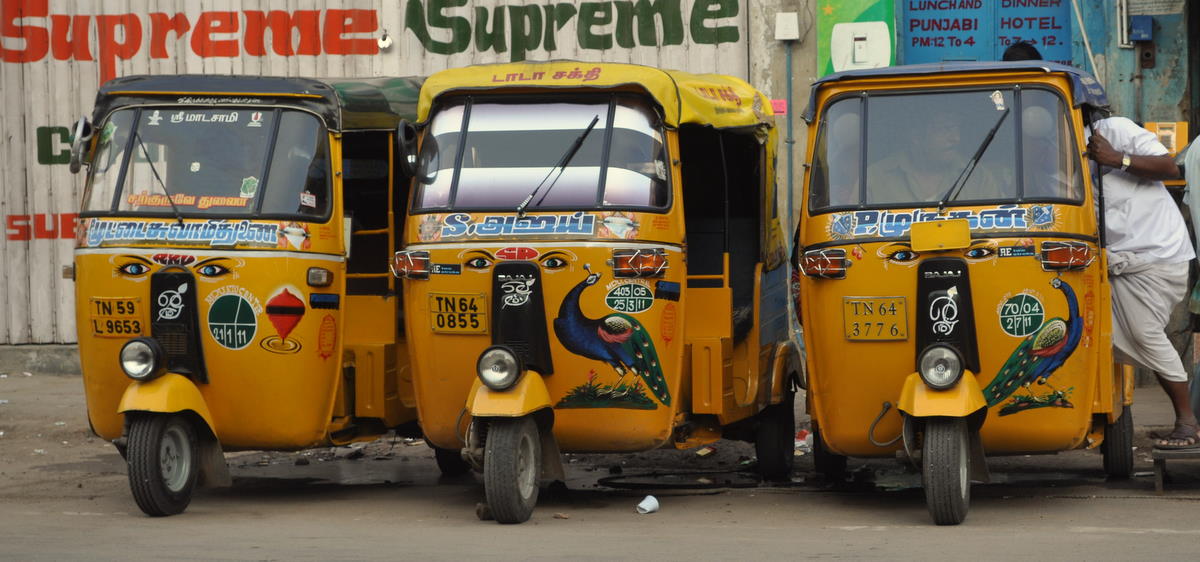

The smallest vehicle we’d typically use is the auto-rickshaw or tuk-tuk. These three-wheelers are basically a tin can on top of a small motorcycle. They are loud, polluting and slow, but very convenient. Drivers are experts at fitting small boxes between lanes of traffic, turning on a dime and often whizzing by cars and people with only a centimeter to spare. And remarkably, we found we could squeeze all our bags and ourselves into one of them. In several cases where there was no alternative, we took a tuk-tuk twenty or thirty kilometers across the countryside.

Automobiles are widely available for rent by the day. For less than the cost of a US rental car, one can hire a car with a driver who knows how to negotiate the cows, people and other obstacles that clutter an Indian highway. Lanes are for reference only and drivers pass on curves with more reliance on their horns than on visibility. The cars are usually recent Tata models, but when saving money one can also get a more classic look. Although the following Ambassador looks like it drove out of a time machine, it came off a local assembly line new in 2008.


Buses are everywhere, both in towns and across the countryside. Most look like they were riveted together out of sheet metal, which conveniently makes them easy to fix after their frequent crashes. Inside, they have the upholstery of an American school bus and sometimes the “feature” of a DVD playing Bollywood gangster flicks at high volume. Because we value our eardrums and longevity, we took as few buses as possible.

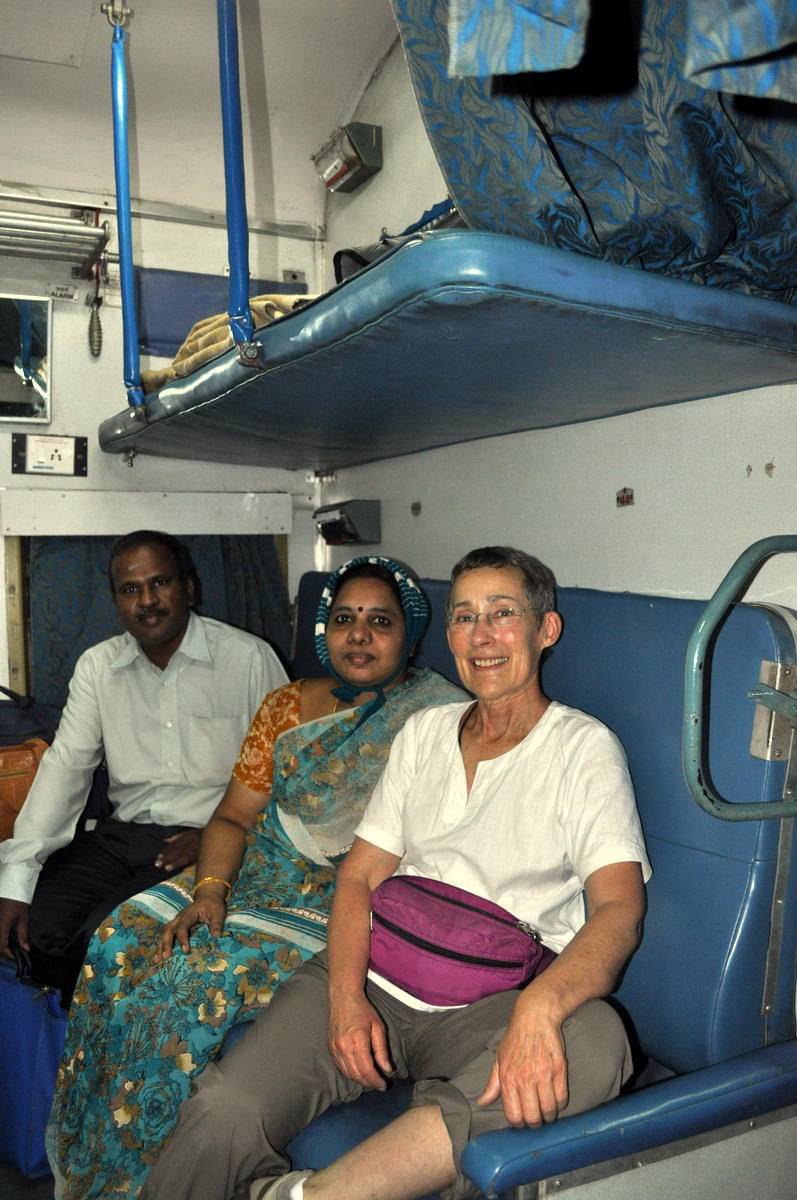
Trains are the way to go as long as you’re not in a hurry. The Indian State Railway network is the second largest in the world, and they move a lot of people around the country. Running on wide-gauge rails, Indian train cars are huge, sleeping six people in three-tier compartments, plus two more lengthwise across the aisle. Relatively comfortable air-conditioned cars are available. Trains run slowly, often stopping for a half an hour or more to let others pass. 400 kilometers is typical for an overnight journey. But despite all this, they work and they are reasonably safe.

I think I’ve finally got the hang of making a train reservation. This can be done either by sitting in a long line in the advanced booking office or by using the railway’s website. The website is more convenient because reservations can be cancelled online rather than by standing in another line at a station that might be way out of the way. Even so, the railways’ website is a disaster, often unavailable or timing out faster than one can complete a single booking. The website is run on underpowered servers that crash daily at 8am when the next day’s tickets go on sale. But it’s worth a few hours online to be assured of a bed on a moving hotel that isn’t likely to have a head-on collision with a tuk-tuk.

India – Seen on the Street

Motorcycles and Helmets

More affordable and more nimble at navigating through traffic-choked streets, the motorcycle, or 'bike', is a common family vehicle. Signs along city streets and rural highways read 'Think of your family. Wear helmet'. It is common to see a family mounted on a bike driven by a helmeted adult male. An adult sari-clad woman rides side-saddle behind the driver. A child often sits in front of the driver and another between the woman and driver. The woman may carry a babe in arms. I have even seen women passengers nursing babies as the bike zigzags through traffic. Only once have I seen a passenger wearing a helmet.

Muslim Women

Muslims comprise 5 and 24 percent of the population of south Indian states. Like Hindu women, Muslim women are more likely than Muslim men to wear traditional clothing. An ankle-length, long-sleeved, loose-fitting black robe marks a woman as Muslim.

Traditional clothing includes a large headscarf, either the circular khimar or the rectangular shaylas, which covers the head, neck and shoulders. The combination of robe and headscarf is called hijab. A few women also wear the niqaab, a face veil covering the nose, mouth and neck and sometimes the forehead as well. In south India robes are often decorated with floral designs made of silver sequins and cut glass beads that sparkle with sunlight as women walk.

Women in hajib rarely cover their hair completely. Similar to the way the sari's end is used as a head covering for modesty or for protection from sun or chill, the headscarf is casually draped over the top of the head with loose, long hair or a braid hanging down the back.

Often brightly colored pants of the salwar kameez peak out beneath the robe, or the front of the robe may be open revealing colorful silk clothing.

It is common to see women in hajib, and even naqiib, walking alone or with other women in hajib, sari, or salwar kameez. Even though it is uncommon to see women driving motor bikes, I saw a woman in hajib and naqiib driving one.

Seat Belts

All the cars we rode in had seat belts, but it was obvious that they were rarely used. Riding as a passenger with a professional driver can be a white knuckle experience. So we confused drivers by insisting on working seat belts.

This meant unloading backpacks from the trunk, fishing around for the missing clips, pushing them up into the back seat and releasing shoulder straps stuck behind seat backs. Once we insisted on changing cars so Tom could buckle up in the front seat. None of our drivers buckled up.

Auto Headlights

Instead of switching from high to low beam, oncoming drivers switch from low beam to blinding high beam. Perhaps this seemingly odd practice is a night time version of a daytime practice.

Daytime driving involves passing one slow moving vehicle after another, ideally without slowing down: buses, trucks, cart loads of cut sugar cane pulled by tractors or a team of oxen. Traffic is heavy on the narrow two lane roads. A driver passes as many slow-moving vehicles as possible, pulling back into his lane a breath before meeting head on with an oncoming vehicle. Oncoming vehicles turn headlights on as a warning.

Lax Law Enforcement

There is a general lack of law enforcement at all levels of Indian society. Seat belts and safety helmets are compulsory nationwide but there is no enforcement. Drivers routinely ignore the most elementary traffic safety rules. For example, motorists run red lights en masse, even though small groups of police officers man many major intersections.

As of October 2008, the Indian Ministry of Health and Family Welfare banned smoking in public. Smoking is illegal countrywide in public buildings, trains, buses, bars, restaurants, theaters, stadiums, stations and bus stops.

Public opinion polls have shown that 80 to 90 percent of the population supports the ban. We did not encounter smoking on trains and buses or by our professional drivers. Some restaurants maintained strict bans on smoking. But smoking continues unabated in many prohibited places as local police officers show up, smoking, to collect their customary tip to ensure ' pleasant cooperation' in the district.

Obesity

The Times of India, 2/23/10, dateline Mysore: The police launched a fitness training program for their personnel. Over 70 personnel who have been found obese have been selected for training.

Despite a seemingly healthy traditional vegetarian diet rich in vegetables, grains, and legumes, middle-class mature adults, both men and women, tend to be quite fat.

There are probably multiple causes: increasing prosperity, abundant use of deep-fry as a cooking method and butter as an ingredient, sedentary life style, a cultural sweet tooth attracted to the wide variety of confections on offer in ubiquitous shops and food stalls specializing in sweets.


By contrast, mature adult villagers are thin as saplings. During the heat of midday, village men often hike their dotis or lunghis above the knee. Flesh seem to be stretched over nothing but sinew and bone. Perhaps body fat is a traditional cultural sign of wealth and status.

According to Wikipedia, obesity is epidemic in India. Among the causes may be the increasing consumption of processed foods. Additionally, many Indians carry a gene that predisposes for fat accumulation, especially around the middle.

Oriental Dreams

British architects working as consultants for the Raj developed an architectural style now known as Indo-Saracenic. The style combines Mughal, Victorian and neo-Gothic elements with elements indigenous to a building's regional location.


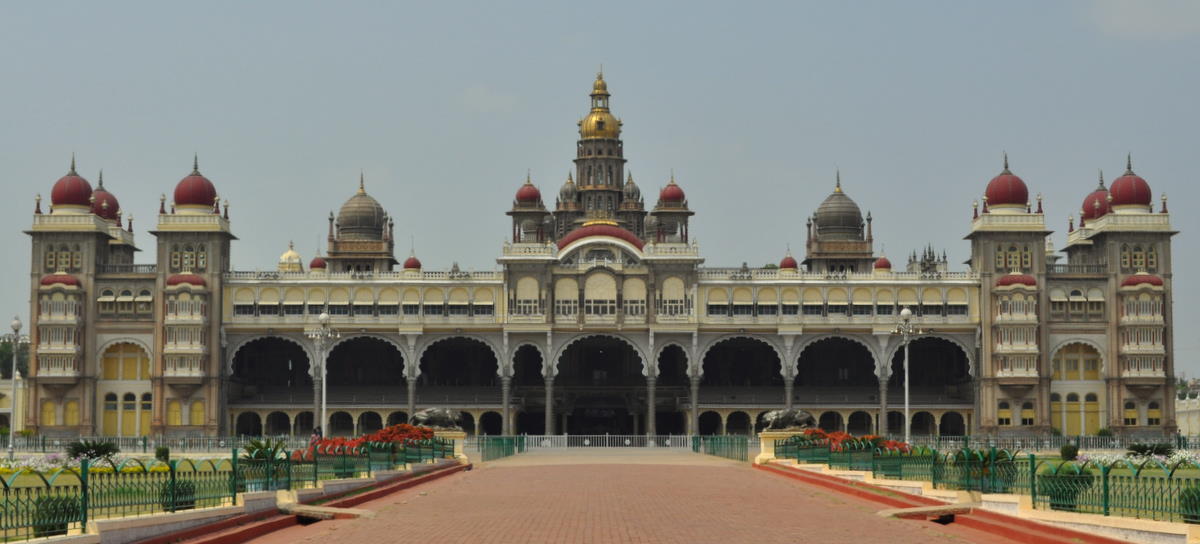
The Maharaja's Palace in Mysore is an Indo-Saracenic gem. After securing dominance in this part of India, the British gave titular power to the local Maharaja. In the late 1800s his wooden palace burned to the ground. Working with a British architect, the Maharaja designed and built the present palace in the space of 15 years sparing no expense.

Completed in 1912, the new palace embodiies the European fantasy of Oriental opulence and spleandor. Sunlight shining through intricately worked, richly colored stained glass dapples a vast ceremonial hall. Pillars, each made from a single stone, soar upward to support multi-vaulted and intricately painted ceilings. Chandeliers suspended with heavy crystal hang from long chains. Delicate floral designs of precious and semi-precious stones are inlaid into marble floors. Inlaid ivory designs adorn heavy ceremonial doors of teak and rosewood.

From the beginning the palace has been electrified. On ceremonial occasions, and now every Sunday night, thousands of lightbulbs trace the palace's outline.

Until Indian independence in 1947, the Maharaja lived, received his subjects, and presided over both his family's and Mysore's ceremonial occasions from this dream palace. After independence the Maharaja was named Mysore state's first governor.

The palace is now a popular destination for both Indian and foreign tourists. The current Maharaja still uses an ancient temple that survived the fire and is incorporated into the new palace.

Meals Ready

Typical south Indian breakfasts and lunches are served on a banana leaf – placed either directly on the table or on a large round stainless steel plate.


For breakfast we can choose one or more of several standard menu offerings: masala dosa is a large thin, crispy crepe-like pancacke made from rice and lentil flour and filled with a spicy mixture of potato and onion; pongal is a porriage-like concoction made from rice boiled in milk and flavored with cashew nuts, curry leaves, peppers and ghee (clarified butter); idli is steamed bread made of a batter of special rice and lentil flours, fermented overnight like sour dough, and served with sambar, a spicy lentil and vegetable soup for dipping; vada is bread made from lentil flour and masala spices, deep fried in either a doughnut or doughnut hole shape; poori is puffy, deep fried circle-shaped bread, like American Indian fry bread but unsweatened; paratha is fried bread made from dough rich in ghee, may include egg or potato.

Filter coffee is strong, dark, sweet and mixed with frothy boiling hot milk. Both coffee and tea are generally served sweet, but I always request 'no sugar'. Coffee is served in a small, stainless cup set inside a small stainless bowl. The drill is to pour the coffee back and forth between the two vessels until cool enough to drink. Upscale restaurants serve milk coffee in a regular cup and saucer. It is usually Nes (short for Nescafe coffee powder), which costs more than the delicious filter coffee.


A thali meal is a fast food lunch, generally vegetarian, the south Indian equivalent of the American burger and fries. Restaurants specializing in lunch thali advertise 'Meals Ready'. First a waiter places a banana leaf in front of each diner. Then another waiter arrives carrying a bucket-like vessel with three compartments containing various masala-seasoned vegetable stews and scoops a portion from each onto the banana leaf. Next another server ladles out various Indian pickle condiments. Rice comes next. A waiter carrying a large pot of steamed rice scoops out a giant heap onto the center of the banana leaf. Another waiter follows close behind ladeling dhal, a thin, spicy lentil soup, onto the rice. Thali lunch may also include small stainless bowls of yogurt and a sweet, pudding-like dessert.

All the locals, no matter what age, gender, or social class, dig in with gusto using only the right hand. I tried eating with my hand but after a couple of awkward meals gave up and used fork and spoon.

Everywhere, from upscale restaurants to open-front food stalls to push-cart street vendors, fresh fruit juice is available: orange, sweet lime, pineapple, grape, apple and sugarcane. Fresh lime juice with soda and sugar is a favorite all over south India. It's a favorite of mine too, but unsweetened so I can add just a touch.

South India

Of India’s 28 states, four are located in the southern portion of the Indian peninsula:

  • Tamil Nadu – about the size of Greece or Louisiana and stretching 910 km (550 miles) along the Bay of Bengal and across from Sri Lanka.
  • Kerala – about the size of Switzerland or Maryland and stretching 580 km (360 miles) along the Arabian Sea.
  • Karnataka – about the size of Syria or Oregon, Bangalore is its capital and high tech center.
  • Andhra Pradesh – India’s fourth largest state, larger than France and about the size of Colorado, Hyderabad is its capital and high tech center.

The States Reorganization Act created states along linguistic lines in 1956. In each of the four southern states the majority of the population speaks one of four Dravidian languages derived from ancient Tamil. Linguists disagree about the relationship of Dravidian languages to other language groups. Nothing is known about the ancient Dravidian parent language. It is widely accepted that Dravidian speakers must have been widespread throughout India before the arrival of Indo-European languages and Vedic Sanskrit from the steppes of central Asia.

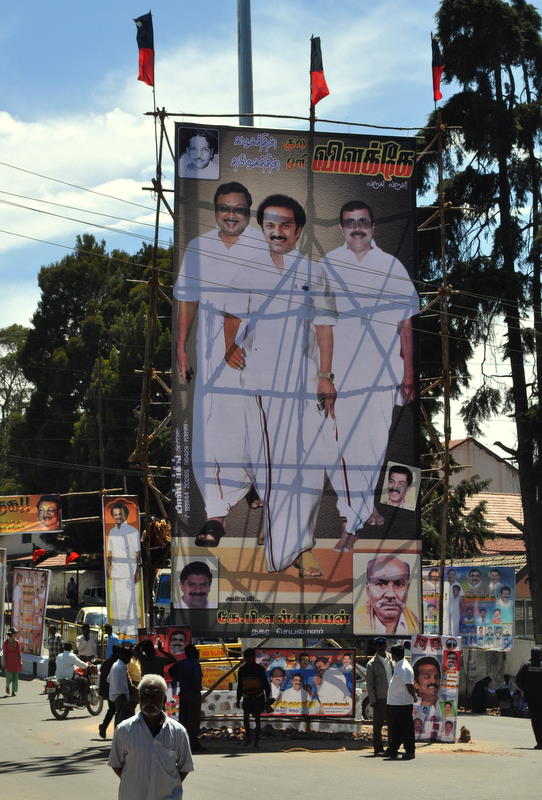
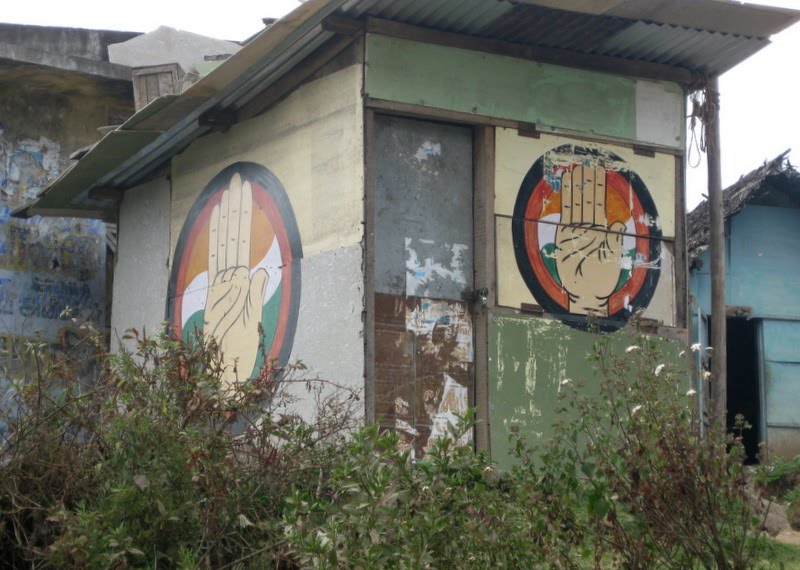
State politics in southern states tends to be dominated by language-based local parties and by all appearances is a lively matter. Regional newspapers place heavy emphasis on local politics. In one of the towns we visited, a new bus station was about to open, with Tamil Nadu’s Deputy Chief Minister attending. In preparation, workers set up hundreds of huge placards with his picture all over the town and its approaches. The Tamil Nadu supreme court recently had to overturn a right-wing party’s attempt to require all people moving into the state to speak Tamil. Each political party is known by both its name and a symbol, which are both shown on ballots to help illiterate voters.


Because of its many seaports, southern India has a long history of trade-based relations with other parts of the world. In the ninth century BC, King Solomon may have had trade relations with a port along the coast of present day Kerala. Chinese, Arabic, Greek, and Roman texts provide first-hand accounts of lively trade and cultural exchange. Syrian Christian missionaries arrived in the first century AD to proselytize Kerala’s resident Jewish community. Islam arrived with Arabic traders centuries before Islamic Mogul rule. Portuguese, Dutch, French and English established trading arrangements with local rulers. Catholic and Protestant missions succeeded each other with shifting politically-based trade relations.

The current sari and salwar kameez traditional dress for women dates from the nineteenth century and was at least partly a result of Victorian prudery. In the heat of parts of south India, women and men traditionally covered only their lower bodies for all but ceremonial occasions.

Due perhaps to its ancient cosmopolitan culture, southern India tends to be more forward looking than the north. South India’s states have the highest literacy and standard of living. State and local governments tend to be less corrupt than in northern India, with more government resources going to infrastructure and social programs. It’s not surprising that India’s high-tech centers are concentrated in southern India.

For an interesting perspective on modern India, I recommend Financial Times journalist Edward Luce’s 2006 book In Spite of the Gods.

Kerala Backwaters

About a week ago, we moved across our first state border from Tamil Nadu into Kerala state. States are more like countries in India, with a new culture and often a new language each time you cross a boundary.

Kerala is a sleepy collection of wetlands that stretches along the western coast of the tip of India. It is actually one of the richest states but not thanks to its socialist, anti-business government. Being close to the ocean and western civilization, many people from Kerala have gone to work in the Middle East, sending petrorupees back from Dubai for their families to build modern houses.


Tourists flock to Kerala to see the “Backwaters.” For about 150 kilometers, the coast is so flat that water goes nowhere. Over time, people have organized canals and levees to separate the waterways from the fields, and these waterways provide a fascinating glimpse into rural life. It isn’t exactly untouched, since tourism is the largest industry, but it’s interesting nonetheless.


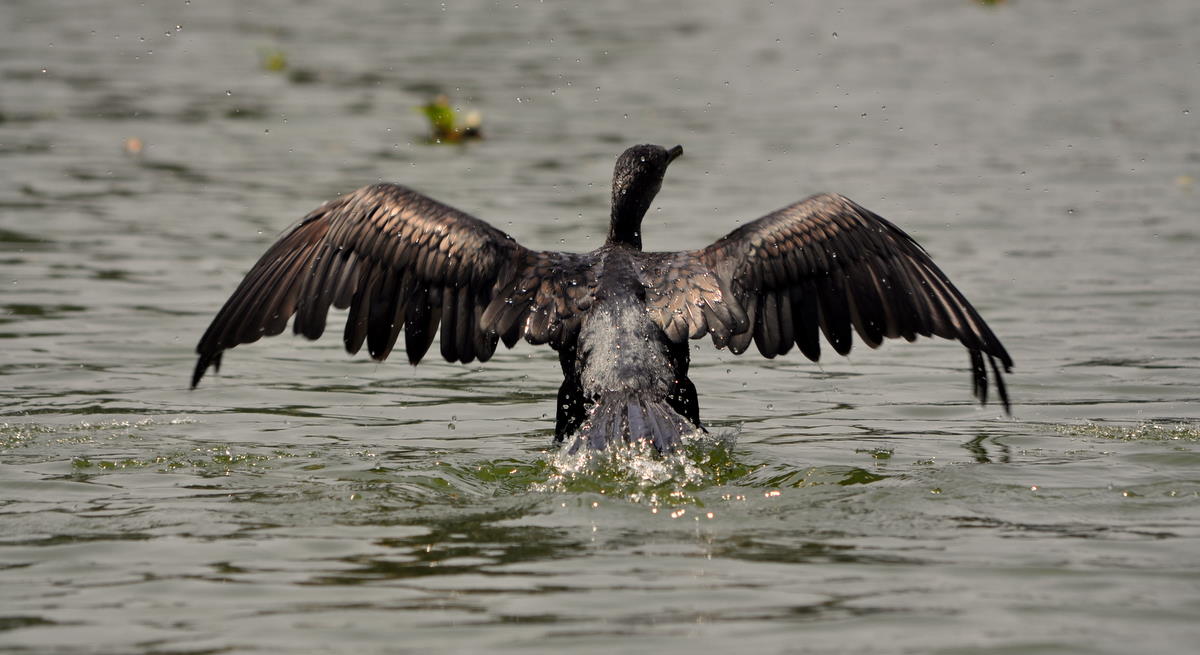
Our first boat was the full-day ride the 70 km from Kollam (Quilon) to Allepuzza (Alleppy). We took the more expensive and comfortable craft, but the program was essentially the same as the local ferries. A few ports of call for lunch and tea. Cormorants and eagles flying and sitting on posts in the water. No one in a hurry.


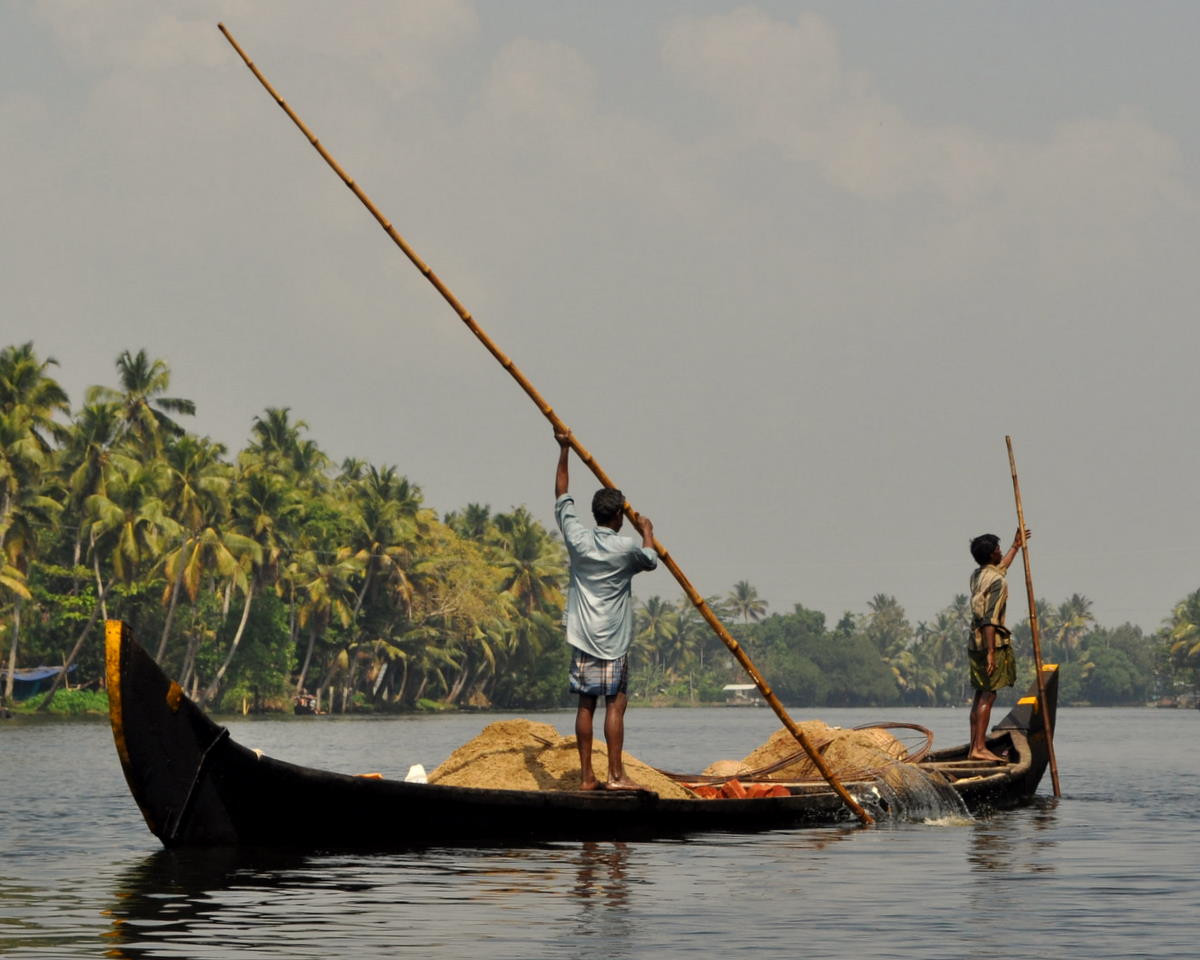
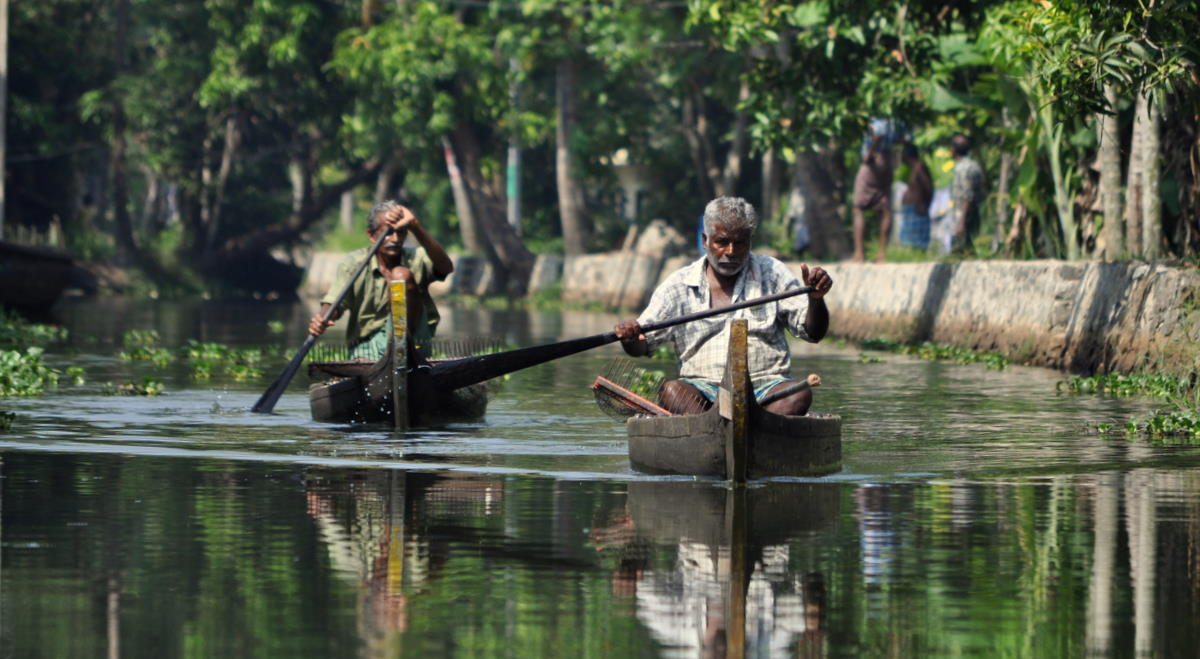
The next day, we hired a canoe. Although I love to paddle, in this heat I left the work to the local driver. It felt a bit colonial, but the driver made good money and sweat less than I did sitting on my butt in the shade. Silent and moving at a walking pace, we were able to see the smaller channels where real life still happens. Men and women washing clothes. Canoes loaded with bricks and sand almost to the waterline. A village ceremony where a man lit a small flame on a pot of flowers on his head and then splashed backwards into the water.


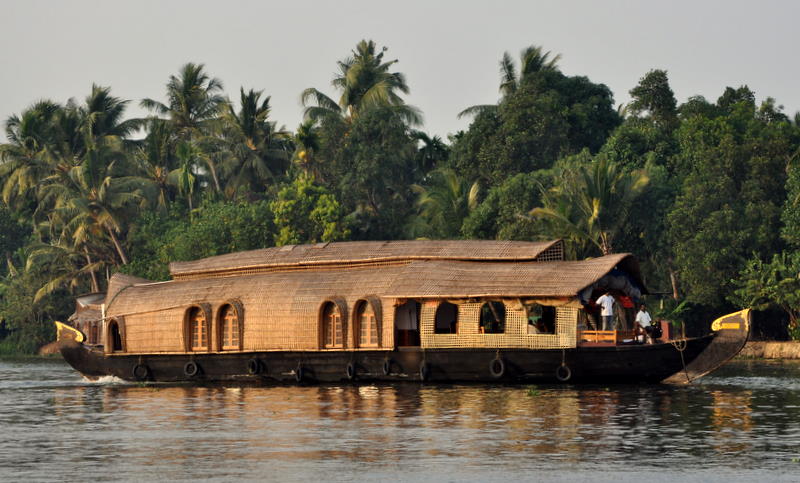
The one thing we didn’t do was rent a tourist houseboat. To feed the tourist hordes’ desire for “authentic” experiences, local people have built over 500 of these imitations of traditional working vessels. Although they make an interesting sight, they inflict serious environmental and cultural damage and just didn’t seem like the way we wanted to spend our holiday. Though I must say, they look like fun.

Kerala palaces

The capital of Kerala is Trivandrum, and it lies at the southern tip. This is a historical accident due to its long-time rule as the small kingdom of Travancore. Here and a few other places, the British found it more efficient to rule through a nominally independent puppet state. In a caste-oriented society, they could control everything if they simply controlled the guy at the top. In Travancore, the guy at the top was more interested in music than in war, which made it easy for all concerned. Descendents of these kings still live in these palaces, though they were stripped of their status after independence.

We visited two Travancore palaces. The one in Trivandrum is more modern and only partially open. Built in the Kerala style with carved horses and slatted woodwork around all sides to promote native air flow, the palace stayed remarkably cool inside. Exhibits included thrones in gold and crystal – gifts from European powers to sweeten the local raja.


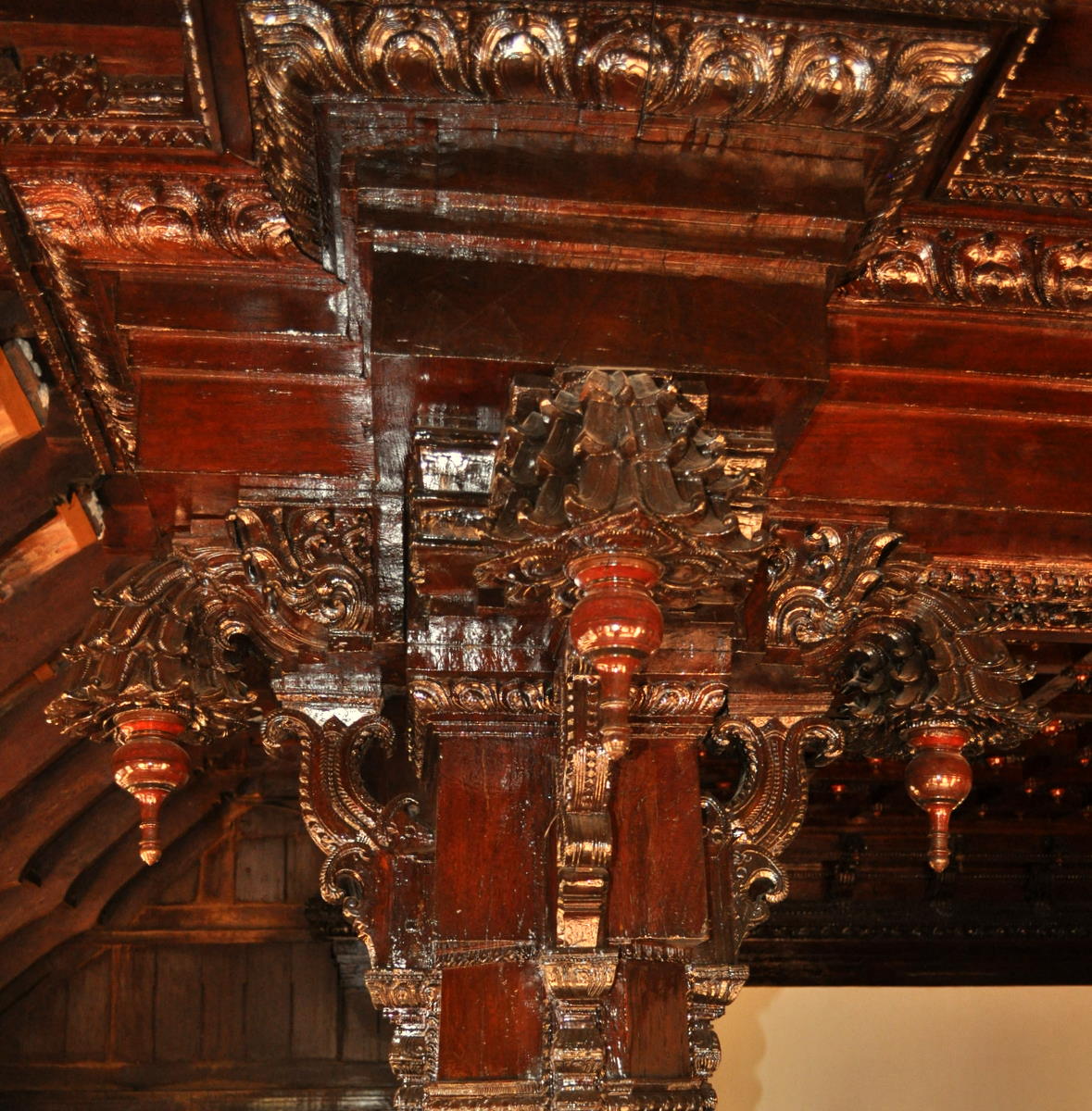
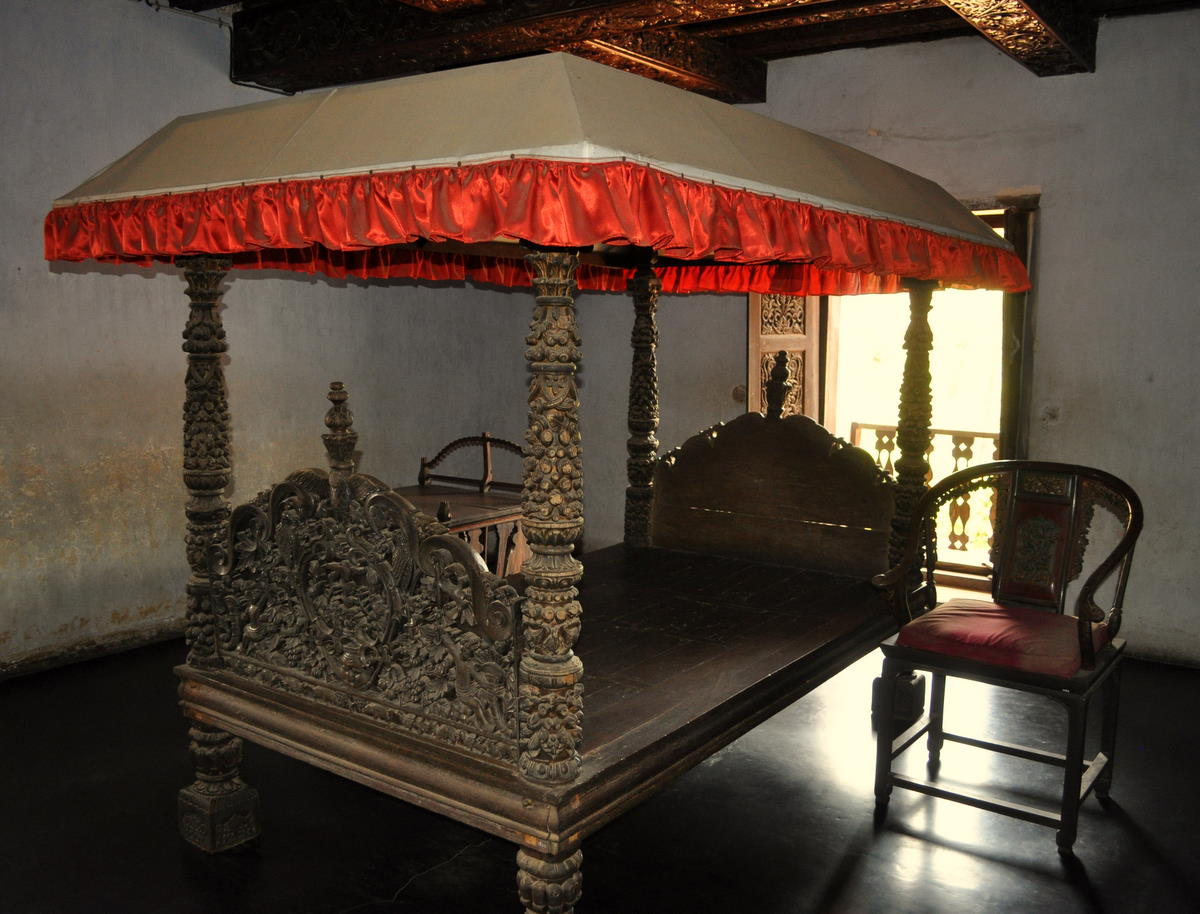
More interesting was the older palace 60 kilometers to the south in the older capital Padmanabahapuram. Some of its column carvings dated back to the sixteenth century. The king’s bed was similarly well carved.


We later spent a day in Kochi (Fort Cochin), the historical capital of another small kingdom north of the Backwaters, which was the beachhead for the Portuguese and later the Dutch and English. Here the palace contained extensive religious murals, only a few of which are visible to the public.

The beach temple festival

While we were in Kochi, a taxi driver told us about a festival happening at a beach village 16 kilometers to the north. We were initially skeptical but decided to take the chance on traveling up in the sweltering heat of the afternoon. We were glad we did.

The festival was in full force when we arrived. Several thousand people were gathered around a small temple and we could hear the sounds of music and fireworks from afar.

The centerpiece of the festival was two teams of seven elephants each. Elephants are sacred due to their association with Ganesh, and large temples often have a temple elephant who delivers blessings with his trunk in exchange for a few rupees. But here they had assembled 14 of the huge animals with gold-colored trunk ornaments and colored tassels. Three people stood on top of each elephant with ceremonial parasols and yak-hair shakers.


In front of each team of elephants played a band of drummers, trumpets and double-reed horns. Each drummer would improvise a few seconds, and the others would answer. The trumpets and horns blared single notes repeatedly as the intensity grew. To each side of the temple, fireworks wallahs set off explosions every few minutes. These bombs were capped metal containers about 15 centimeters high, which they filled with gunpowder in a tent nearby. The man lit their fuses from less than a meter away. The temple elephants seemed quite used to all the noise.

After dark was the real fireworks show. It began with a string of thousands of firecrackers and cherry bombs that stretched most of the way around the temple. I tried to film a video, but it was so loud that I had to cover my ears. This led to a full fireworks show, with rockets launched from ten-centimeter-diameter pipes. Safety precautions were limited to a rope and fence about 5 meters away, and the fireworks professionals were much closer than that. My dad would have enjoyed my front-row seat.


For a real blast, play this video:

(click here if the you cannot play the youtube video)

Rough and ready internet

The idea that India is leading the flat world electronically into the 21st century is a bit of an exaggeration. Although Indians are well educated in the sciences and large parts of the growing economy depend on the internet, these cluster in large cities and isolated groups. Much of the country lies 10 to 50 years behind in infrastructure and sophistication.

Nowhere is this more obvious than the challenges of getting connected while traveling. In the West, we are used to connecting our laptop to a wifi service in any hotel down to the cheapest Motel 6. And during the day, a visit to Starbucks or a quick scan will usually yield an open hotspot, often free.

Not in India. Most hotels haven’t even got the idea that travelers might want to connect from their rooms in the middle of the night. I’m sure it would be different if we were staying at the Taj, but we’re not being cheap, either. We are staying at midrange hotels that cater to foreign and domestic tourists and business travelers, often a business hotel near a train station. But there is nothing in the room and not even a business center or lobby hotspot. Hotel staff generally smile and say no problem – there’s an internet café down the street.

Internet cafes are everywhere, but they are really nasty places. They are rarely air-conditioned, so the heat of the computers adds to the native swelter. Mosquitoes abound. The machines are often five years old and half are broken. Viruses are rampant. Trying to use these machines for anything more than webmail is an exercise in frustration.

Many internet cafes in India refuse to let people connect their own laptop through either a cable or wifi. I’m not sure if it’s fear of viruses, terrorism, bandwidth abuse or just extra work, but they simply refuse. So each time we come to a new town, we have to interview café owners to find the one that will let us connect.

I use my iPhone a lot, though it too has challenges. I have to adjust settings and watch usage to make sure I don’t run over the 100 MB that I’ve paid for. And half of the time it insists on connecting to a carrier that doesn’t include data service or won’t connect it to an international phone.

Despite all this, we have managed to stay connected to both email and the real world. We pay all our bills through the internet. Efax sends me all my junk faxes by email. We get our postal mail thanks to our housesitters and a wonderful service called Earth Class Mail that acts like an electronic PO Box, opening our postal mail and scanning, forwarding or shredding it on our direction.

It all works, but we’re still a long way from a truly flat world.