Category Archives: All

Kattai Kuttu Performance

Soon after arriving in India, we got an opportunity to attend an authentic kattai kuttu performance at an all-night village festival.

Kattai kuttu is one of several traditional Indian entertainments and is indigenous to Tamil Nadu state. A mixture of music, dance and theater, kattai kuttu performances enact well-known mythological stories from the Mahabharata, making the legends accessible to the people.

We arrived after dark and the festival, honoring the village goddess, was already in progress. A tractor pulled a large flower-decorated float carrying an image of the goddess and many children through town. A man with a long pole hoisted electrical wires so that the float could pass underneath.

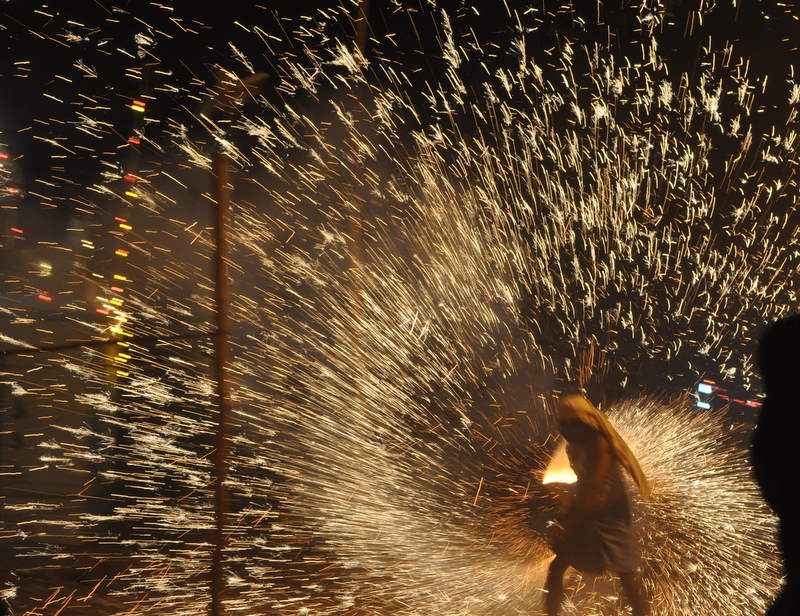
Then villagers set off fireworks and tremendous firecracker ‘bombs’, all the more impressive because we could have walked right up to the exploding shells.


The kattai kuttu performance began at 11pm and ended at 7am without a break. Along with 200-300 villagers, we sat on the ground under the stars. From time to time we lay down and napped or got up and walked around. Some villagers slept, but a good core paid rapt attention through the night. Audience members sometimes came on the stage to give money to the actors playing their favorite deities.


Performers wore elaborate makeup and costumes dictated by the kattai kuttu tradition. The actors spoke, sang and danced accompanied by a chorus of singers and an orchestra of a harmonium, finger cymbals, drums and a loud oboe-like instrument.


Most of the actors, chorus members and musicians were students at a boarding school founded by a hereditary kattai kuttu actor. The school’s mission is to pass on the kattai kuttu tradition and to provide young performers with an education so they can qualify for good jobs in India’s growing economy – performing alone will not provide a living.

Temples, temples, temples

We started in Tamil Nadu state because it is the closest to the start of Indian history. The Dravidian culture traces its roots through several thousand years of unbroken history, since this remote area was never overrun by the Aryans, Moghuls, and other waves that swept across the rest of India. So it is like a time capsule with thousands of well-preserved temples, some of the holiest in India.

The capital, Chennai, is huge but hardly historic, since it was founded and built by the British. There are of course many temples and they were built to the same design as temples a thousand years older. We visited several during the two days we stayed there, and they gave us a taste for what would follow.

Although there are many variations on the design that later spread throughout Asia, most Dravidian temples are laid out as a series of concentric rectangles that lead into the central image of a god, usually some manifestation of Shiva or Vishnu. Often the central object is a lingam, a simple post that represents Shiva's power and many other things. This male symbol is usually centered in a basin that represents the female and channels water and holy oils out to a spout. Here in southern India, the whole inner temple may act as the basin with a spout coming out of its side.

Each of the four entrances is usually capped with a high tower called a gopura. In the south, these towers can rise as high as 60 meters (200 feet) and they are often covered with colorful statues.

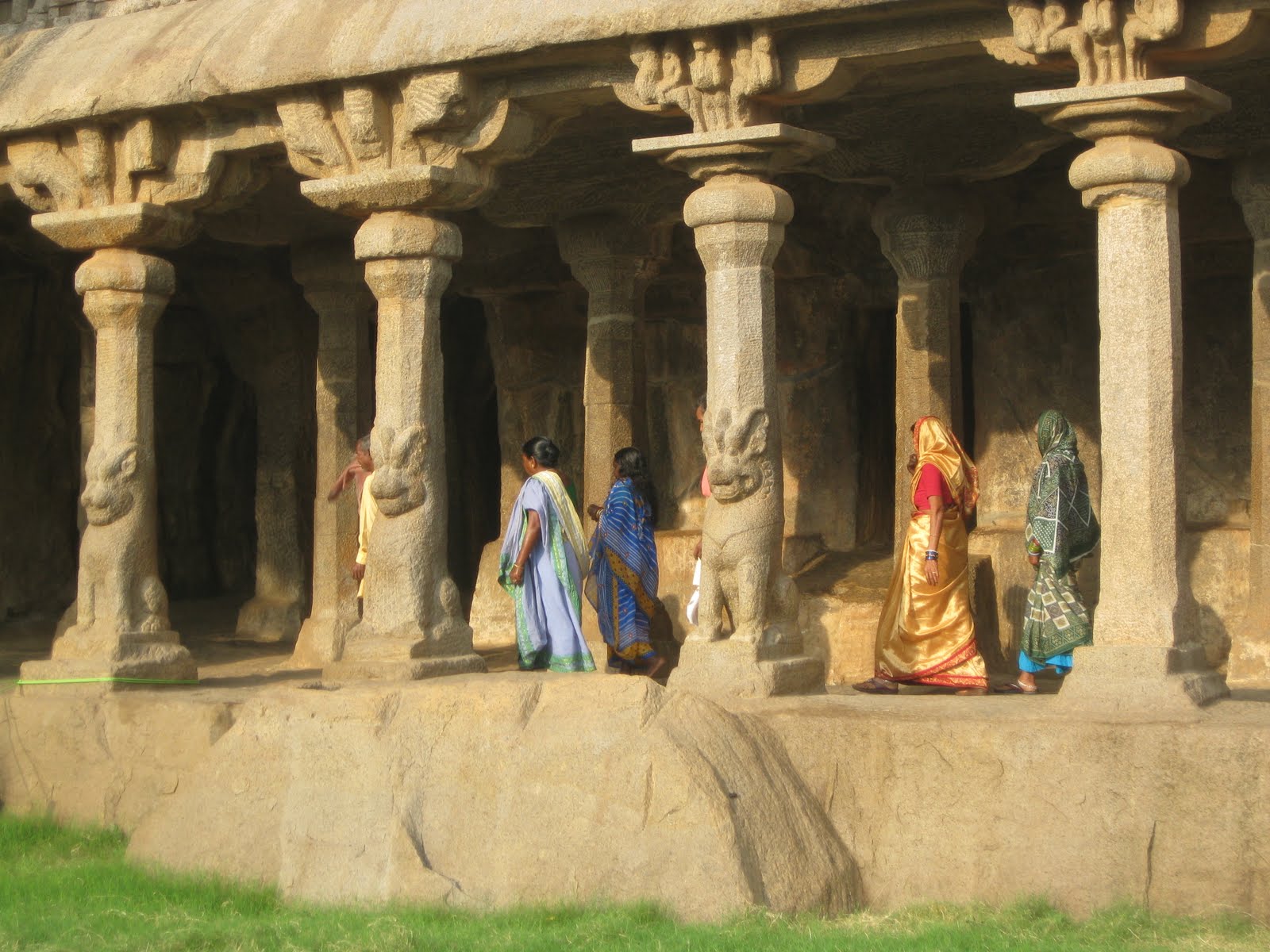
Our first stop after Chennai was Mamallapuram, a small city two hours to the south. For more than 1300 years, this has been the stone-carving captal of India. In addition to its famous Shore Temple, Mamallapuram houses a set of five “rathas” (chariots) that are small temple buildings carved out of a single rock. They were models and not used as temples; indeed some speculate that they might have been advertisements for the local stonecutters' craft.

We next traveled inland to Kanchipuram, one of the ancient capitals of India. This is now a small city that boasts many large and ancient temples. One of these called Kailasanatha was built by the Pallava civilization in the 8th century and has remained largely untouched except by some clumsy recent efforts at restoration.

Our next temple city was Tiruvannamalai, the place where Shiva is said to have demonstrated his supremacy as a lingam of fire. We arrived just after a huge festival where thousands of pilgrims lined up to receive blessings from the priests at the center of a dimly lit hall. We were sorry to have missed the spectacle, which culminated in a fire at the top of the mountain overlooking the temple, but we were glad not to have to battle the crowds.

We took a brief break from the temples in Pondicherry, the capital of the small French colony in southern India. Pondicherry is an incongruous enclave with Catholic cathedrals at its center and Parisian street names like Rue Suffren. Yet even here the local ashram owns most of the town.

The next town south was Chidambaram, considered the place where Shiva won a dancing competition and became Nataraja, Lord of the Dance. Six times a day for more than a thousand years, the local priests have been performing a ceremony to help Shiva continue the cycle of creation.

We witnessed two of these almost Dionysian ceremonies. In preparation, the priests lit a large number of oil lamps inside the temple. Then, the ceremony began with priests ringing large and small bells in the courtyard and intense rhythmic drumming. Inside the temple, the chief priest lifted one burning lamp after another in a blessing motion. At one point, the drummers led the crowd of worshippers on a procession clockwise around the temple. Finally, two priests ascended into the innermost sanctum and did some more invocations culminating in a circle with the largest burning lamp. This completed the cycle, and the worshippers dispersed satisfied that the world can continue until the next ceremony.

Our next stops were a group of three temples built by the 1000-year-old Chola civilization. In this early period, the central tower dominated the building. Tanjore (Thanjavur), the most famous of these, had the tallest tower in India at the time of its construction. We were struck by the elegance of both its architecture and its many statues.

Tamil Nadu's largest interior cities also have its largest temples. At Trichy, a huge temple dedicated to Vishnu has high gopuras at its main entrances leading to not less than eight enclosures around the central shrine. The outer layers almost blend into the city, with priests and holy object hawkers living and working within its walls. Most of this temple was relatively modern, with the largest South gopura finished only twenty years ago.

After a short break, which we'll describe in other postings, we went to Madurai, a 2500-year-old city that was capital of several civilizations. Its central temple contains areas for both Shiva and a manifestation of his consort Parvati. During the day, each is worshipped in its respective inner sanctum, but at night there is a ceremony to allow them to sleep together. At 9pm, the priests ring a bell at Shiva's temple to signal the start of a procession that brings his traveling image out in a silver sedan chair. The priests are careful to fan the box to keep the god cool, and they provide flowers and food such as a banana. Finally, when Parvati is ready, they take the image into a special room inside her temple and sing lullabies.


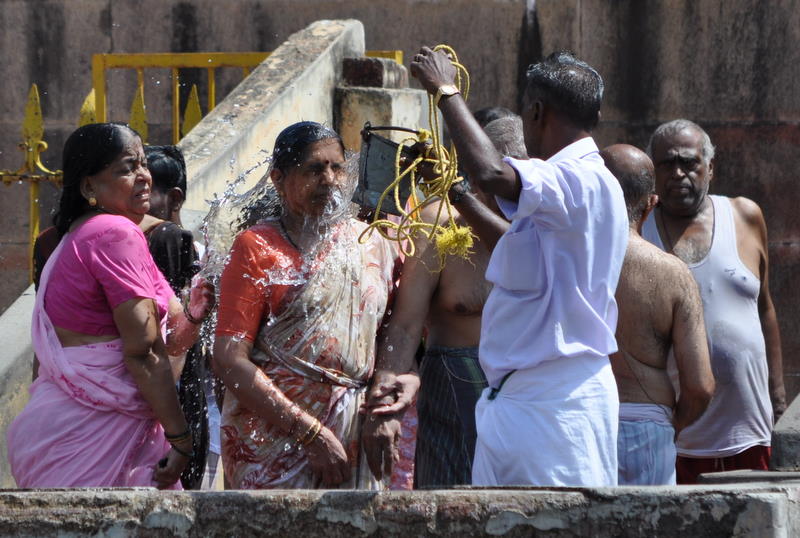
The final stop on our temple circuit was Rameswaram, a pilgrimage town on an island that almost forms a land bridge to Sri Lanka. It is here that Rama was thought to have built a lingam of sand to make up to Shiva after rescuing his wife from the monster Ravena, who was a brahmin and therefore not entirely cool to kill. This is a big stop on the Hindu pilgrim trail, with thousands dousing themselves with the water from 22 tanks around the temple, each thought to have a different shealing property. The temple itself is famous for its long corridors built in the 16th century. Several of them are over 200 meters long and supported by 1216 carved pillars.

Forts and palaces

Although temples dominated our itinerary, we also saw some more secular monuments along the way.

The largest was a fort built over several centuries at Gingee, a small town in the middle of nowhere. The outer defensive wall was a triangle measuring several kilometers on each side, with walls over 10 meters thick. Inside, many layers of imposing defences were built on three mountains that rose out of the plains. We climbed the 1200 steps up the highest of these, unbearably hot even on a winter morning. These defences seemed impregnable, but they did not ultimately stop anyone, as the fort passed from Indian to French to British hands. I can only guess that in a determined siege, walls and mountains count less than access to food, water, and local support.

Other forts seemed to have a less military purpose. Trichy is famous for its Rock Fort, built to overlook the city by the seventeenth-century Nayak kings. Most of the construction along the 400 steps to the summit was temples, however, and the castle at the top seemed more for living than defence.

In Tanjore, the same Chola king who built the temple with the great tower also built a palace. Most of what remains today, however, is from the 17th to 19th centuries and is slowly rotting even though the king's descendants are still living inside.

Madurai has an impressive palace built by the Nayak kings in the 17th century. Much of it was torn down to reuse building materials, a common sport of both Indian and British rulers. But the main hall is still impressive enough to serve as backdrop for innumerable Bollywood movies, one of which was filming an assassination scene while we visited.

The most remarkable was a forgotten palace in Ramanathapuram, a small town on the road back from Rameswaram. Only one guidebook thought to mention it, and it was so obscure that our driver had to ask directions to find it down dirt streets. And yet inside, every wall and ceiling was covered with impressive 17th-century murals. They were unlit and unmaintained, with piles of wood scattered around the floor. The Architectural Survey of India's only interest seemed to be employing two people to sell tickets to the occasional visitor.

Women’s dress


I am struck by women’s dress and the manner in which it juxtaposes modesty and display. Almost without exception, south Indian women who I’ve seen out in public wear traditional clothing – either the 6.5m sari draped over a short sleeve, close-fitting, midriff-baring top or the three piece salwar kamise – long or elbow length sleeve top of varying lengths, trousers varying from baggy to tights, and a long shawl draped in such a way that both ends hang down the back . Married women generally wear the sari and single women the salwar kamise.

For foreigner women or the odd local women who wear western clothing, trousers are okay but shorts, bare legs and bare shoulders are considered immodest – even though daytime temperatures are hot throughout the year. Except in the most popular tourist destinations, foreigners are fairly rare and the locals seem to enjoy looking us over from a distance. Northern Hemisphere tourists who choose to wear tank tops and short pants are either ignorant of local sensibilities or choose to ignore them.


Here in the south, the center of silk weaving, saris of thin silk are common dress for shopping and visiting temples. Colors range across the spectrum from deep red, orange, purple and green, to brilliant red and yellow, to pastels of every hue. Designs are woven into the silk saris and always include a border and often an intricate design on the portion of the sari that drapes down over the back. Designs are made with gold thread and often include sequins and shiny beads. Necklaces, ear rings and large filigree nose studs are of various grades of real gold. Jewelry also includes rings on the fingers and toes and ankle bracelets of small bells that jingle with each step. Unlike in Mediterranean countries where traditionally dressed older women often wear black, white haired grandmothers wear saris as bright as those of their granddaughters.


School girls wear simple uniforms – blouse and mid-calf length skirt or simple cotton salwar kamise. Otherwise out in public with parents, little girls wear knee length dresses or salwar kamise (without the shawl) often decorated with ruffles, sequins or other things that sparkle. Older girls wear salwar kamise or blouses with modest length sleeves and long skirts. The fabrics are often silks of beautiful colors, textures and decorations.

The smattering of Muslim women in their long black robes, black headscarves, and for some a veil over the nose and mouth, stand out like black crows among peacocks. Their girl children dress in bright colors like Hindu children. I can only imagine that under the black shroud, the Muslim women are just as colorful as their Hindu sisters.

Rough and ready hotels

The leaders of Rough and Ready Tours actually prefer nice hotels. We can't afford to stay in five-star luxury, but we don't need to go to the bohemian extreme either. In India, $30 can buy a decent air-conditioned room, sometimes the best in town.

But often things don't work perfectly. A few good hotels have internet connections, but the routers are usually broken or working only in the lobby. Hot water might be turned on only a few hours each morning, and it can take forever to reach the tap. Better are the “geysers” (pronounced “geezers”), personal water heaters that are almost as fast as flash heaters. But these are often turned on by complex switches that only the hotel staff know.

Hotel staff can be unfamiliar with modern appliances. We struggled to get a working remote control for an air conditioner. The bellman brought us several and seemed convinced they were working even though they had no effect on the unit. It was not until I pointed out that they were from a different manufacturer that he realized he had to find a different one.

Service can be spotty. Because of a festival one day, we were forced to pay extra for a deluxe room in an upscale hotel on the edge of town. The room was great, but their restaurant's service was the worst I have seen anywhere in the world.

We were the first people in the restaurant when we arrived a little before 7. We had to fight to get a menu, which was unnecessary because they did not start serving food until 7:30 and even then almost nothing was available. After a long interview in sign language, we convinced the waiter to bring a small starter, thinking we could take a minute to decide on the rest.

Big mistake. The waiter disappeared for about 20 minutes and finally came back with the snack. But nothing could convince him to take our order. He went back and forth to other tables pretending to do something. Each time he would then go back to the kitchen window and write on his pad for 10 minutes for no particular reason. By the time we physically grabbed him and gave him our order, several other customers had stormed out of the restaurant.

Amazingly, our food showed up almost immediately.

And then there was the Ritz. All the guidebooks agreed that one temple town had no good hotels. But two books suggested the Hotel Ritz. We made a reservation and had good hopes when we pulled up to the “Al Ritz” sign.

We should have moved on at the first sign of trouble. The first room they showed had an air conditioner, but it blew only hot air. The secod room was very smokey. In a third room, the a/c worked but the ceiling fan did not. In the fourth room, they couldn't get the a/c going. Finally they found a fifth room where everything more or less worked. At least they had plenty of free rooms.

We got out our sleeping bags to avoid the bed bugs. The sheets and pillowcases felt like they hadn't been washed in a month. In a few places we could see throgh holes to the mattress.

As we settled in for the night, we noticed small blood stains on the wall where previous residents had swatted mosquitos. Sure enough, the mosquitos joined the bed bugs in bothering us all night even though we turned the ceiling fan on high. They were probably coming in through a large hole in the bathroom wall.

Flushing the toilet was also amusing. The plumbing had cracked in such a way that half the water spurted out the back of the basin. Fortunately, Indian hotel bathrooms have drains in the floors.

We were glad it was for only one night.

On to southern India!

Yes, I know. It's been over a month since our last post. We've been busy.

For most of this time, we've been in various parts of the US, visiting friends and relatives, relaxing, regrouping, and preparing for the next phase of our travels. Since our house is rented, we've remained nomadic, staying with relatives in California, Pennsylvania, Oregon, and Washington. Our thanks to all of you who have hosted us! Among other things, we:

  • did some pretending with our adorable grandsons in Portland and our adorable nieces in Mill Valley.
  • visited my parents and their friends at The Village at Penn State, many of whom seem to be avid readers of this blog.
  • saw other good friends and relatives too numerous to mention.
  • spent several late nights in the bar with my former Symyx colleagues (hisachiburi desu ne!)
  • filed amended tax returns for the years we lived in Japan.
  • took care of a year's worth of doctor and dental appointments.
  • researched health insurance options in case we're still footloose when our COBRA coverage ends.
  • sorted pictures, though by no means exhaustively.
  • registered the domain roughandreadytours.com so that you don't need to type “blogspot” and Chinese readers can still find us when their government shuts down google.
  • twice reinstalled Windows and all of our software to fix our laptop's failing system disk.
  • turned away two attempts to recruit me back into the working world.

And we prepared to travel lighter.

We had way too much stuff in Nepal. That was partly because we were moving back from Japan and we had to carry medicines and other things that we could not ship. But mostly we just had too much stuff.

We learned there is a new branch of Asceticism devoted to traveling with only what will fit into a single carry-on bag. Although we haven't begun chanting the mantras of www.onebag.com, we saw the benefit of packing efficiently enough to get everything on our backs in those cases where it will be necessary. And we had to come up with a better approach than our hiking backpacks, which cannot be easily locked or packed.

We resolved to avoid paper books as much as possible. We discovered that Lonely Planet guidebooks can be purchased chapter by chapter as PDF files readable on a computer or iPhone. We bought a Kindle, which we knew would be obsolete as soon as Steve Jobs announced his iPad, but still useful for the next year while he works the bugs out.

We bought a pair of travel backpacks that can be zipped and locked. We bought compression bags and organizers so that we can cram enough into a medium-sized pack to make it too heavy. It isn't pretty, but we are now able to carry six months of gear through a train station or city street.

So where are we headed?

We really don't know, because we don't believe in over-planning. We have to be free to follow our noses if we find an interesting detour or festival, since the most rewarding things in life are usually not the things we expect. But we have made a broad plan to take us through this summer:

  • From January 25 through February 28, we will be in southern India, in the states of Tamil Nadu and Kerala.
  • In March and April, we will take an immersion course in basic Mandarin Chinese at a private school in Kunming, the capital of Yunnan province.
  • In May, we will return to Nepal to see the rhododendron flowers and a festival in Lo Manthang.
  • Later in May, we will return to northern India, probably Ladakh and other parts of the Himalaya that are shielded from the monsoon.
  • Sometime in July, we will come back to North America for more visits and a stay at our summer house in Canada.

Beyond that, we really haven't thought much. I did buy a book about central Asia and began dreaming of Samarkand and the Tian Shan (Heavenly Mountains), but we're a long way from getting visas to Kyrgyzstan.

So a week ago we boarded a flight from San Francisco through Narita and Singapore to Chennai, the Indian city formerly known as Madras. We both shed a tear of nostalgia passing through Japan, where we had great experiences and developed many close friendships. We will come back, but not now.

India has already proved surprising and wonderful in unexpected ways. I will save the details for future postings, but my overall feeling is of discovering a land that I barely knew existed. Like most Americans, I grew up with very little sense of the more remote parts of the world. I have since traveled in Europe, China, and even Nepal and Pakistan. But India alwayes seemed a land apart, huge and strangely forbidding.

Hinduism is not an easy religion. Although I had a college roommate who considered himself a convert, I have never really known much about it. Its sacred texts run thousands of pages of complex philosophy, and one's head spins from the different deities and their manifestations. And it seems closer to the animistic practices of primitive people than to our modern world – even less appropriate than other religions, which have almost universally brought suffering and oppression to the people they seek to liberate.

And yet here it is, the foundation of all eastern thought. Buddhism inherited so much from Hinduism that it could reasonably be considered a sect. Tibetan Buddhism in particular owes much to the primitive rituals of earth, fire, and reincarnation that one finds at every turn in India. Every clockwise walk around a temple and every blaring trumpet reminds us of rituals we've seen from Lhasa to Tokyo.

And India itself is both modern and otherworldly. The physical world is neglected to the point of being a garbage dump, and yet a massive middle class builds comfortable houses with spotless interiors. And while it neglects the physical, India trains its children far better in mathematics and intellectual pursuits than our Western schools. It is refreshing to be in a place where store clerks add in their heads as fast as I do.

It's high time we learned something about this place.

Full postings for our Annapurna trip

As I promised in my interim postings, I have finally pulled all the text and pictures together to tell the story of our trek around Annapurna and our subsequent travels to Chitwan and Kathmandu. As with Dolpo, these postings cover many pages for those wishing to read them.

The notes go back to November 6, the day we returned from Dolpo to Kathmandu. Although they are all posted with today’s date, I have arranged them to display in chronological order. To see all the entries, you will have to click the “Older Posts” link when you reach the bottom of each page.

Overall, this was a much easier trip than Dolpo, as we could eat and stay in local guest houses, usually in private rooms. Marcia and I stayed healthy throughout except for one bout of intestinal trouble and a head cold I brought from Kathmandu. We both lost weight and now feel strong enough to climb Mt. Everest, which we actually did several times over in the course of our travels.

The Annapurna circuit is justly famous, as its spectacular scenery covers a huge variety of terrain from jungles to alpine passes. It is a well-inhabited area with plenty of services and local activity. It offers views of the many peaks of Daulighiri and Annapurna, the seventh and tenth highest mountains in the world.

Over 25,000 people follow the Annapurna trek each year, which means a lot of fellow travelers. We tended not to socialize much with the younger crowd, but it was instructive to encounter dozens of languages and cultures from around our very large globe. Most were European, especially French, who seem particularly fond of using their long vacations following in the footsteps of Maurice Herzog. But there were many other nationalities, from Russian to Australian to Chinese to Thai and Malaysian. Americans were a very small minority, I guess because the only people with enough money these days don’t have time to make such a long trip.

We hope you enjoy the pictures as much as we enjoyed taking them.

Nov 6 to 10 – Recovering in Kathmandu

The five days we spent in Kathmandu were mostly devoted to recovery. We slept long, ate lots of Italian and Indian food and did very little. Marcia went to the spa at the Hyatt Regency, a little bubble of the western world on the edge of town.

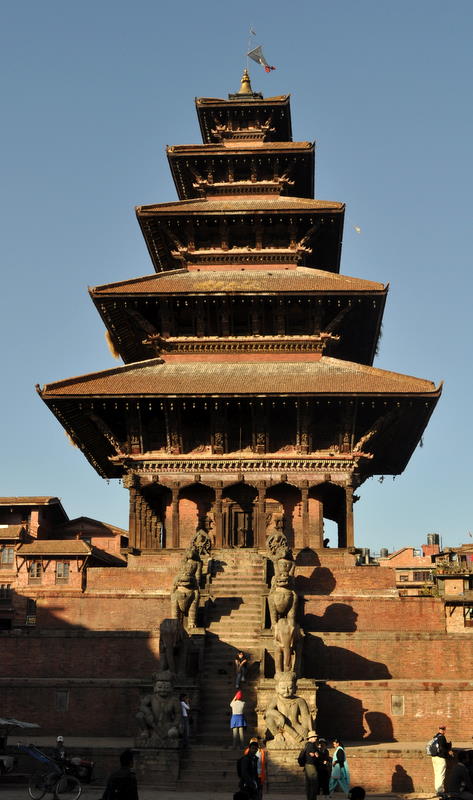
We did make a one-overnight outing to Bhaktipur, an old restored city about 12 kilometers from Kathmandu. Historically there were three cities that made up the Kathmandu Valley. Kathmandu and Patan are quite close and now almost merged into a single city. But Bhaktipur, at the other end of the valley and on the trade route to Tibet, was left relatively untouched until the 1980s, when a German group helped restore it and put in a modern sewage system. The result is a kind of working museum city with some of the best temples and monuments in Nepal.

On our very first night back, we had dinner with Sange Sherpa, the guide who had led us on an 18-day trek to the Everest region in 1999-2000. He is now running a pizza parlor in Barcelona and married to a Spanish woman named Merse. They were back to repeat their wedding celebration in his village in eastern Nepal. Sange is a really interesting fellow who now speaks four languages fluently. We were one of his first clients when we met him at the mountain airport ten years ago. His brother Ngima organized the Dolpo trek for us.

Before long, we had gathered enough strength to start talking about and planning our next trek to the Annapurna region. We considered proposals from both our Dolpo guide Kinna and our cook Sonam, who also does guide work. It was a difficult decision because we liked both of them, but we ultimately chose Sonam, who was more organized and had a really good bond with Marcia.

Just after we locked in our departure date as November 11, I came down with the worst allergy and asthma attack I’ve had in years. For two days I sneezed and coughed so badly that I feared I would be in no condition to hike. But we had set wheels in motion that were hard to stop, so we continued with our plan. Fortunately, I found the right combination of medicines and was able to get things under control just as I was packing.

Day 1 – Nov 11 – Buses, jeeps, and footpaths

We got up at 3:45 because we had to be on the road by 4:30 to avoid a political action by the Maoists, who had scheduled a one-day blockade of all roads in and out of the Kathmandu Valley. Negotiations to bring these former rebels into the political system are going badly, and the Maoists decided it was time to do a show of strength as a threat of worse if they did not get their way. We had to be well outside Kathmandu before 6am.

The roads, which are never good, were particularly congested as other trucks and buses tried to get through before the witching hour. But we finally made it out to central Nepal and began counting the kilometers towards Pokhara. With about 50 to go, we branched off and went up a side road to Besi Sahar, the traditional beginning of the Annapurna loop trek.

After an early lunch, we changed to a Jeep and continued up the new road that is under construction and already filled with ruts. This road is both a blessing and a curse. It will bring electricity, food and medicine to the people of the Manang valley. But it will also change and mostly eliminate one of the most popular remote treks in Nepal and all the business that comes with it. Trekking companies are already looking for alternatives that will be necessary in a few years.

For us, it allowed us to compress the first two days of lowland walking into a couple of hours. We got out at the first rockslide blocking the road and walked about two hours to a nice guest house, where we had dinner and spent the night.

Already Marcia and I are more comfortable than we’d ever been in Dolpo. No matter how many times the staff bring us cups of tea, a tent is still a tent. Annapurna guest houses (sometimes called teahouses) have had forty years to develop into the most advanced accommodations in the Himalaya. By staying and eating in these, we can travel with only light baggage and a minimal staff.

Our staff consists of only two people. Sonam is our guide, who keeps us on the right track and negotiates with the teahouses. 19-year-old Kichiri Sherpa is our porter, carrying both of our backpacks and his own minimal gear. Kichiri has not yet filled out to the broad dimensions of his fellow villagers, but he seems fine with carrying a load that weighs as much as he does.

One could argue that a guide is unnecessary in a well-known area like this, but at $10 per day, it’s nice to have a communicator and friend on the trip. Many of the young trekkers here carry their own packs, which strikes us as a hard way to save a little money. We only wish we could have a porter for our next trip to the Sierras.

My allergies and asthma have had a miracle cure now that we are on the road. I must have been reacting to one of the many substances in Kathmandu’s polluted air, so a change of scene has done me good. Although I’m still coughing a bit, it is not going to interfere with our trip.

Day 2 – Nov 12 – Waterfalls and road construction

Our first full day of hikng up the valley dawned cloudy. Fearing rain, I asked Sonam to by some plastic to cover the backpacks. He didn’t believe it would rain since Novembers are almost always good weather, but he did as I asked.

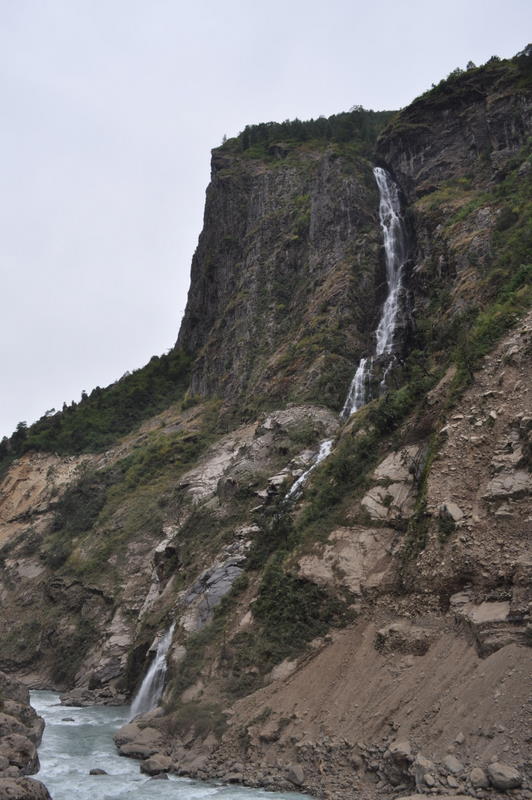
The trail followed a gradual course up the river that we will be following for the next week. There were many high waterfalls from streams entering the valley.

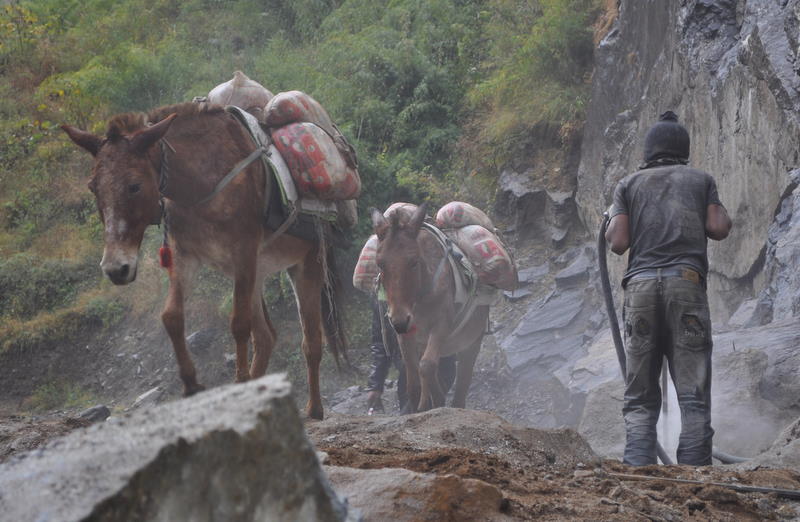
Road construction was also a constant presence, as the workers tried to push the jeep road up a seemingly impossible canyon. Their approach seems to be to brutally blast away any outcroppings in their way, which will leave an unsightly and unstable slope ready to slide across the road with every monsoon. We had to hold up for a few minutes while they set off a huge explosion across the valley. At other locations, they use a combination of power and hand tools, with an army of workers to throw rocks down the slope. Mules walk calmly past the jackhammers.

Sure enough, it began to rain a little after lunch, first on the mountaintops, then a few drops on the train, and then more steady rain. By the time we reached our stopping place in the middle of the afternoon, our jackets were soaked, more from sweat on the inside than from the rain.

We spent the night in a town called Tal, which took its name from the lake that used to fill the wide valley. The lake is gone but a wide, braided river remains on the broad gravel floor.