Author Archives: Tom

Day 3 – May 5 – Top of the main Kali Gandaki valley

Leaving Kagbeni, the trail enters the restricted area that requires a special permit costing $50 per day. Originally intended to limit numbers and impact of trekkers on the culturally interesting and militarily sensitive border region, the permits now have become a simple moneymaker for the corrupt Nepali government. Still, it keeps out the hordes of college-age trekkers that flood the Annapurna trails.


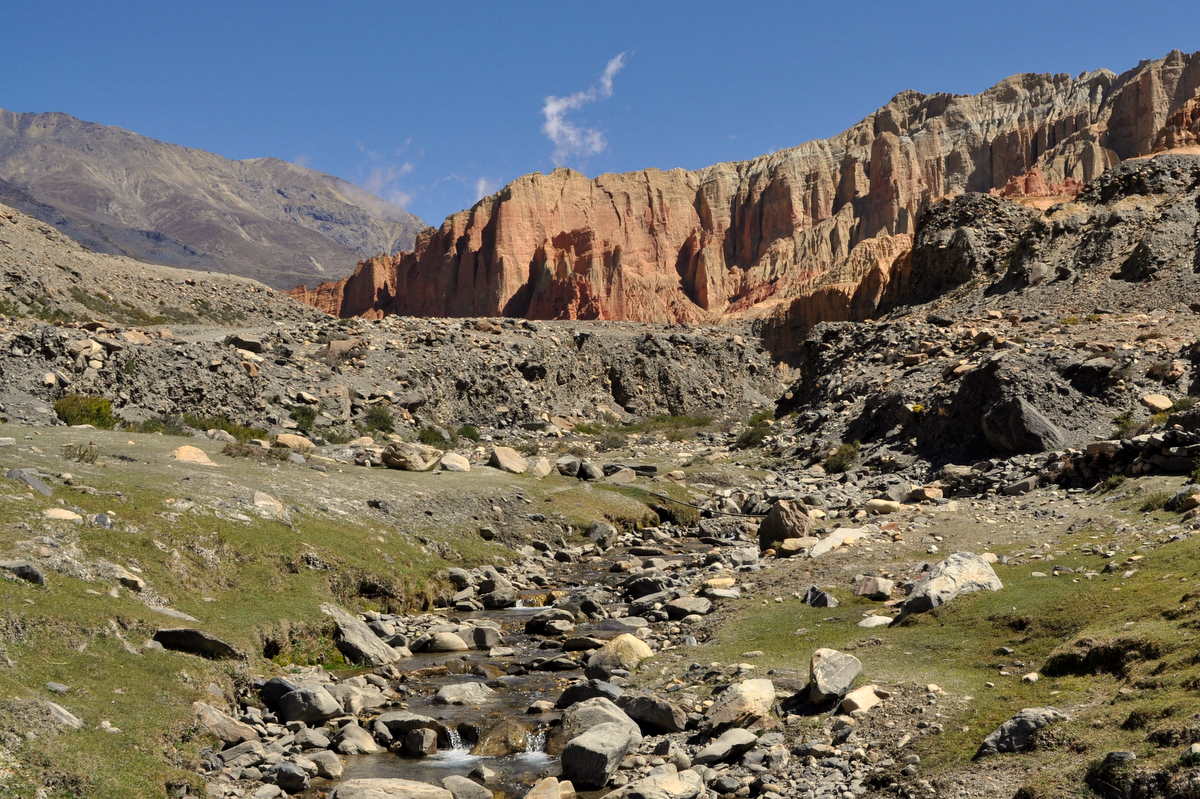
The walking was again along the flat Kali Gandaki floodplain, although we increasingly had to climb side hills in places where the river ran right up to the edge. Around mid-morning we passed the stream that drained the valley we crossed on the last few days of our Dolpo trek. We could look up and see the trail where it crossed the ridge 1600 meters (one mile) above.

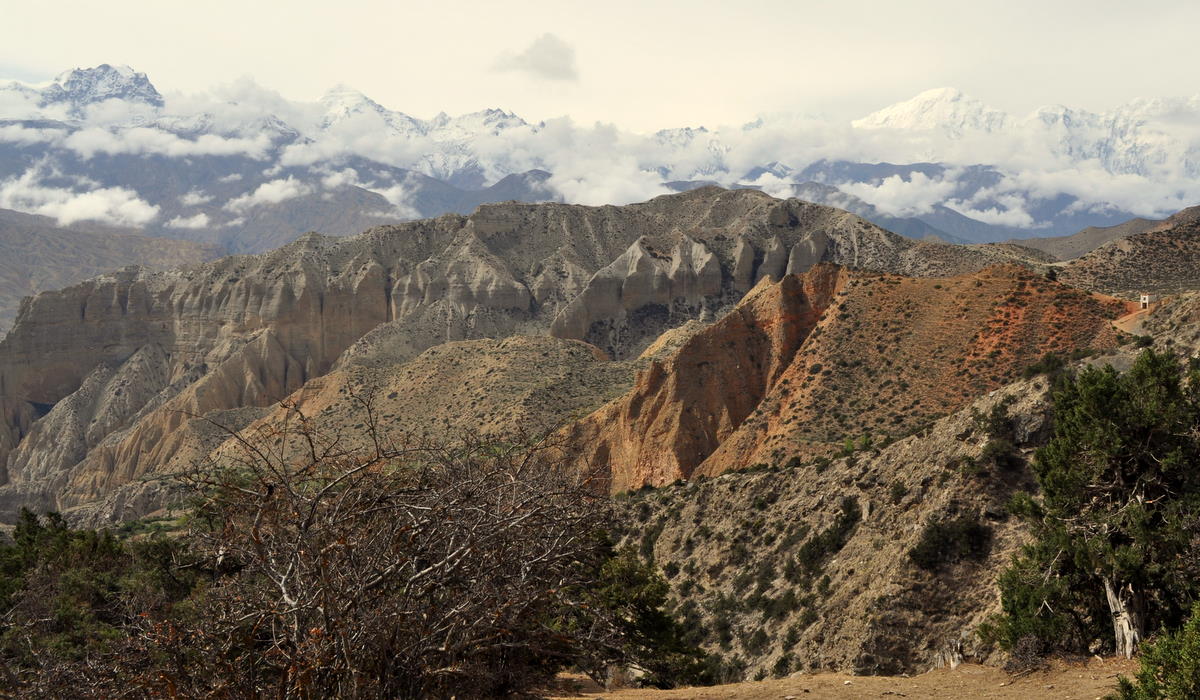
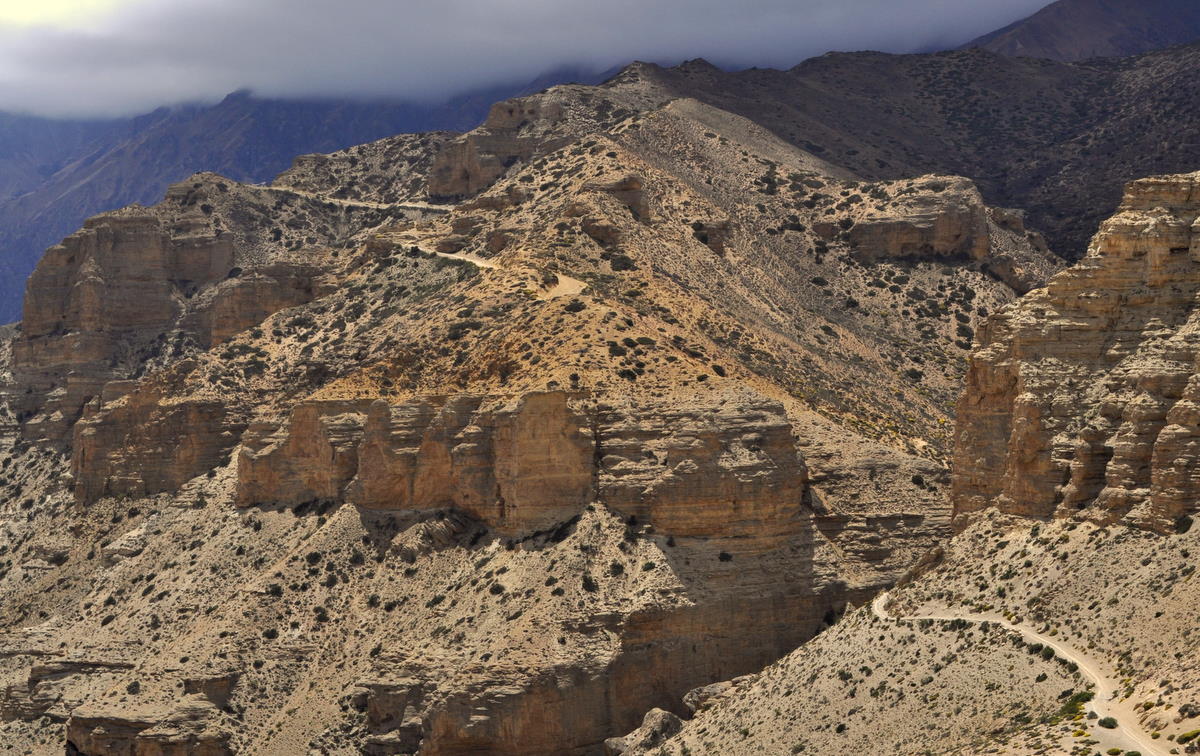
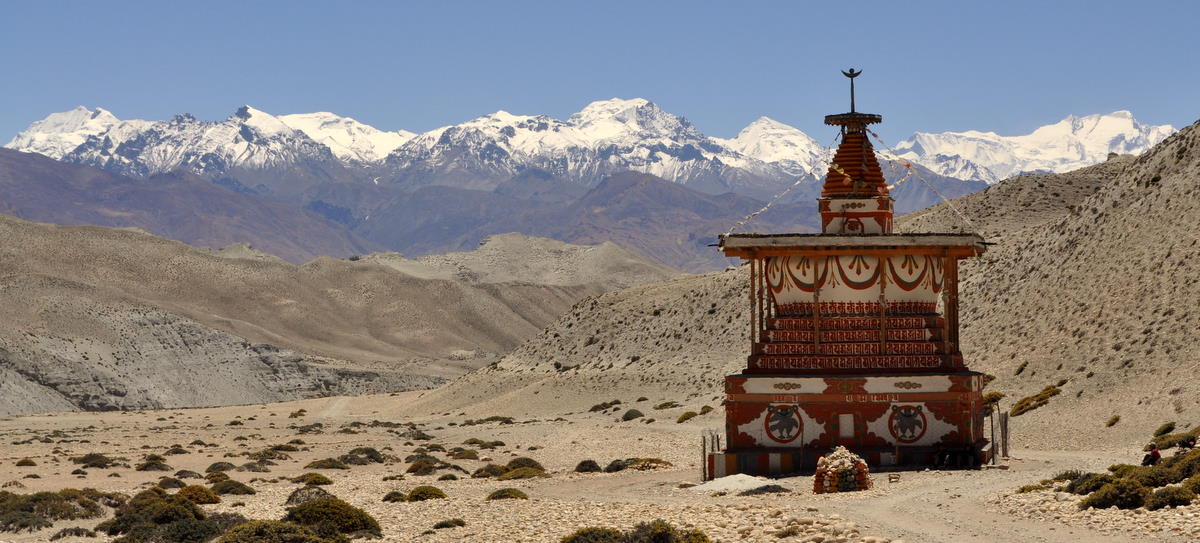
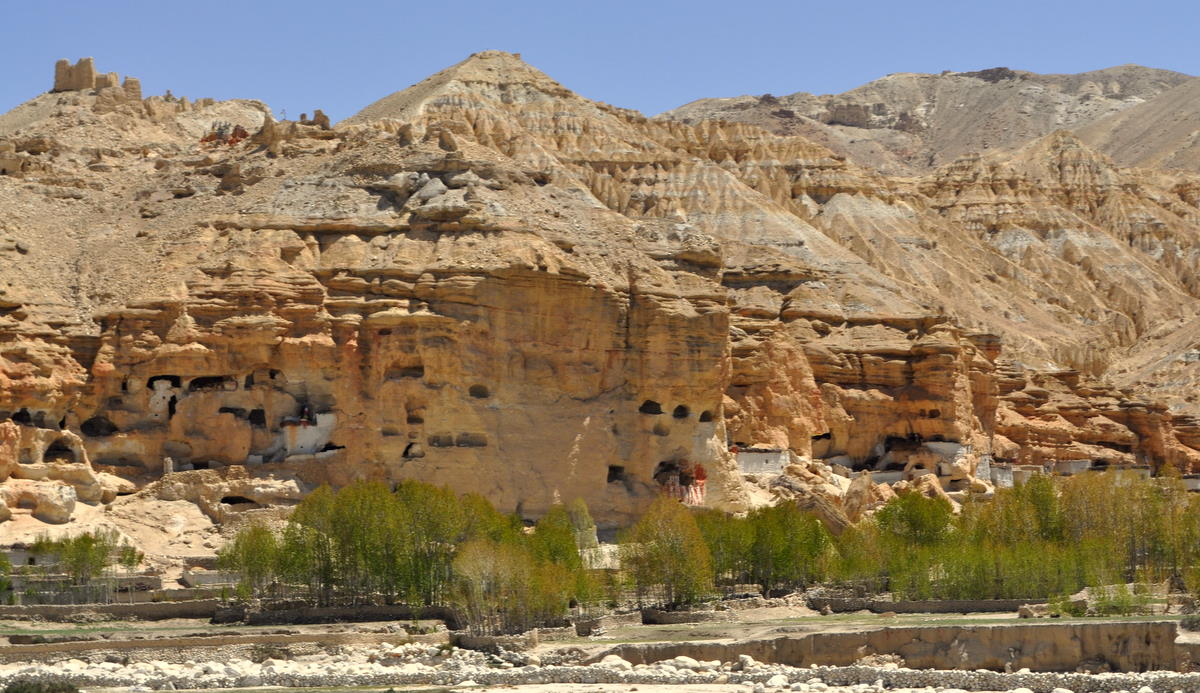
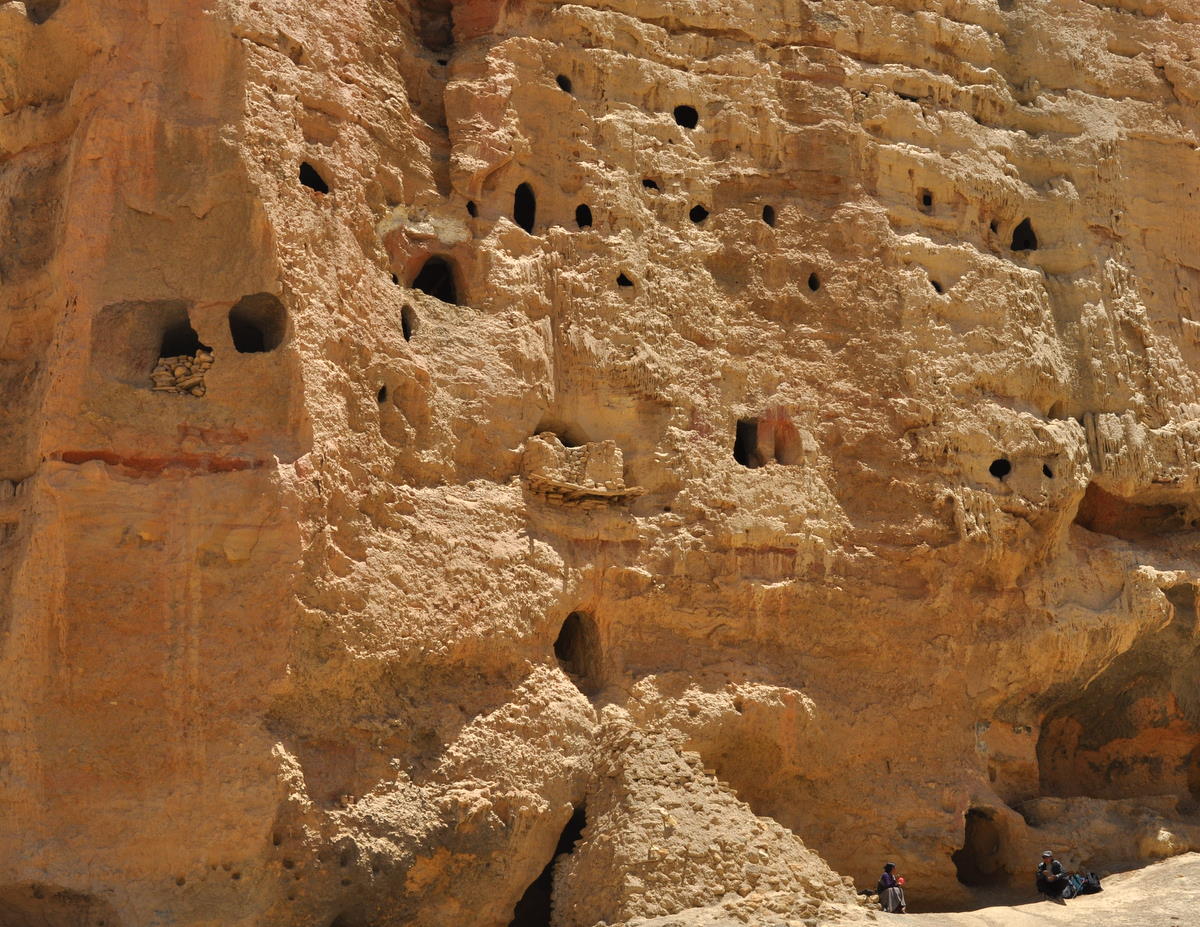
The sandstone cliffs in this area were dramatically different from the Himalayan mountains to the south. Natural and manmade caves have provided shelter since prehistoric times.


Lunch was at another walled village overlooking the river. Another male fertility figure stood at the north entrance. Water was plentiful, as the village had diverted a stream to feed the town and its irrigated fields.


We ended the day at Chele, a small village at the head of the valley. Here the river comes out of a narrow slot canyon markedly different from the floodplain below. The canyon is narrow enough that no trail can go through, so we will spend the next few days climbing over a ridge on its west side.

Day 4 – May 6 – Samar


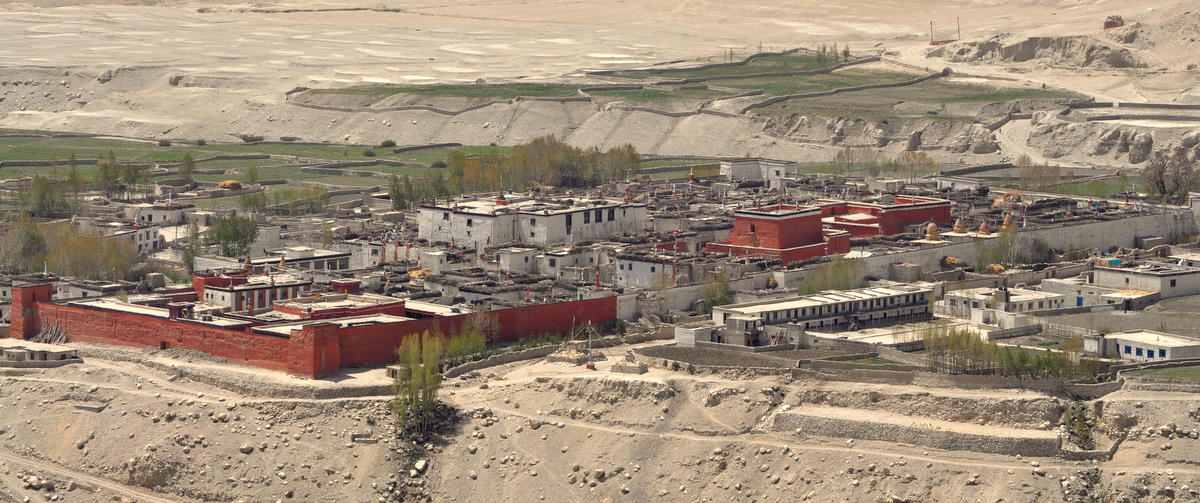
This was the first real climb, going up a beautiful trail on the side of a lateral mountain. At times the trail was carved right into the sandstone. A compact village faced us across the valley.
Although we thought we were pretty well acclimatized after two months at 2000 meters elevation in Kunming, the elevation gain up above 3100 meters proved too much for Marcia. She was feeling a little nauseous even at breakfast and it got worse as she climbed, with diarrhea in addition. We weren't sure whether it was altitude or an intestinal bug, so we treated for both.

Our original plan was to climb to a teahouse at 3900 meters, but given Marcia's condition, we decided to stop at our lunch place Samar, a three-yak village at 3600 meters. Marcia slept all afternoon and felt a lot better in the evening as long as she didn't exert herself.

While Marcia slept, I read a book and walked around the village. A two-year-old boy on his grandmother's back looked at me cautiously as we passed. Village children often don't know what to make of a tall man with fair skin and a beard. But this time, once he had reached a safe distance, the boy waved and blew me a kiss.

Day 5 – May 7 – Four passes to Ghami

Marcia was feeling better but still not up to the 7-hour day that would be required to get back on schedule. I had our guide inquire about the cost of a horse, and it was only US$30, plus $3 for the horse man. It says something about the standard of living when a horse costs ten times as much as a human. In any case, we proceeded with Marcia atop a very gentle steed named Siddha, the rest of us walking.


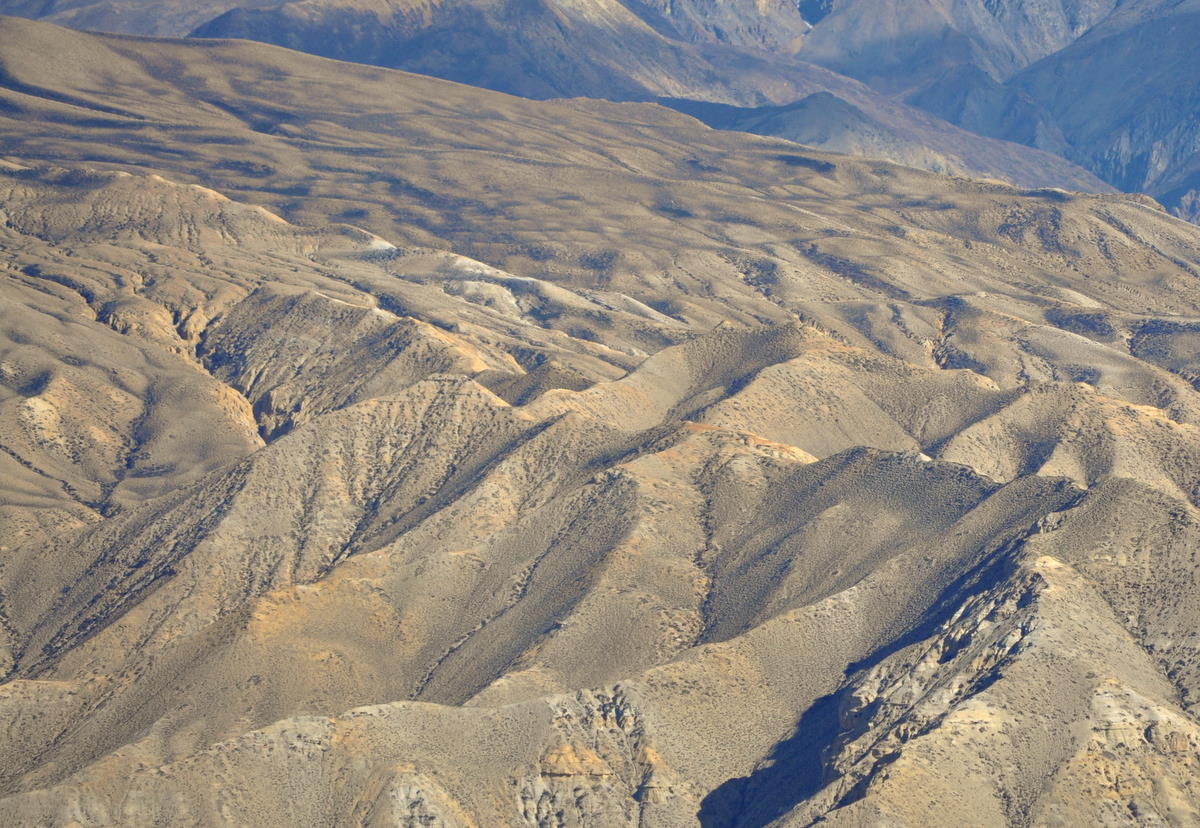
This was indeed a long day, crossing four low passes and considerable distance. Traveling south-north in Mustang is like crossing the ribs of a comb. Nothing high, but the series of passes and ravines is quite tiring.

Along the way were a number of small teahouses and villages. Views changed rapidly as every hill seemed to have a different color or texture. The weather was mostly cloudy with a few drops of rain, fresh snow in higher elevations. We did catch a glimpse from the pass of the very peak of Annapurna I.


Day 6 – May 8 – Ghar Gumba to Tsarang

There were two routes to Tsarang, our next overnight stop. Marcia was still not feeling strong, so she went with our cook on the easier one over a low pass. I went with our guide Kinna on the scenic route over a higher pass visiting a famous monastery named Ghar Gumba.

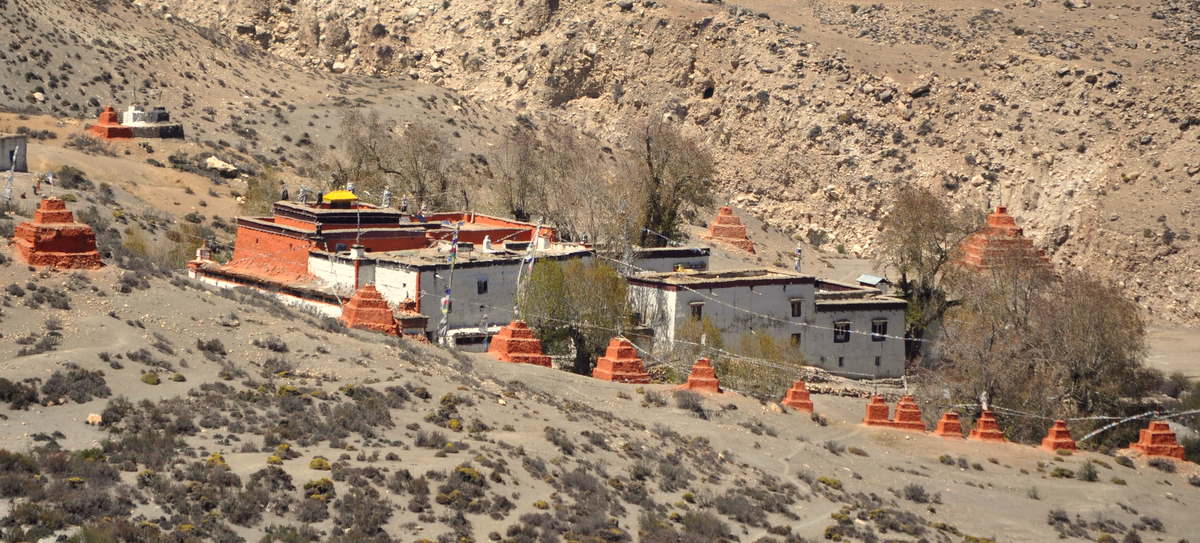
Ghar Gumba is very old, possibly the oldest Tibetan monastery in the world. The story goes that people were trying to build Samye, the first monastery in Tibet, but a demon destroyed their work every night. They sent for a famous lama, who did battle with the demon across much of Tibet. Finally he told the people that the demon could not be defeated until they first built a monastery here at Ghar Gumba. They did so and the lama killed the demon, allowing them to proceed with Samye and then other monasteries in Tibet.

Along the trail we passed several other remnants of the mythical demon. Just as we were leaving Ghami in the morning, we went along a the longest mani wall in Nepal, possibly the world. A mani wall is built with holy stones usually carved with the mantra om mani padme om. You walk respectfully to its left. In this case the wall was several hundred meters long, said to be the dead demon's intestines.


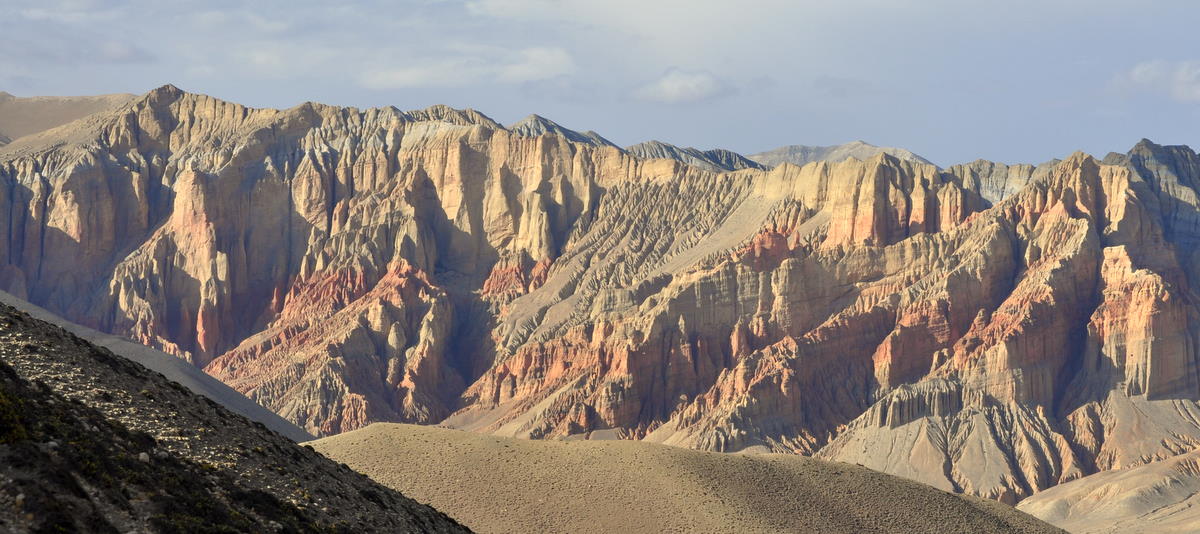
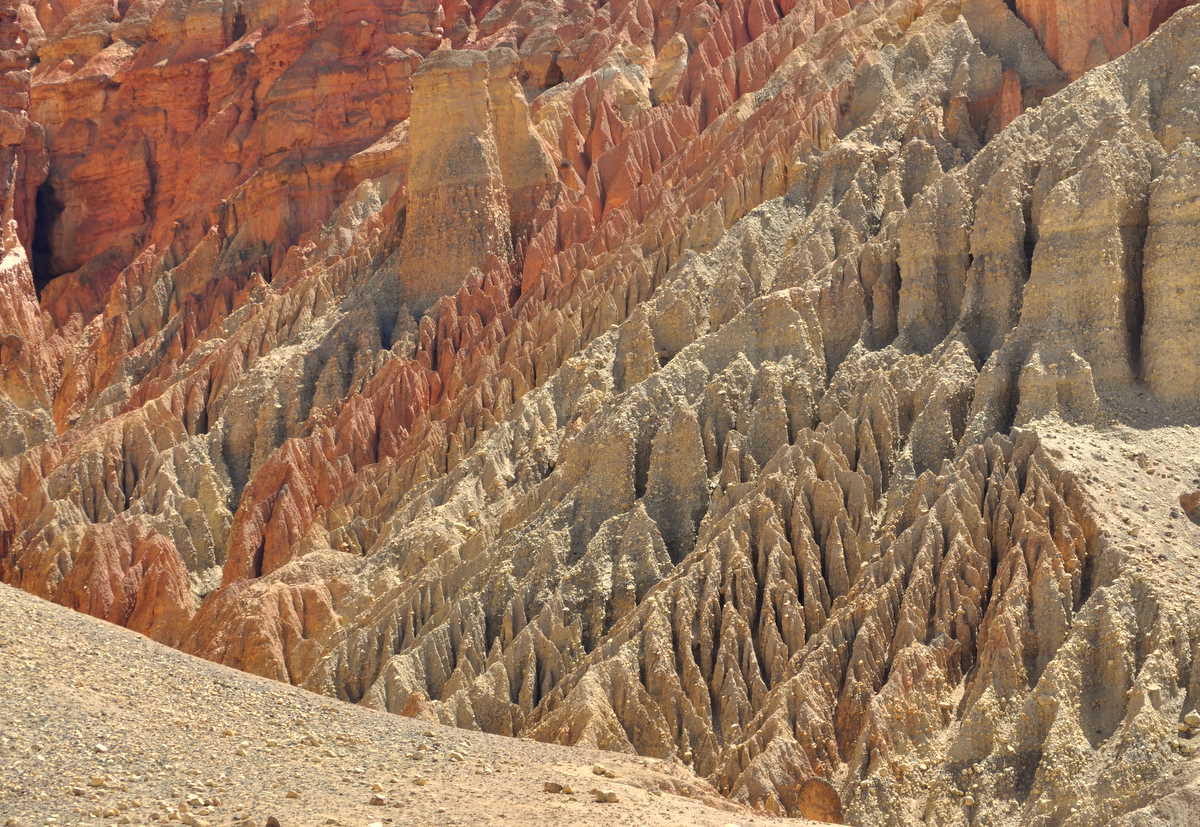
We spent the next several hours climbing alongside spectacular reddish cliffs unlike anything we'd seen elsewhere in Nepal. The “hoodoos” of Utah's Bryce Canyon are the closest analogues I could think of, but these were larger and more varied. The story goes that these cliffs owe their red color to the demon's blood, which it dropped while dying from the lama's blows.

We climbed up through the hoodoos to a viewpoint where we had lunch. From there we had views of the Himalayan peaks to the south, with the great north face of Annapurna I towering over the rest. From most places to the north, the view of Annapurna I is blocked by what Maurice Herzog called la Grande Barrière, a 6500-meter knife ridge that no one would ever want to climb over. But we were far enough away that the whole top of the mountain was visible over the barrier.

Kinna had told me that the pass was at the top of the hoodoos and that it was flat from there on. I am learning that a Sherpa defines “flat” as anything less than a 10% slope. In this case we had another 100 meters to climb to the real pass.


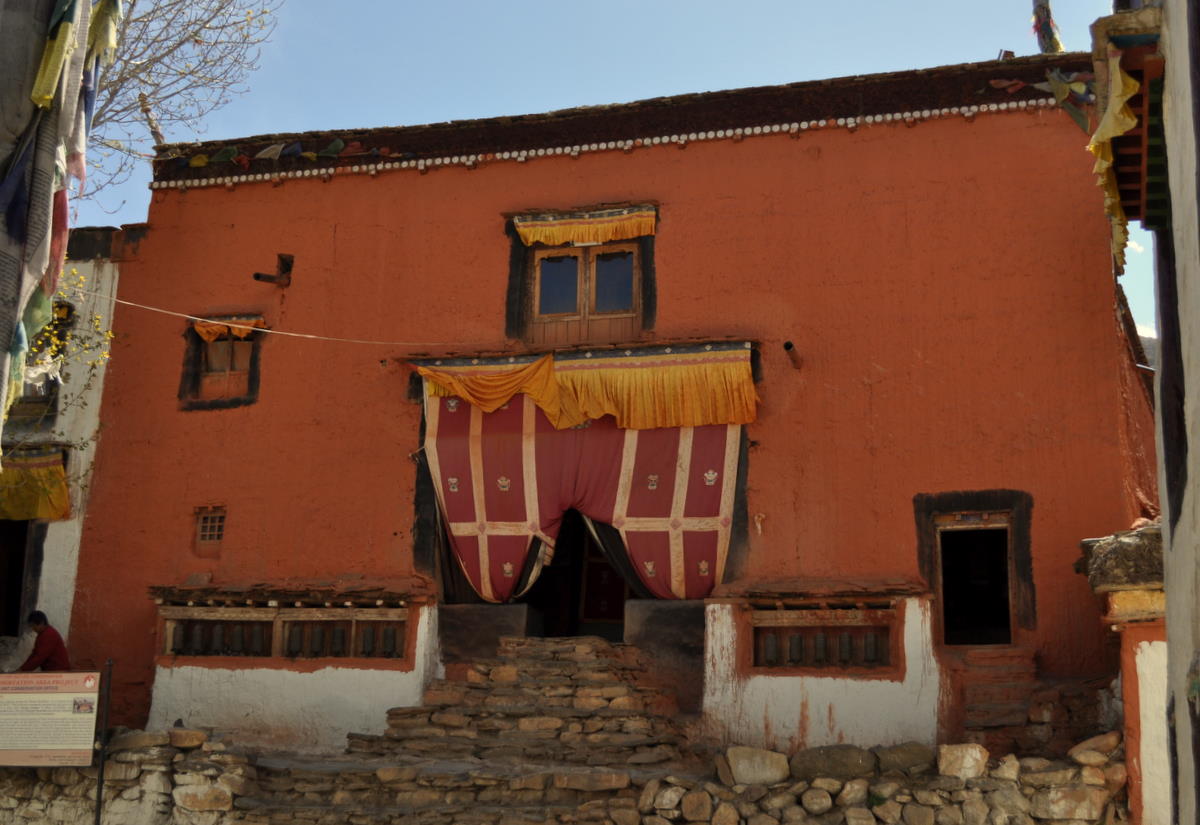
The gompa was small but interesting. Some of the statues had clearly been replaced. One gold Buddha looked might have been mass-produced in China. But the main image of Guru Rimpoche was clearly of great antiquity. About a dozen pilgrims, mostly women, had made it this far up the hill to do their prostrations. The resident monk blessed me by putting holy oil on my head, which was already greasy enough.

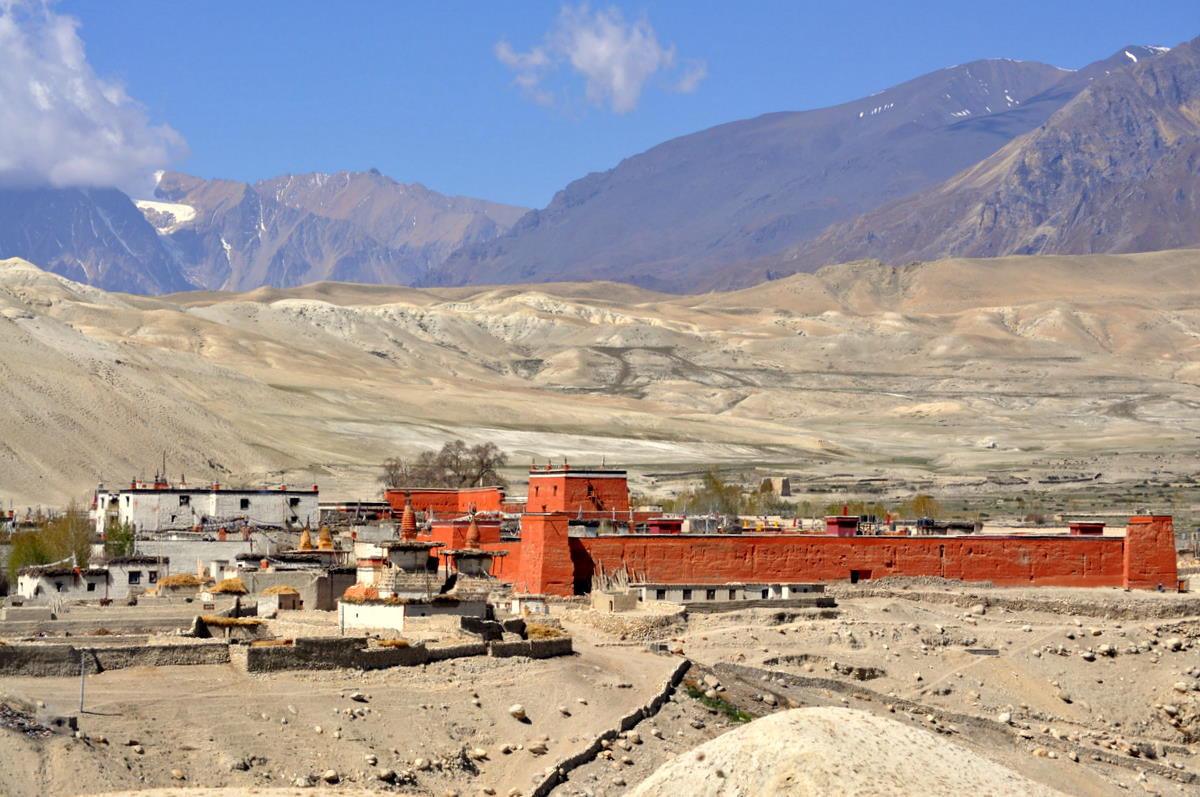
We spent the rest of the afternoon walking down the long valley to Tsarang, another monastery town where the King of Mustang has a second palace that seems to be gradually tumbling into ruin. The king obviously prefers to spend his winters in the milder climate of Kathmandu.

There were more great views of Annapurna I just before sunset from just above the village.

Day 7 – May 9 – Tsarang to Lo Manthang

The last day of hiking northward was along the dirt road that now extends from Tibet to two days south of Lo Manthang. In a few years the road will reach Jomsom, and constant traffic will break the tranquility of Upper Mustang. But for now traffic is limited to a couple trucks and tractors each day.

Fortunately, one of these trucks came along just as we finished crossing the first stream canyon. Marcia was still feeling ill from altitude, so we flagged down the truck and got her seated with the driver and two local girls in the cab. Our guide Kinna went along with the other men on top of the load.


I opted to keep walking. The road was generally flat and easy, though at the end it climbed over the 4000-meter Lo Pass. The weather was beautiful, giving crystal-clear views of Annapurna I, Nilgiri, and the other mountains to the south. I even caught a glimpse of the top of Dhauligiri, though real views will have to wait until our return down the east side of the valley.


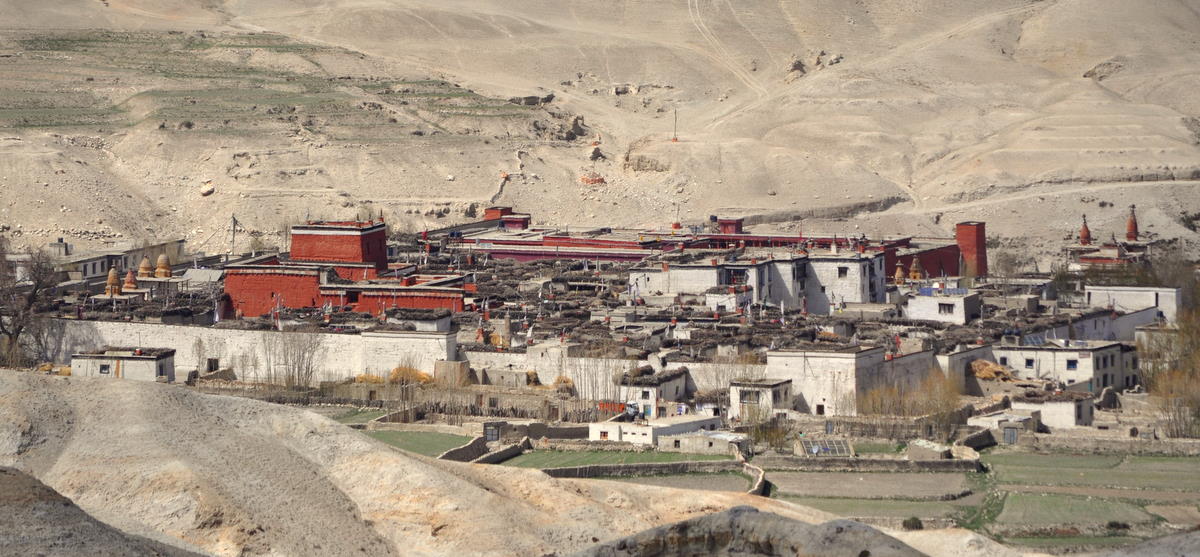
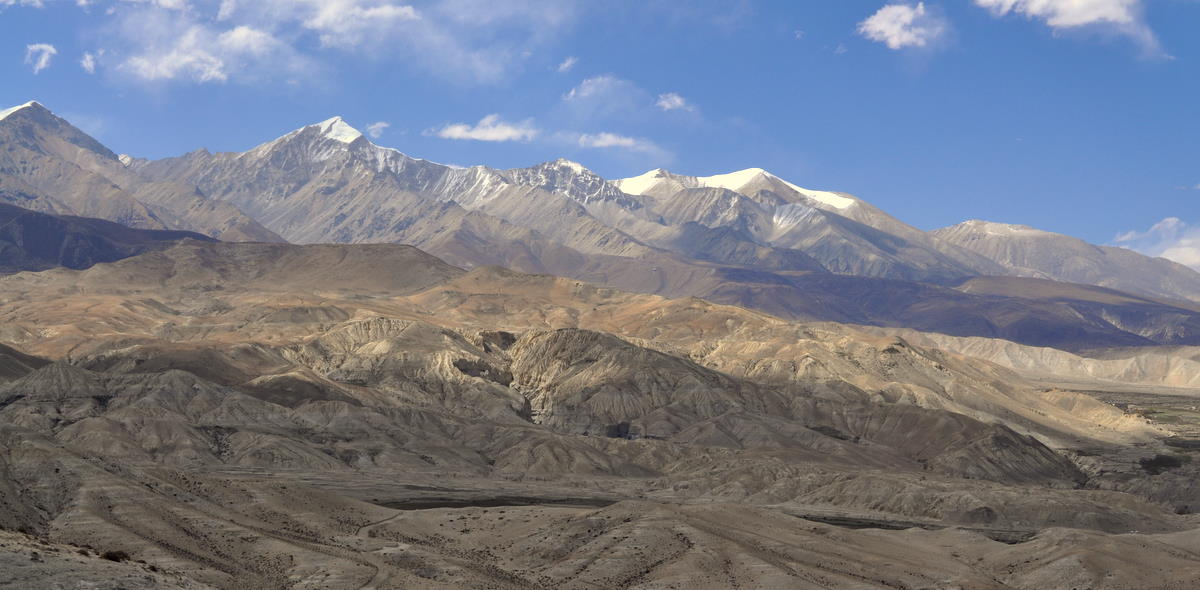
From Lo Pass, I could see the walled city of Mustang's capital Lo Manthang and the irrigated green fields that surrounded it. Even more impressive was the huge, multi-colored valley that stretched up to the Tibetan border, towards which the upper Kali Gandaki river continues to eat.


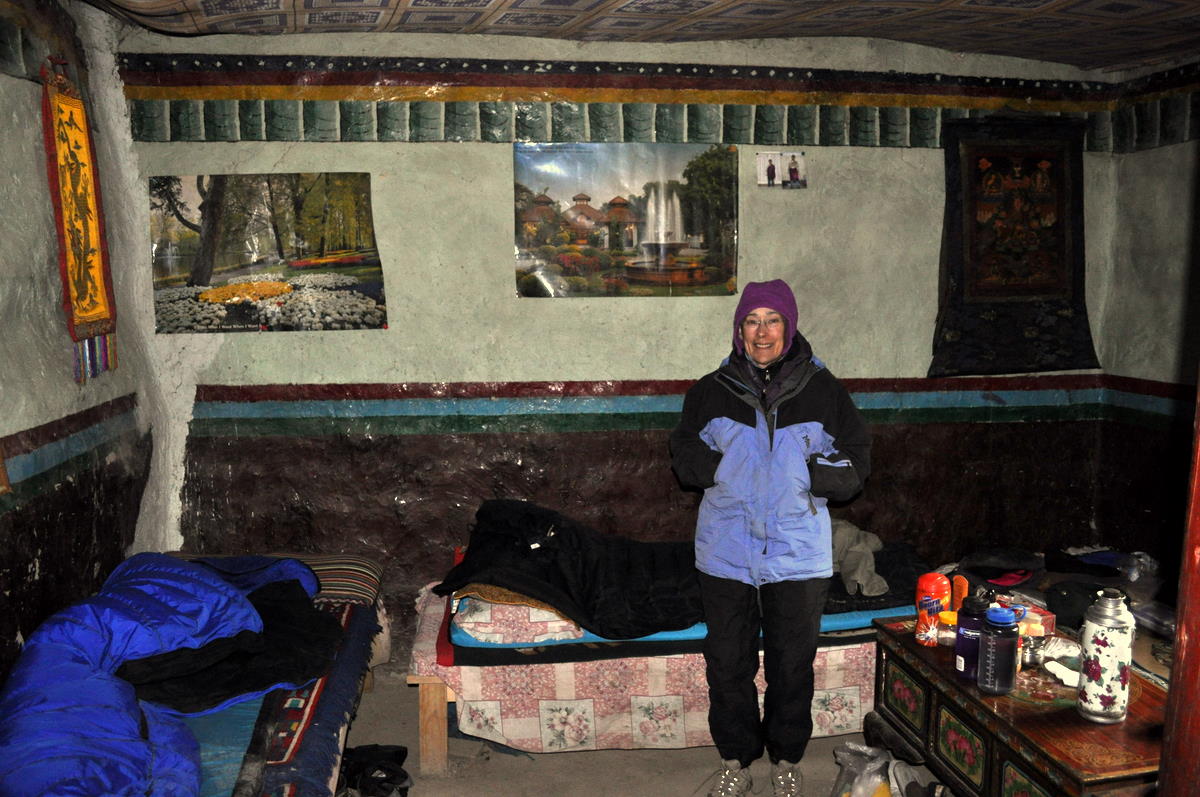
Kinna met me at the pass and showed me to our lodging. Because of the festival, all guesthouses and camping areas were full, but Kinna had arranged for us to stay in the house of one of his friends. The house was at the southwest corner of the inner city, putting us right in the center of the action. We slept in the house gompa.

Day 8 – May 10 – Tiji Festival first day

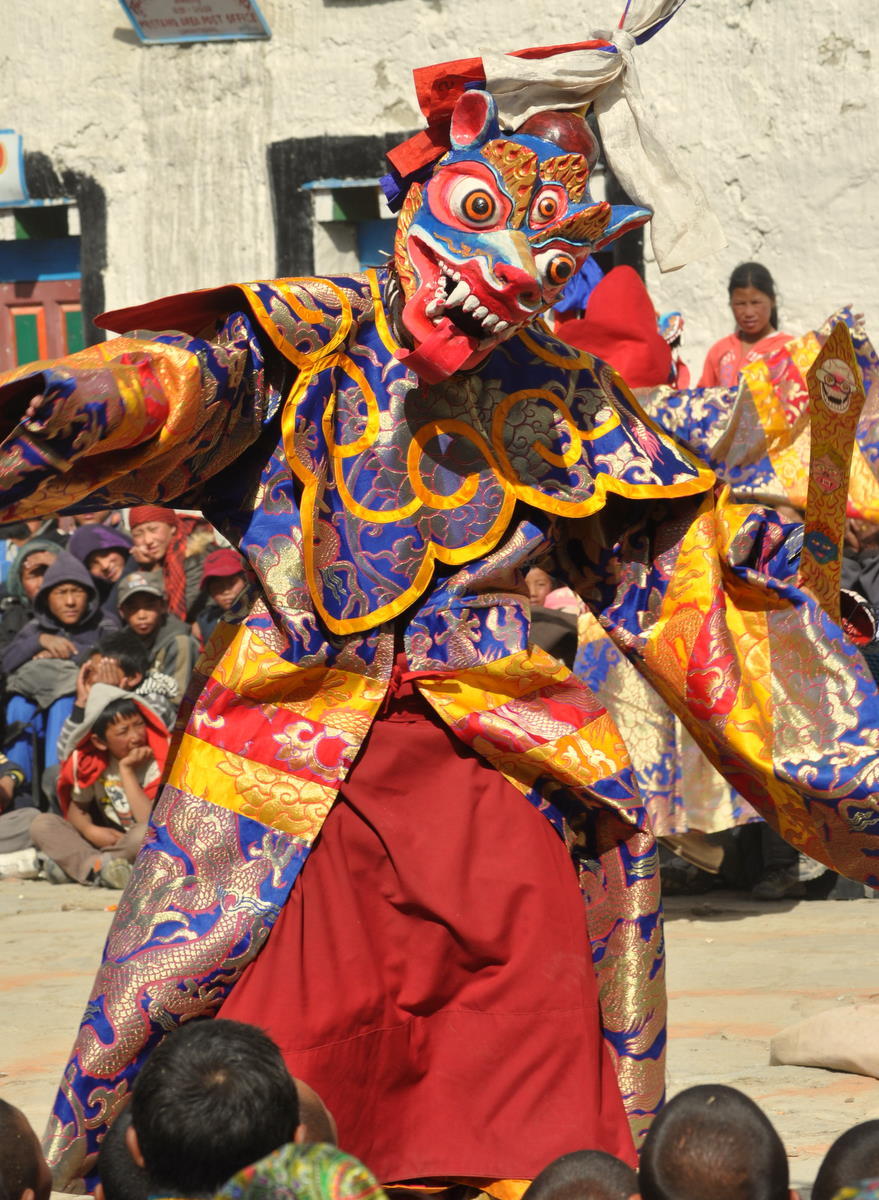
We timed our trip to attend the three-day Tiji (or Tenchi) Festival in Lo Manthang. This is a traditional Tibetan Buddhist festival that is devoted to removing evil obstacles, thereby ensuring everything from summer rains to world peace. It is a commemoration of the triumph of Padmanasvara (Guru Rimpoche) over the forces of evil.


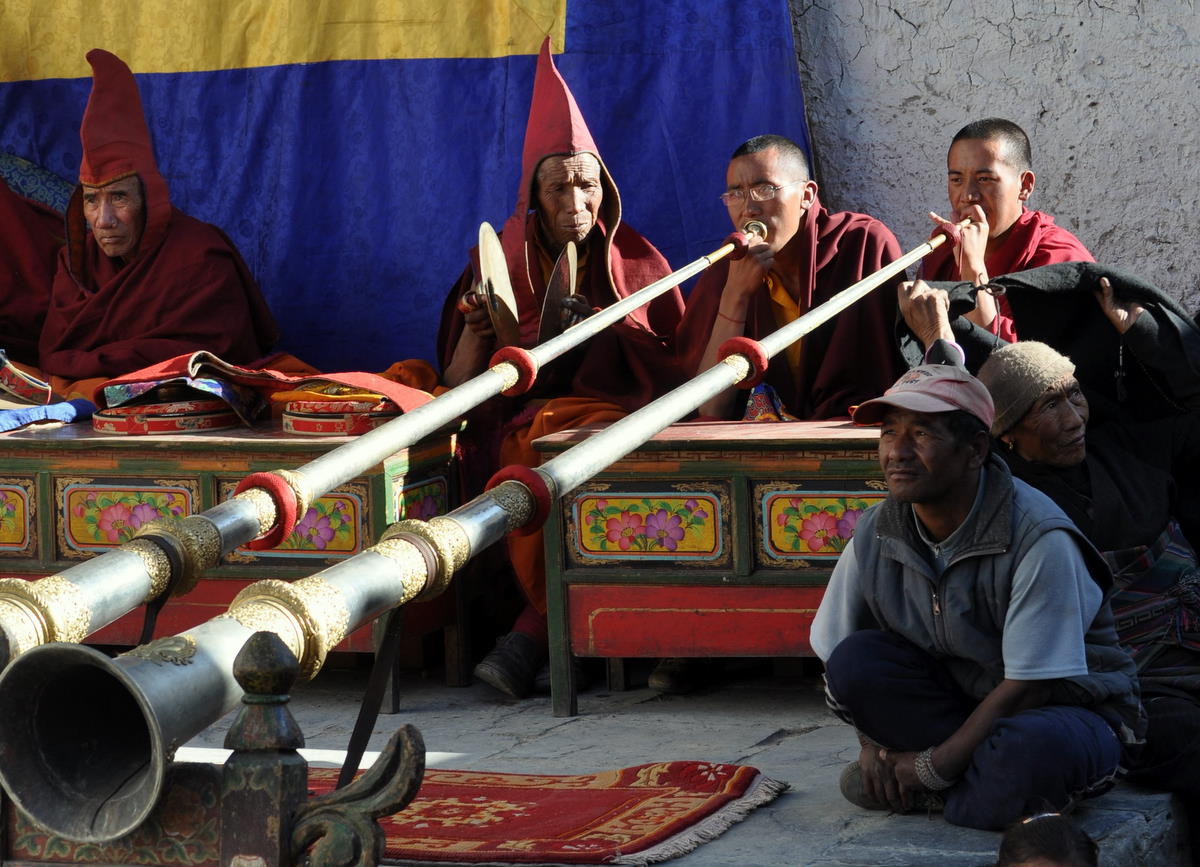
Even before the festival, the monks of Lo Manthang's four monasteries were busy performing pujas to the accompaniment of Tibetan bass trumpets. With a length and bore similar to the bass trombone I used to play, they are typically played on the pedal tone (fundamental) and second and third harmonics. The monks accompany their chanting with mudras (formulaic hand gestures) that can also be seen in Buddhist art works.

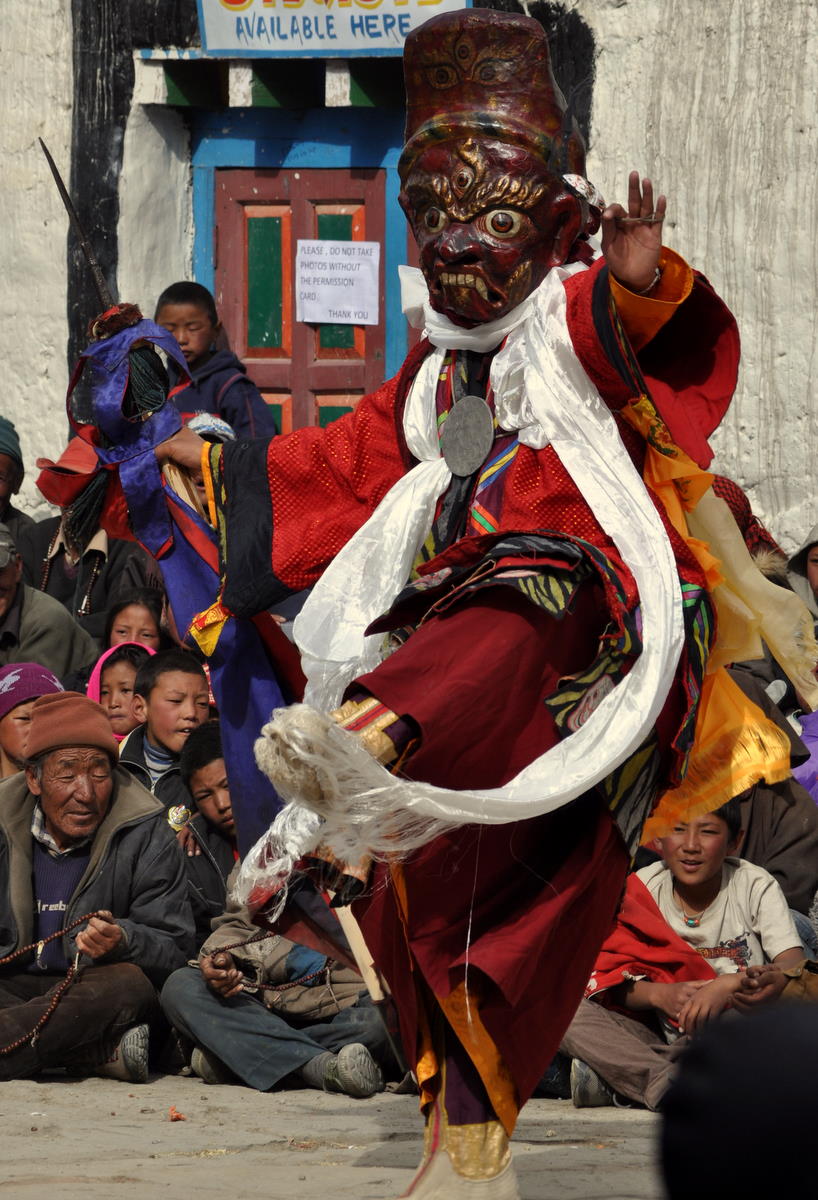
The dances are a reenactment of the myth of Dorje Shunu, who was reborn to make a series of dances to defeat the forces of evil. The lead monk dancer or tsowo plays the part of Dorje Shunu to do various ritual acts of purification and exorcism. The tsowo prepares for the ceremony with three months of solitary meditation.

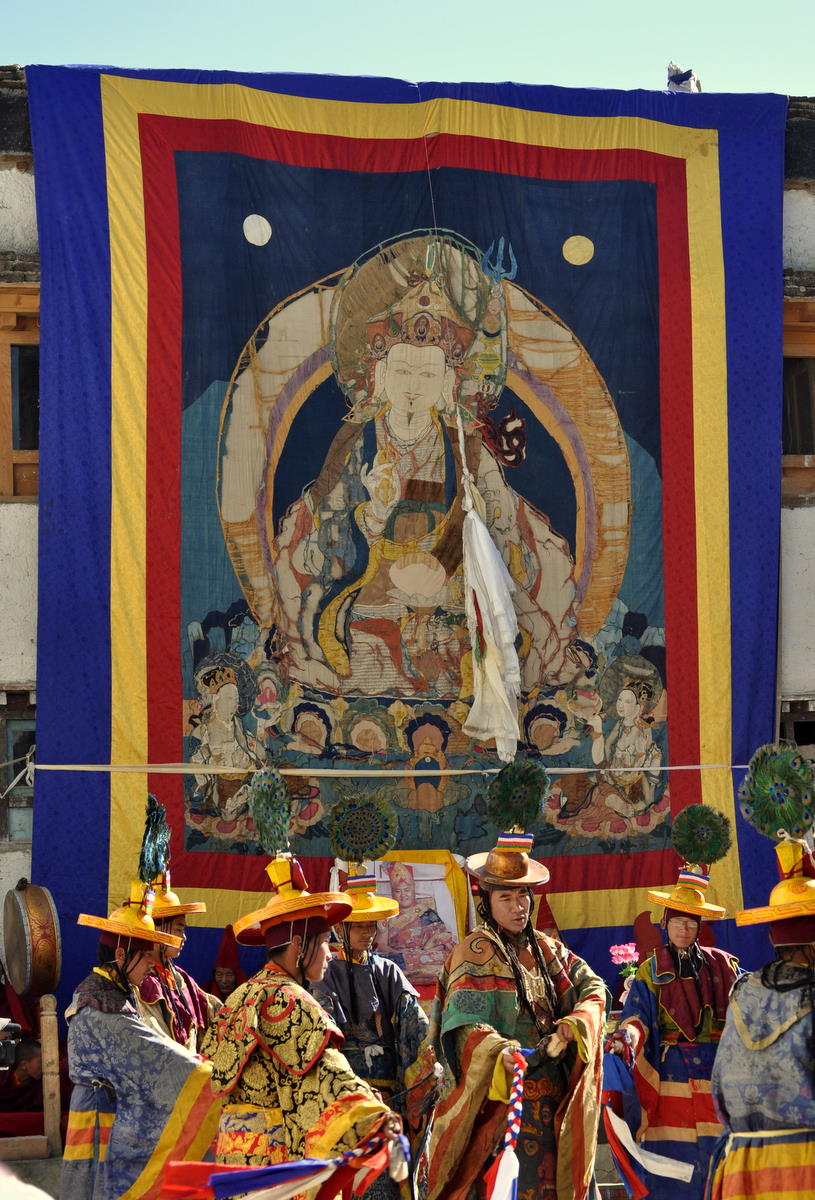
The dancing started in the mid-afternoon and continued until dark. This first day's dancing was relatively simple, with mostly slow movements in a circle representing a mandala around the tsowo. The monks wore brightly colored robes but no masks on this first day.


The backdrop was an embroidered silk thangka of Padmasambhava unfurled from a three-story building on the end of the square. The thangka used on the first day is 400 years old.

Day 9 – May 11 – Tiji Festival second day

In the morning, monks were back in the monastery performing pujas, which continue into the afternoon's dancing.

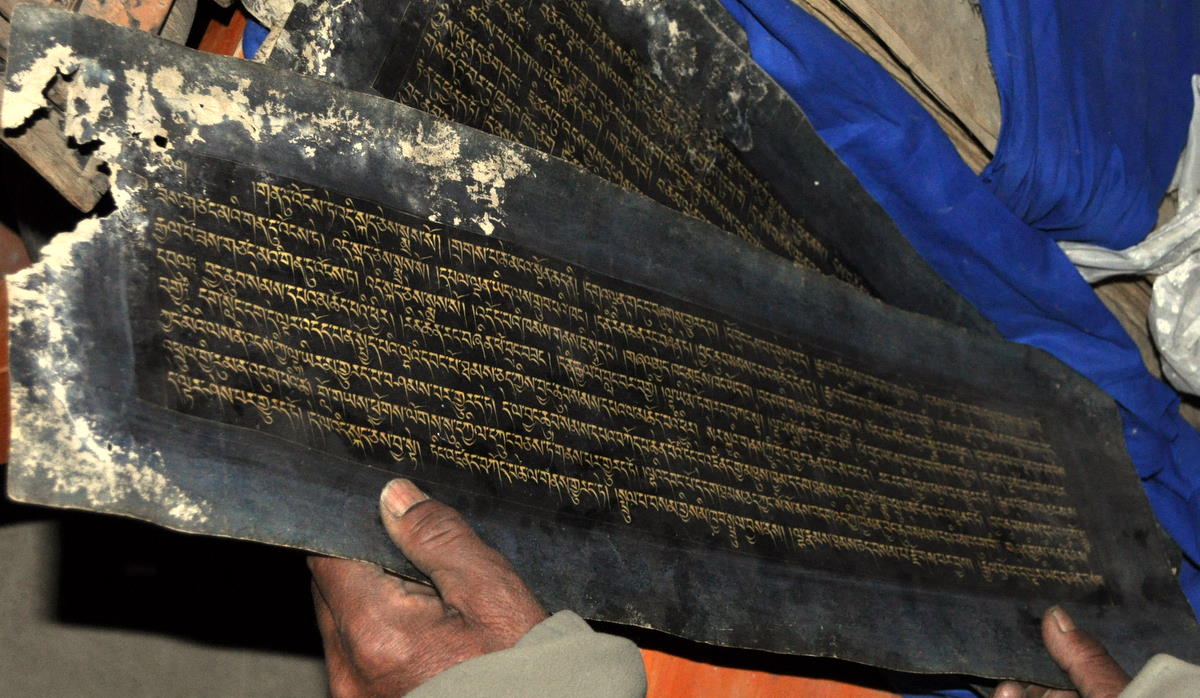
We took the opportunity to visit one of the monasteries' museums, a dark room that held a number of historic treasures including manuscripts written in gold on bamboo leaves. A number of these had been recovered from cave dwellings in other parts of the valley.


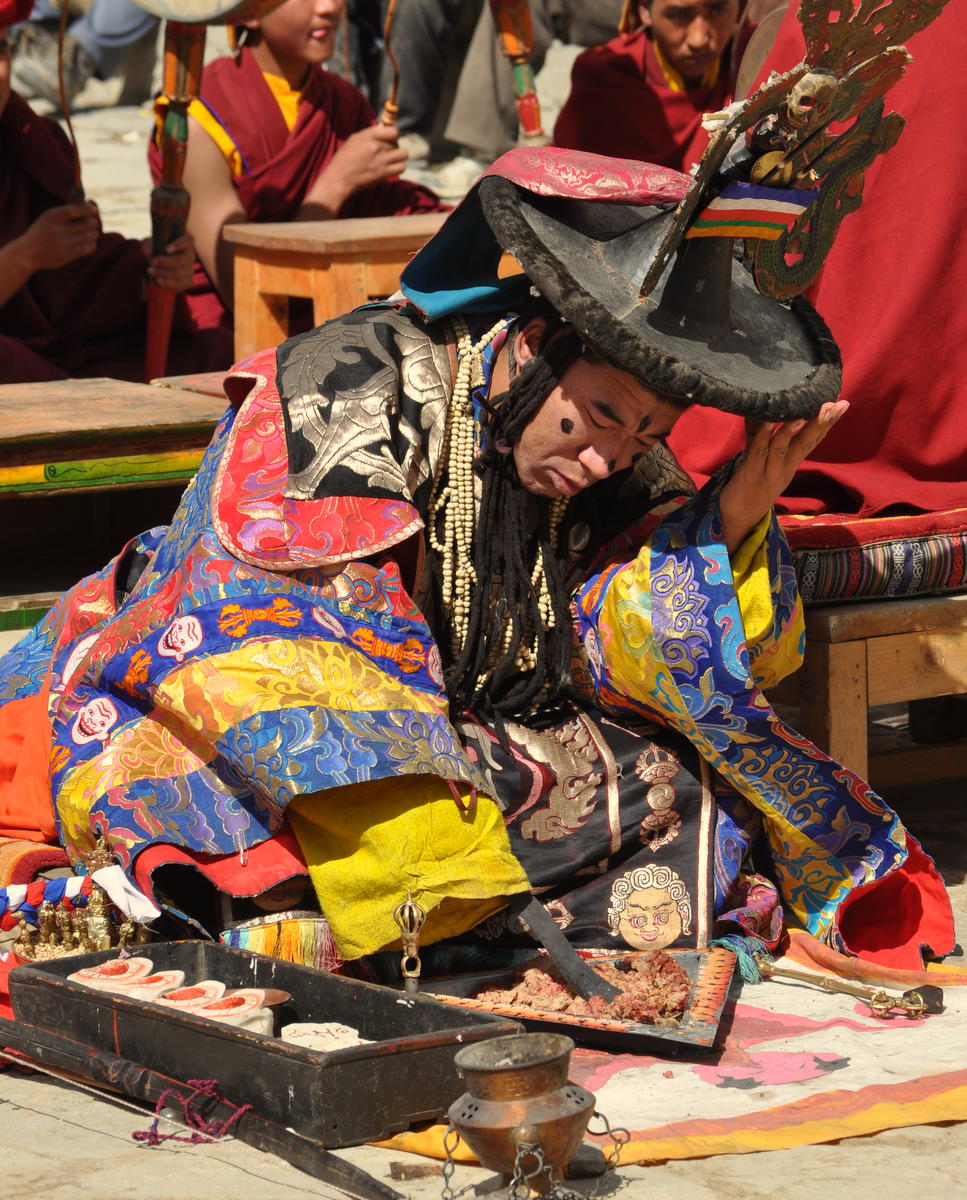
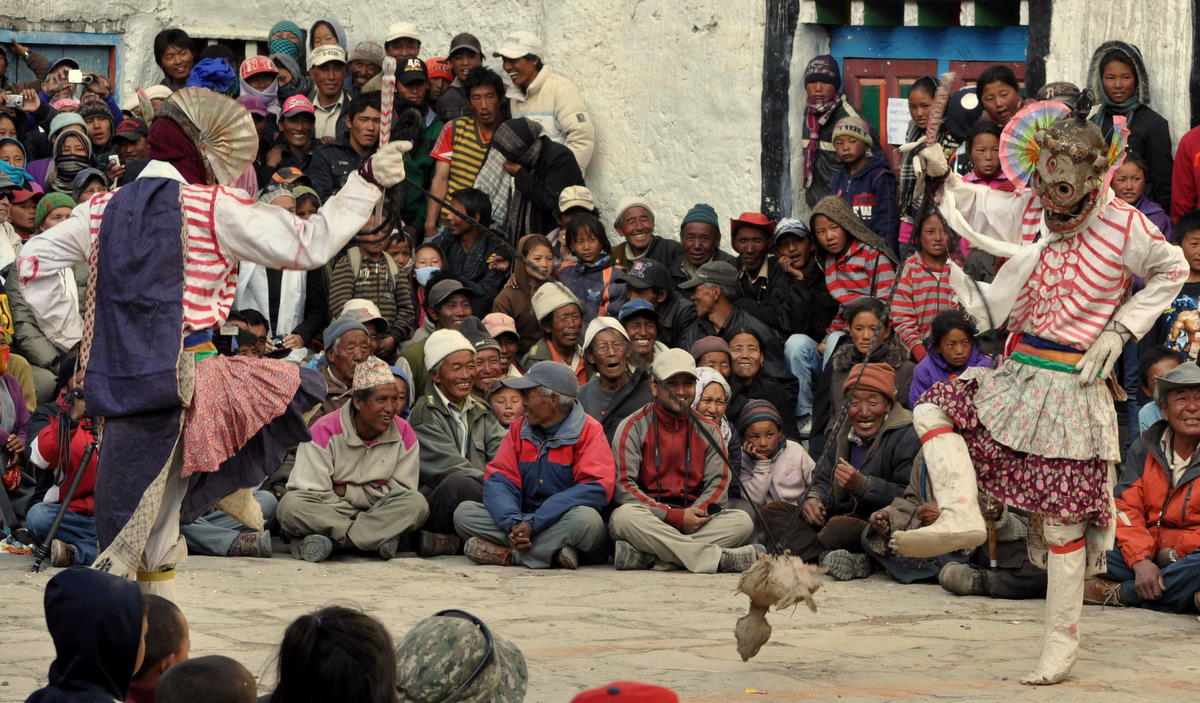
The second afternoon's dancing was more dramatic than the first. The monk dancers wore elaborate masks and costumes and acted out roles in the action, which was like an exorcism of the evil spirits that might stand in the way of crops, world peace and other good things. The evil spirits were led to gather in a small effigy, which was then purged first by dancers in skeleton costumes and then killed by the tsowo performing delicate surgery with ceremonial knives.


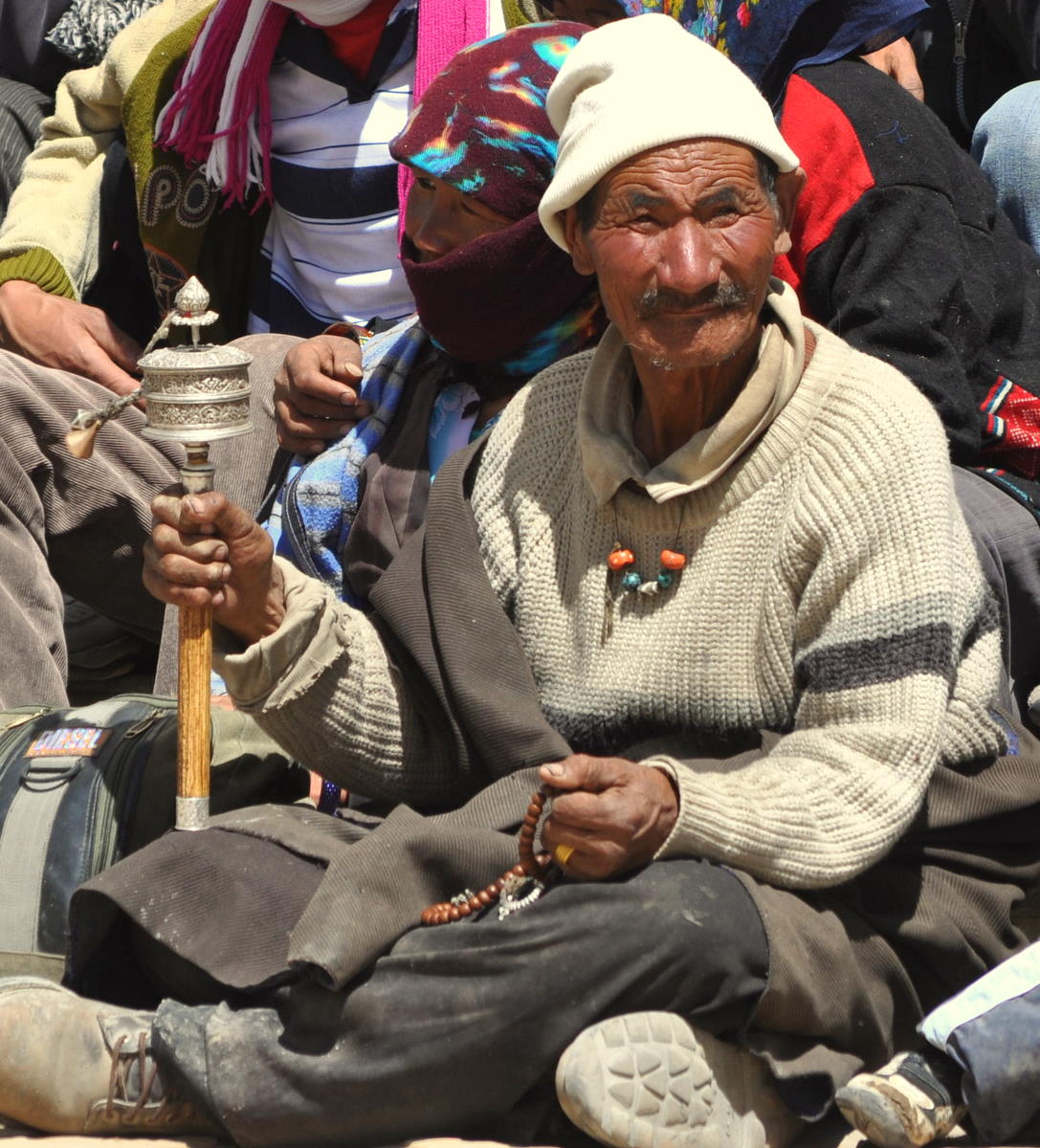
Equally interesting was the crowd, which was predominantly local people of all ages. People were very involved, sometimes calling out at key times. An old man was selected from the crowd to hold the effigy in the dance with the skeletons.


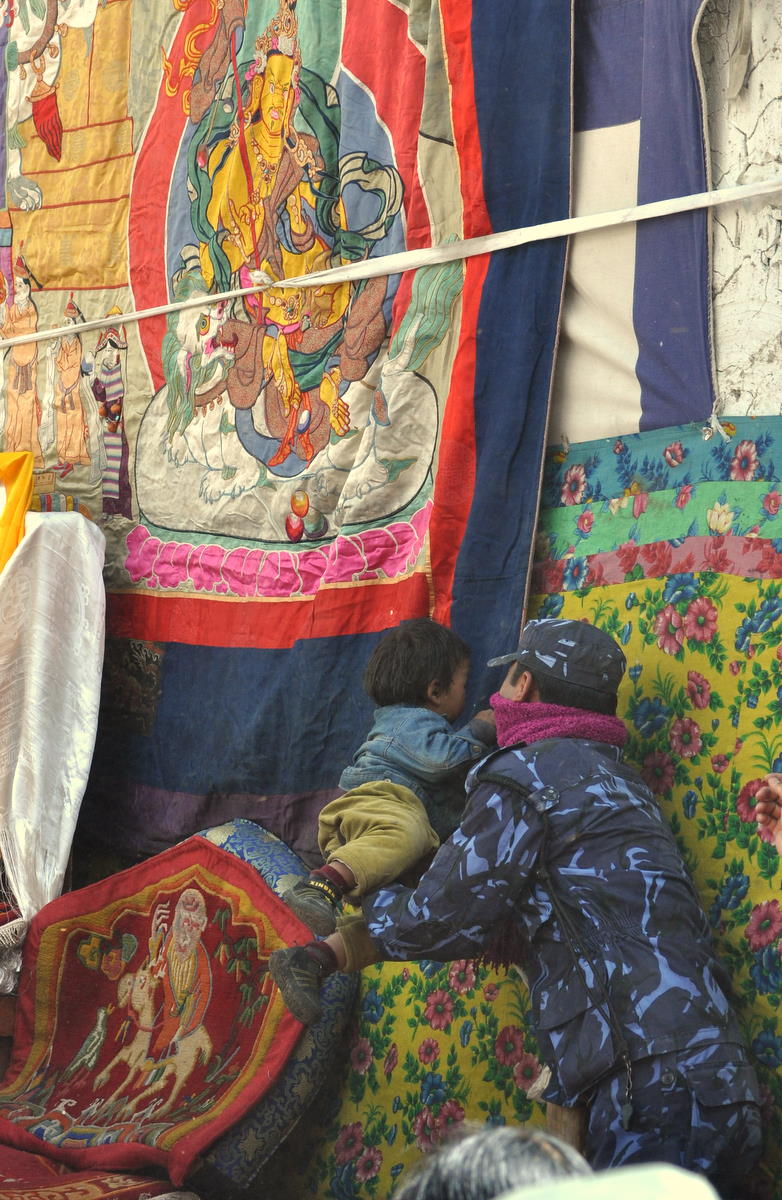
On this second day, they used a newer thangka backdrop representing Padmasambhava in eight of his different forms. A half hour before the dance, a man brought the wrapped-up thangka out of the king's palace to the sound of horns and cymbals. Believing it to have magical properties, the crowd reached to touch the precious cloth.


The action continued after the thanka was unfurled. A stream of people came across the podium to give their hats and in some cases their babies to a Nepali police officer in camouflage fatigues, who touched them to the thanka and returned them. Nowhere but Nepal would a member of the military be so integrally involved in this traditional spiritual ritual.

At the end of the afternoon, police and volunteers held out the thanka so that the whole crowd could file under it for another blessing.

After dinner, I went back for a few minutes to see the school dance performances. I had unfortunately missed the previous night, when the more traditional folk dances were presented. This night featured mostly adaptations of popular Indian songs and dances. Even so, it was interesting to see how a small town puts together a show of amateur performances of its young people. The crowd was larger than for the monk's dance, almost filling the courtyard.

Day 10 – May 12 – Tiji festival final day

There were no events in the morning other than the continuing pujas in the monastery, so we took a walk around the walls of the town.

After lunch we staked out our place at the festival. The crowd was smaller than for the previous two days, which seemed odd since this day's activities were at least as interesting.

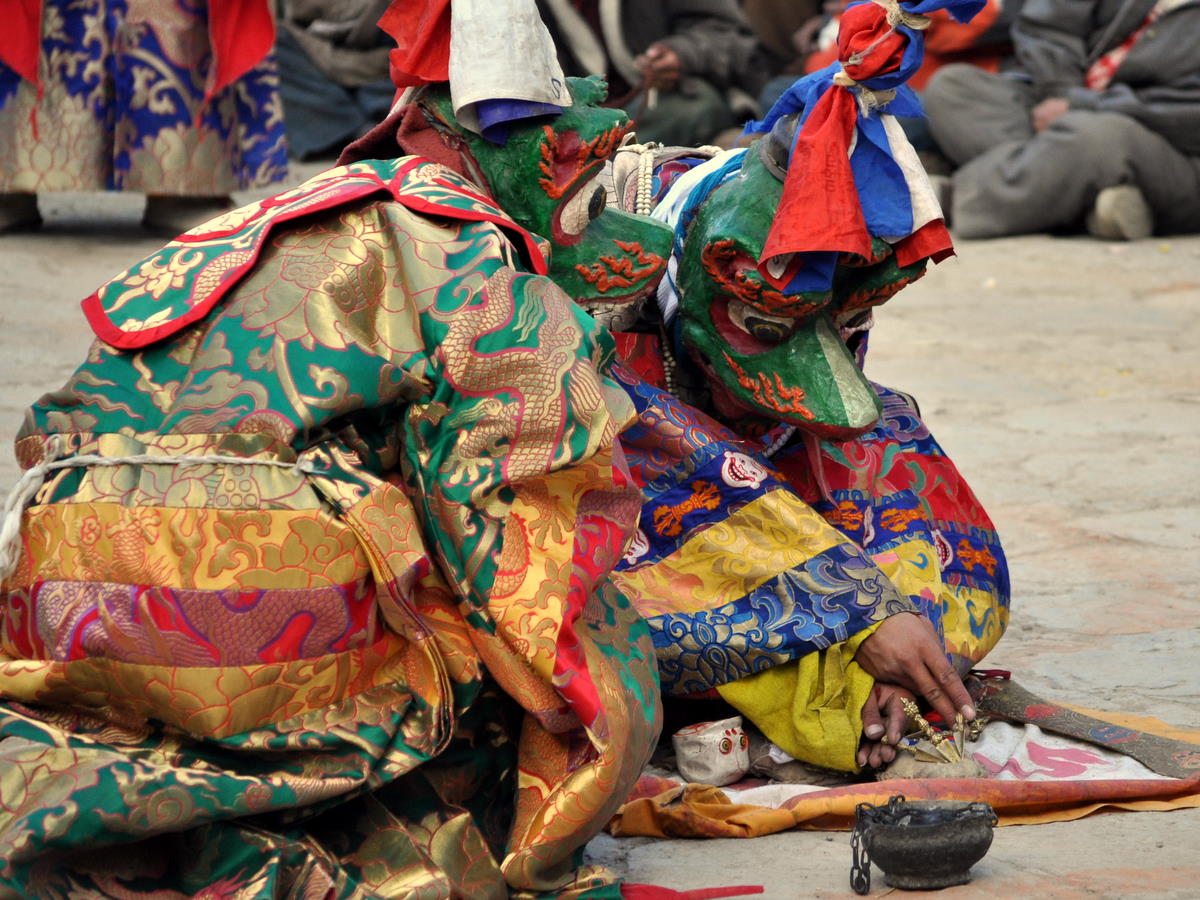
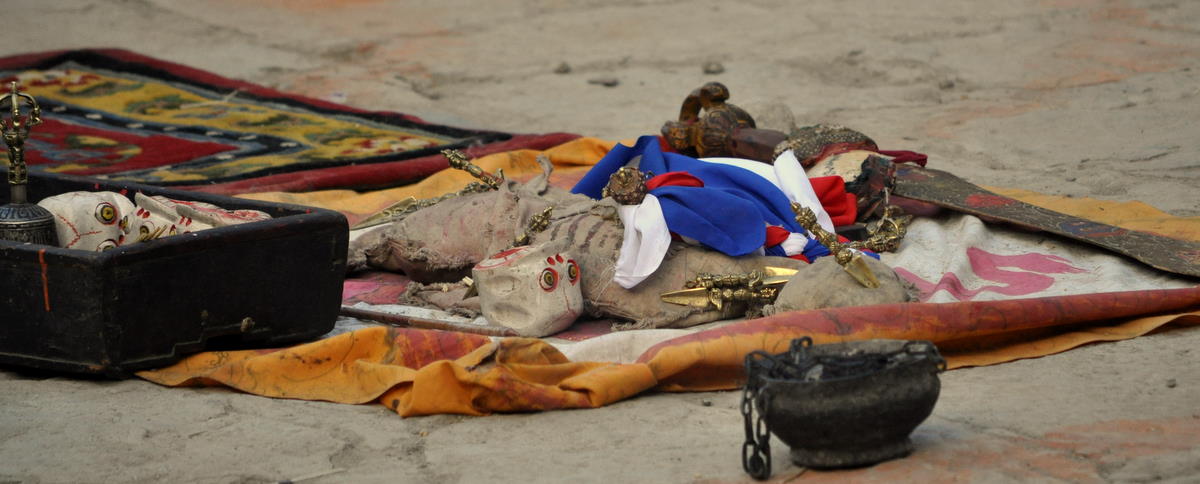
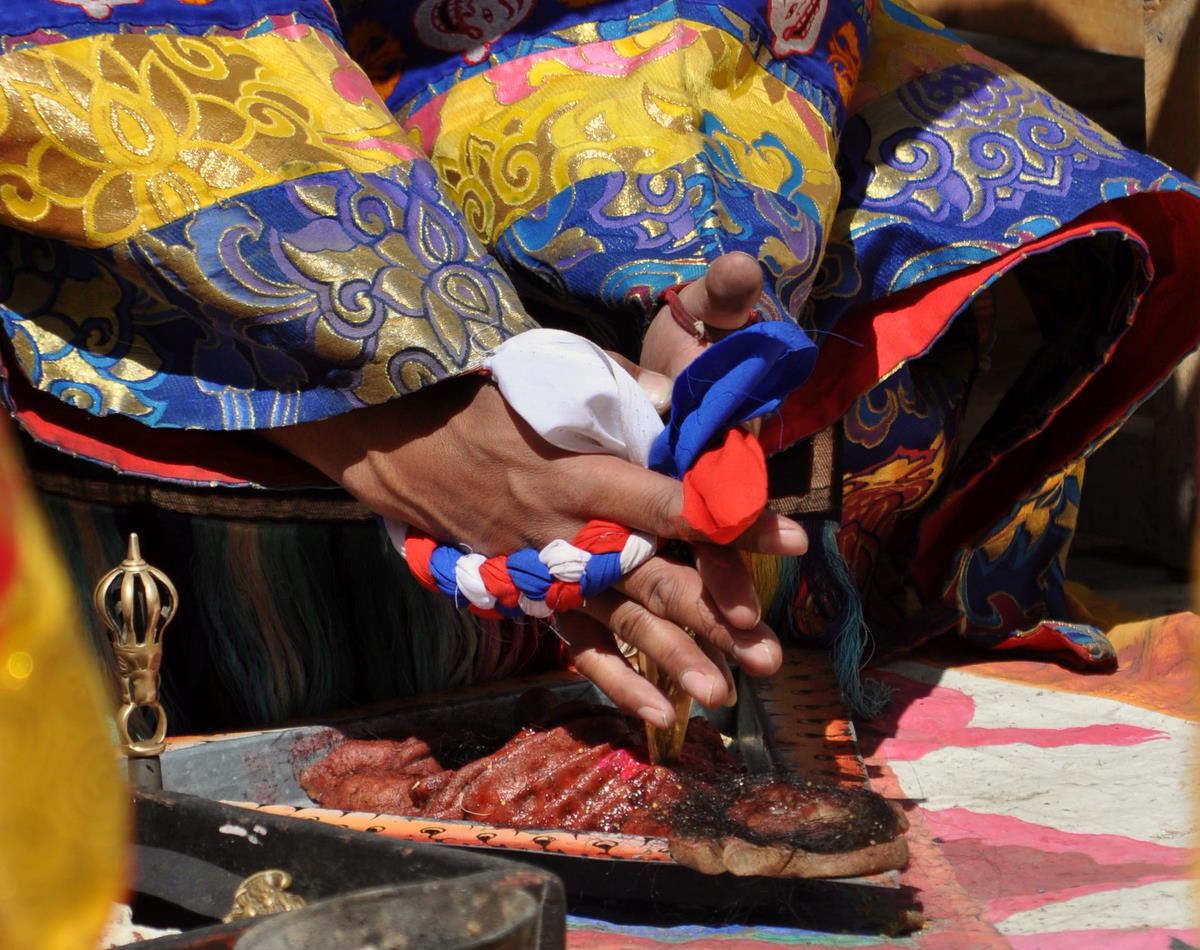
The afternoon began with a solemn puja of the monks now chanting and blowing their horns in the middle of the town plaza. The tsowo, among the chanting red-hat monks, performed ritual offerings and then another exorcism of an effigy of the demon. This time, however, he stuck his ritual daggers and knives into a piece of goat meat that had been sprinkled with red powder. Three masked dancers assisted him. By the end of the ceremony he had cut the meat into small slices, neutralizing the evil it embodied.


For the conclusion of the ceremony and the festival, we all moved outside the city walls. Throughout the pujas, the monks had been preparing five tormas, small ritual piles of tsampa (barley cakes) covered with sacred red power. The tsowa now needed to throw them ceremonially on the ground in an auspicious direction that would ensure rain for crops and the other goals of the festival.


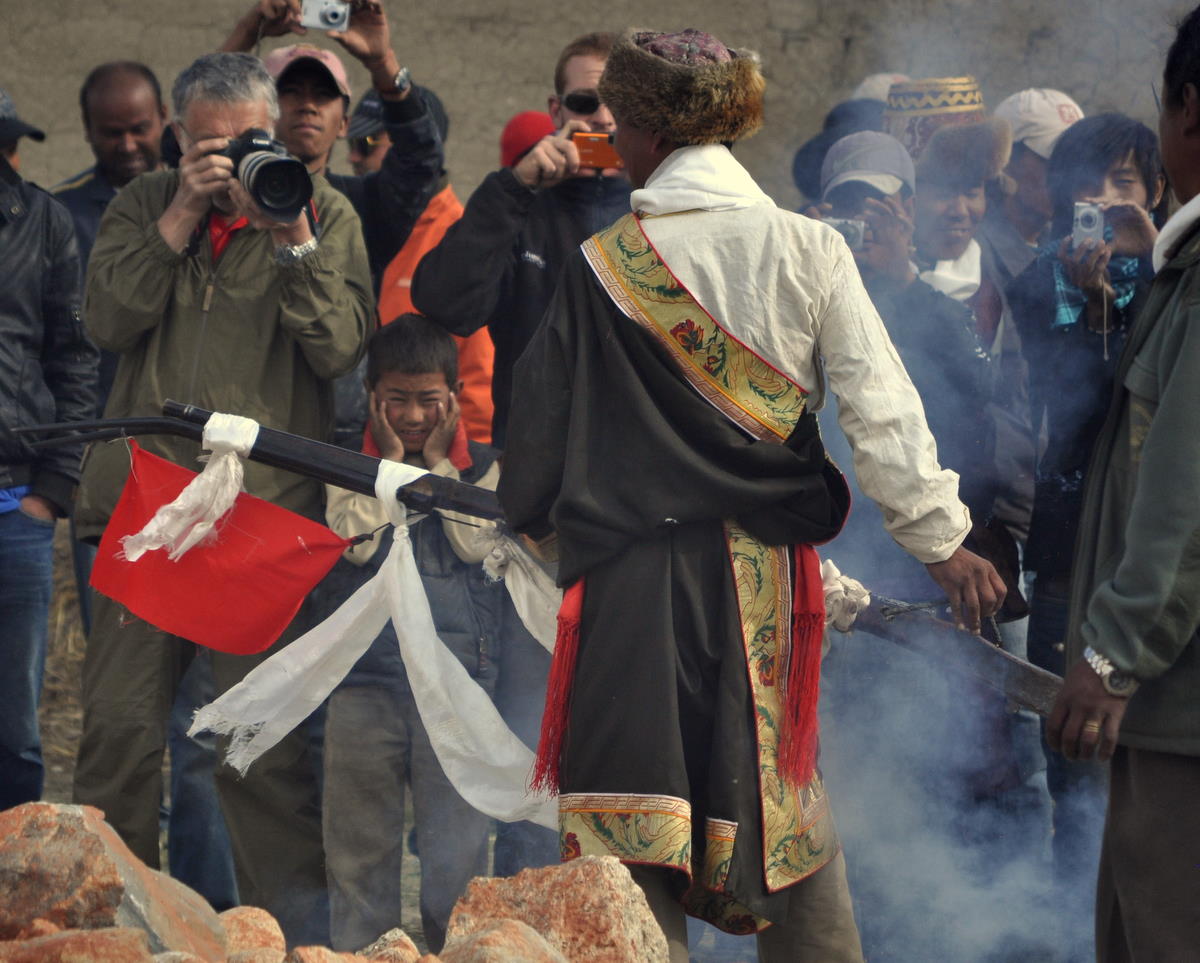
By tradition, the king chooses the direction by firing a gun. This time, the 77-year-old king delegated the task to his nephew, the crown prince. Helping him were bodyguards and other members of the royal family, all of whom wanted to take a few shots with the medieval muzzle-loaders. All fired their muskets to the north.


Once all the royals had fired their shots, the tsowa slowly threw each of the tormas upside down on the ground in the same direction. To complete the ceremony, he covered them with an old snow leopard skin and gave a final whack. The festival was now successfully finished and everyone filed back into the town.


We then did something no other visitors could do. We joined the royal party at the king's palace. Our guide Kinna had been to Mustang over 50 times in the 20 years it has been open, and with his fluent Tibetan he had struck up friendships with most of the royal family and their bodyguards. He was therefore able to talk his way through the barriers and get us an audience with the king. (Some other groups also visited the king, but they had to wait for a non-festival day.)

The king was in his living quarters on the fourth floor of the palace (the first three seemed to be mostly storage). Since he didn't need to go out into the festival this year, he was dressed in faded Western sportswear and could have been mistaken for any local on the street. We each offered him a kata (ceremonial scarf), which he insisted on putting around our necks to bless us. At his request, we sat for ten minutes sipping an orange drink and making small talk about innocuous subjects like the weather in San Francisco (also arid but not as cold as Mustang) and then said our farewells. We also gave katas to the elderly queen and crown prince, who was in another room whooping it up with his friends. On the way out, Kinna was happy when one of his royal friends gave him a cigarette – Marlboro rather then the cheap Nepali brand.

Day 11 – May 13 – Garphu

Lo Manthang was much quieter with the festival over. Most of the foreigners had left and the locals were sleeping off their hangovers.

Being in no rush, we planned our trip so we could spend two more days exploring the valleys that stretched northward toward Tibet. Today we chose the northeast valley where the monastic village of Garphu is located.


We hired horses for the trip, even though we could have walked. I hate to admit it, but despite all my years of rough and ready tours, this was the first time I had ridden a horse. This one was easy: he was well-behaved, knew the route and rarely went faster than an easy walk. Nepali horses are smaller than American horses, so this also reduced the difficulties of mounting, dismounting, and saddle discomfort. He did, however, drop to his knees and dump me on the ground once in apparent protest over my weight.

Garphu is quite a population center, with more than a thousand people spread out over several villages. The only high school in Mustang is located here, so children from Lo Manthang either need to make the two-hour walk or live at the boarding school.

It has been a population center since prehistoric days, judging from the large number of cave dwellings in the cliffs above. We were able to visit one of these, which had five levels of rooms hollowed out of the sandstone. The 150-centimeter (5 foot) ceilings were a problem for me but probably not the local inhabitants. On the way out we bumped into the crown prince, who was also on the same excursion.


We then visited two small monasteries on the opposing hill, ate our sack lunches and returned to Lo Manthang.

In the late afternoon, I checked my email on the one satellite link in town. Good thing, because there was a question I had to answer from the travel agent in New York who was working on our visas for our planned trip to Uzbekistan in the fall. More on that in another blog entry about Delhi already posted.

Just to be sure, I resolved to call the agent when she came in to work. 9am New York time is 6:45pm in Nepal (the silly 15 minutes are a political statement to show that they are not the same as India, which in turn needs to be 30 minutes different from Pakistan).

Telephone calls can be very fustrating in Nepal. Although almost every store offers ISD (international) phones at about $1.40 per minute, they cannot always get a landline connection. This particular evening it was impossible. Finally, the man of the house came home at 8:30, an hour and a half later then he had promised, and he let me use the few remaining minutes on his cell phone. Fortunately, I was able to reach the agent and confirm everything was now ok.

Day 12 – May 14 – Namgyal

The northwest valley is much shorter and could be visited on foot in half a day.

We first climbed to two ruins overlooking Lo Manthang. The higher one had once been the king's palace but was now just a few wind-eroded walls. Good views but a lot of wind.


We next visited Namgyal monastery, one of the largest in Mustang. Built on a hill, this monastery had 500-year-old paintings blackened by as many years of soot. A monk offered us tea and snacks in the student dining hall, which we consumed quickly because the young monks were starting to file in for their lunches. Also, the weather was starting to threaten, depositing a dusting of snow on the higher peaks.


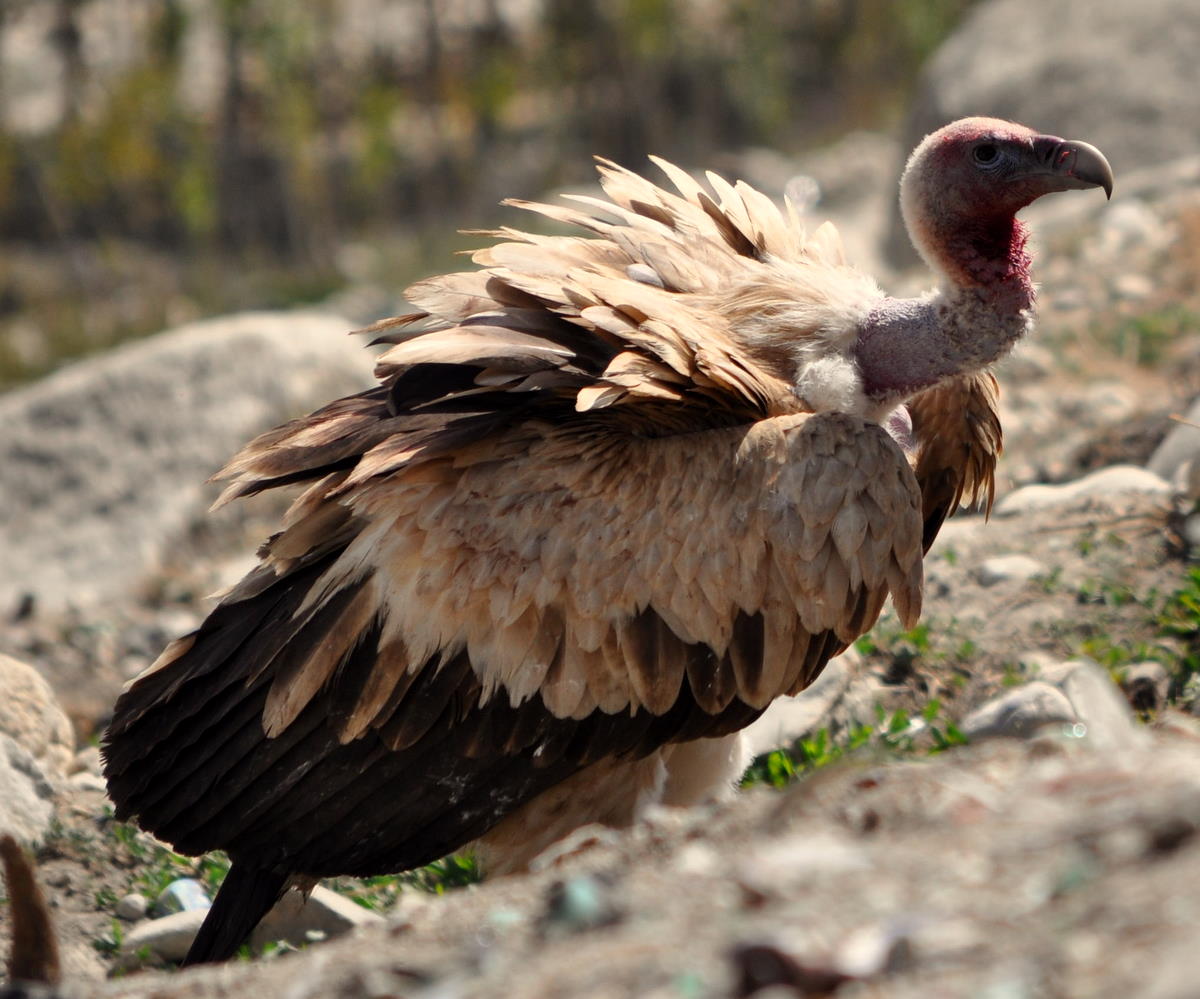
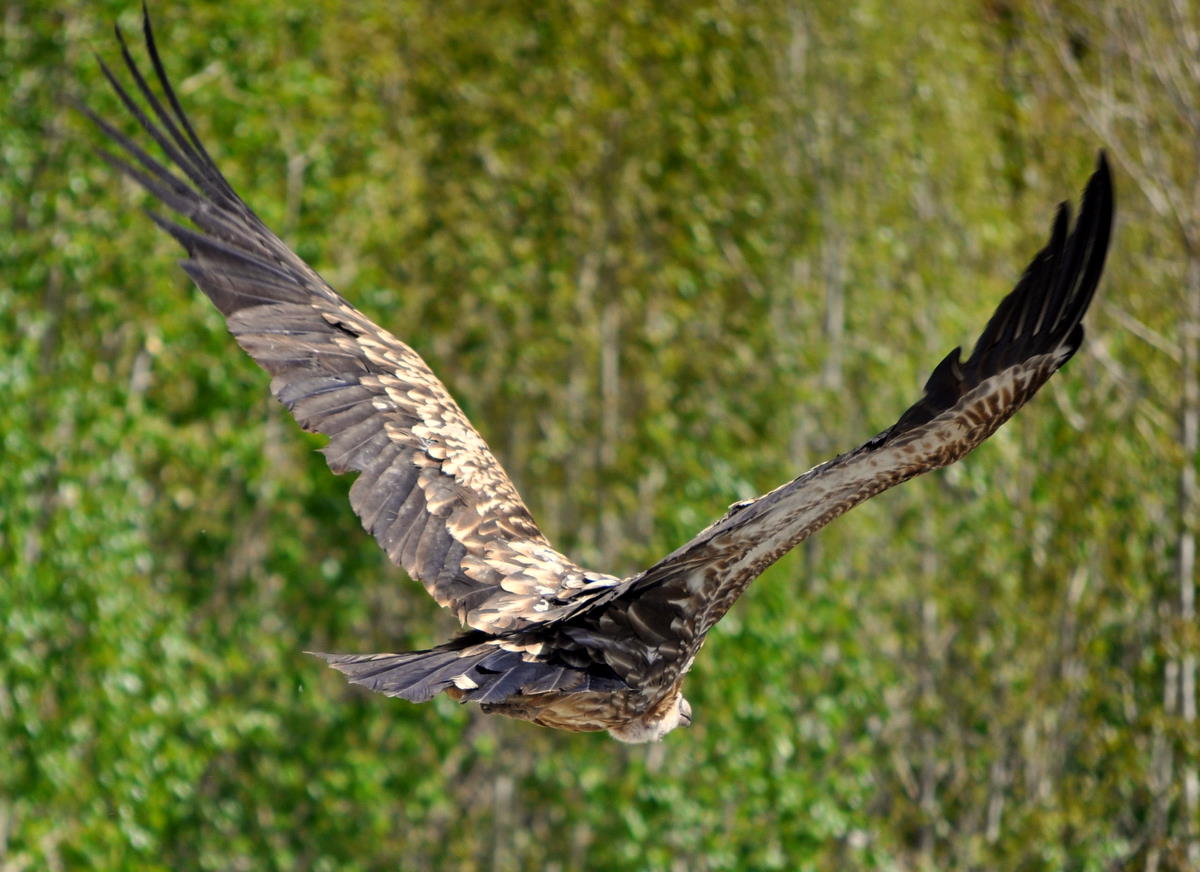
On the way, we saw several white Himalayan vultures working on a dead horse. These and their larger brother the lammergeier are among the largest birds on earth and have been known to fly as high as Everest.


In the afternoon, I handled some more email, unfortunately creating work for my dear brother who was handling our affairs while we were on another planet. Simple things like making a phone call or faxing back a form were impossible here.