Unlike the other Central Asian languages, which are of Turkic origin, Tajik is descended from Persian and closely related to the Farsi spoken in Iran and the Dari in Afghanistan. But as a relic of the Russian domination, it is written in the Cyrillic alphabet, supplemented with a few extra letters to represent guttural sounds that are not in Russian. Since both Tajik and Russian are commonly used, it is sometimes hard to tell which language a sign is written in. Not that it matters, since we can't read it either way.
Arabic is the clerical language of Islam, but we didn’t see it much, even in mosques. In fact, we even spotted this minaret with Tajik (Cyrillic) writing in the brickwork.
Chinese is also becoming visible on the sides of buses and road signs, as the Chinese government is pouring in millions of dollars of aid in road and tunnel construction to gain leverage over their neighbors to the east. Of course, no local people speak Chinese.
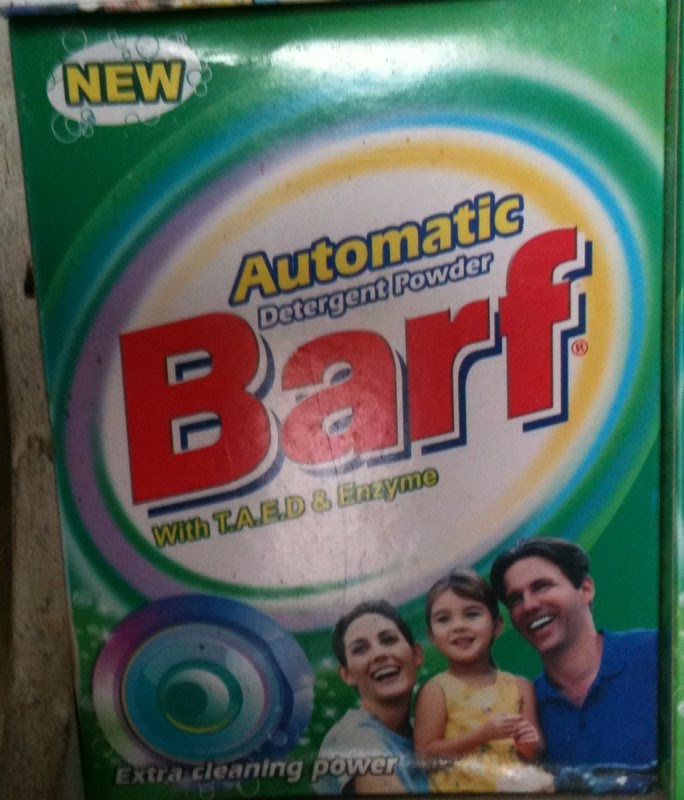
But the Roman alphabet is also present, as products also come from Uzbekistan and beyond. This makes for some interesting collisions of trademarks in the market, like the following Iranian laundry detergent, whose name means quot;snow” in Farsi.