Category Archives: Himalayas

Day 24 – Nov 2 – Moving down the valley

Today was tough for Marcia, who hurt all over following yesterday’s ordeal. Although the hike was a moderate 4 to 5 hours descending and following contours, those things still put strain on Marcia’s old knee injury and her newer pulled muscle. Sonam was great in staying with her and helping her the whole way, but I knew she was in pain with no easy solution until we got to Jomsom.

The scenery was very beautiful in a different way than Dolpo on the other side of the pass. We spent the whole day in the deep canyon we had seen in the setting sun from the mountain the previous evening. The mountains on both sides were snow-capped and the 6000-meter peaks on the south side had several glaciers. With the river at the bottom at roughly 3000 meters, the canyon was roughly twice as deep as the Grand Canyon and three times as deep as Yosemite Valley.

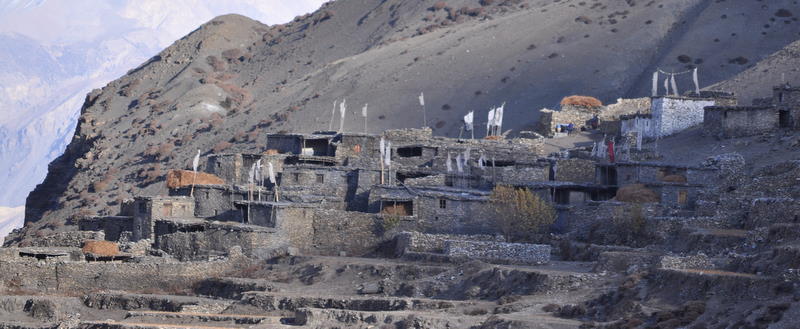
We ended the day at the summer village of Sangdak, built in a tight cluster at the top of farming terraces. The harvest was finished, and the village abandoned for the winter. The altitude of our camp was 3750, the lowest since Lake Phoksumdo. But it still felt quite cold.

It remains uncertain whether we can finish the trip tomorrow. Under normal circumstances, it might be possible, but I told Kinna we must make plans if the long descent proves impossible for Marcia. We will get an early start and make a decision at our lunch stop.

Day 25 – Nov 3 – Another long day

We woke up at 5:30 for an early start and we were on the trail by 6:40. Marcia and I were motivated to get to Jomsom if possible despite our pains, but within an hour the older yak man was muttering that we would never make it at our slow speed. We spent the whole morning, in fact, climbing an ever-ascending slope around various drainages, which was much longer than it appeared on the maps. By the time we had reached our predefined lunch spot next to a half-frozen spring, it was 11:30 and we had climbed 800 meters (2500 feet).

Our agreement was that we would make a final decision whether to camp or push through at this lunch stop. Even the yak men knew we couldn’t make it, but Kinna was still pushing us to try since there would be additional costs and flight rearrangements if we could not make it by early in the morning. I was firm and told him we had no choice since Marcia could not do an 1800 meter (6000 foot) descent on top of an already long morning. He agreed to stay with the yaks and keep them behind us so that we could stop at or before the first water if Marcia’s health required it.

Almost immediately the situation again got out of control. Around the next bend, an avalanche had created an icy patch that was difficult to cross. The yak men cut enough steps for the yaks, and they were off like a shot. Kinna and Sonam stayed to help me and Marcia across, which was necessary but allowed the yaks a kilometer’s head start. On top of everything, Marcia and I were hit with almost simultaneous bouts of diarrhea, which slowed us further.

The trail was long, even in descent. We crossed two more drainages before a slight climb across the final shoulder of the mountain. From that point, the view was spectacular, stretching from the desert canyons of Mustang past the Thorung La (pass) where the Annapurna loop crosses the divide to the full massif of Annapurna to our right. The Kali Gandaki valley and various towns lay tantalizingly close below us. One loses a sense of scale in such huge surroundings, and it’s only through experience and map-reading that I knew that it would take us at least 4 hours to reach the bottom, which was almost 2 kilometers below.


When the yaks disappeared, I knew Kinna might again have trouble enforcing our agreement to stop at the first water. To begin, there was no water or campsite on this steep slope. The yak men had told Sonam that there was water just around the bend of the mountain, but that was not the case. In fact, they were clearly proceeding to the first real campsite in Phalyak, which was almost all the way to Jomsom and too far for Marcia. I do not think that the yak men were intentionally misleading us. More likely they were just oblivious to the distances and vertical changes that are nothing to them but exhausting to us. But either way, it was clear that their focus was on their yaks’ pasture and not on our health.

I did what Kinna should have done and ordered Sonam to run ahead and stop the yaks at the first water. This saved the day because he found a small stream in a deep chasm just at the point where daylight ended and Marcia ran out of steam. There was no campsite, but Sonam found a flat place about 500 meters further on and set up our tents in the middle of the trail, having the kitchen staff haul up water from the stream. Had he not caught the yaks and made them unload, we would have had another exhausting moonlight walk downhill.
My US cell phone had reception from a village across the valley, so Kinna called Ngima in Kathmandu and asked him to take care of all the hotel and flight rebookings. With some luck, we should be relaxing in Jomsom by lunchtime and flying to Kathmandu the next day.

Day 26 – Nov 4 – Jomsom!

Day 26 was the last of our trek. We were now less than ten kilometers from Jomsom, most of it downhill. As we came past the first farming village, we could hear a symphony of animal bells and farm workers singing. We climbed over a small ridge and descended a long, steep scree slope, which was very hard on Marcia.

The scenery was of unbelievable scale. Directly across the valley was the face of Nilgiri, part of the Annapurna massif. Further down our side of the valley was the peak of Dhauligiri I. Between the two, the Kali Gandaki river flowed through the Himalaya in a valley 6000 meters (20,000 feet) beneath the summits on either side. This is generally considered the deepest valley on Earth, though the Chinese recently dispatched a team to the Tibetan border to “scientifically prove” that the great bend of the Yarlung Tsampo / Brahmaputra is deeper. Regardless, it was a sight to behold during our last descent.


And then suddenly we were in Jomsom. After a few hundred meters of trail along the riverbank, we found ourselves walking down a stone-paved street past jeeps and motorcycles. Our hotel was near the airport on the other end of town, and along the way we passed the Nepal Army School of Mountain Warfare, a bit of a joke considering how badly they fought a loosely organized band of 15,000 Maoists over the last decade. Marcia and I hadn’t seen a military or police presence since we left Dunai 25 days ago.

Jomsom has changed since some of our friends visited in the Eighties. A road down the valley now lets motorized vehicles bring people and goods in and out. The stretch near the airport is lined with dozens of trekker hotels offering nice rooms and international dial telephones to the thousands of foreigners passing through on the popular Annapurna loop.

We took hot showers and had a big lunch in our hotel’s upstairs dining room. From our window we could see groups of trekkers stopping in at the checkpost. They all looked so clean! Personal cleanliness must be a lot easier in the local teahouses than in a tent in Dolpo.

In the evening, Sonam and his crew served a huge feast now that they had access to better ingredients and equipment. After dinner, we gathered everyone to give thanks and the obligatory tips, a standard ritual at the end of any trek. Marcia handed out ceremonial katas (scarfs) and I distributed wads of cash to each person in proportion to their contribution. Everyone seemed genuinely happy. We had been through a lot together.

Day 27 – Nov 5 – Back to Kathmandu

We arose early for the flight from Jomsom to Pokhara, the only quick way out. Jomsom has a new airport and control tower, though it fortunately still uses the old entrance surrounded by Tibetan prayer wheels, which I used to ensure a safe flight. Those should be a feature of all airports!

The flight took off about an hour late because the Agni Air pilots decided to have breakfast. But once we got in the air and did the steep turn in the valley, we had a spectacular view flying down the valley between Annapurna and Dhauligiri. After crossing the shoulder of the mountain, the plane descended over farming terraces into Pokhara, the only developed city in western Nepal.

Although Pokhara seems like a delightful place to spend a few days, Marcia and I plan to come back later, and we were motivated to get back to our clean clothes in Kathmandu. So we had Kinna negotiate to get us the last two seats on a flight leaving right away, and by 11am we found ourselves back in the big city.

It took a little work to find a good hotel room, since our organizer Ngima was away on a trek and he hadn’t booked a room in the guesthouses that are always booked full in this busy season. But his wife met us and was very helpful in helping us move to another hotel in a quieter location. The room was large enough for us to lay out our stuff and it had a bathtub, Marcia’s primary requirement, though we learned later that its hot-water heater was only large enough to fill a quarter of the tub.

Kathmandu is overwhelming even when arriving from another place in the twenty-first century. But for us who had not seen a car in almost a month, it was like coming to a different planet. The smells, the sounds, the crush of people were all a shock. But it was comfortable and it had good food.

Marcia and I are spending a few days relaxing and letting our muscles heal before posting everything and making new plans. Come back soon for more!

========== End of detailed Dolpo postings ==========

Dolpo trek finished – back in Kathmandu

Marcia and I flew back from Jomsom to Kathmandu today and we are back online.

Thanks, Russell, for posting updates while we were away. As the last post said, we had an amazing trip to a very wild region. It was also very strenuous, crossing 7 passes over 5000 meters high. Marcia and I managed to stay healthy except for some aches and pains. We are now enjoying some much needed rest and maybe a bath or two.

I do have a month’s worth of postings drafted on my PDA, and I will upload them and pictures as soon as I figure out how to move them over. Please check back in a day or two.

Finally, Tom and Marcia have arrived in Dolpo

This morning I got a call from Tom's parents in Pennsylvania, who had talked with Tom a few minutes before. There is also a text message on my cellphone, which I quote:

“Made it to Dolpo. Trek starts tomorrow. No Internet until ~Nov 6. Please post this on blog because we can't.”

So, it seems that Tom and Marcia's 100% chance did indeed come through, and they are now finally in Dolpo. The weather, reportedly, is beautiful.

If I get any more text messages or other communication, I'll post them here. Have a great trek, T&M.

zp8497586rq

100% Chance!

Well, the airplane situation continues to change but Yeti Air still has not gotten us to Dolpo.

To begin with, yesterday’s plan to drive to Surkeet last night was reversed within an hour, allegedly because the plane was too small to carry both us and our baggage. But the airline assured us that there was a “100% chance” we would go out on the first flight today.

So we packed all our luggage again today and went to the airport at 7am. No plane. At 8am, I joined our guide, went upstairs and talked with the manager. The plane was in Kathmandu overnight and left at 7:45 to fly to Simikot (in the far west) and would come immediately after. We will fly at 10:30am.

We sat and sat, and nothing happened. Finally, at 10:30, I went upstairs to join several other furious group leaders. The story now was that the flight left Kathmandu at 9:45 due to weather delays, has to go all the way to Simikot, stop a few more places, and won’t be here before 1pm. And that’s too late to fly into the mountains where the winds will be heavy and the runway too short. (That last part was actually true.)

At this point, I lost my temper in a measured way. You can’t yell in Asia – if you raise your voice you have permanently lost the argument. But I made it clear that I was not going to leave the manager’s office until he got us a plane. I offered to sleep overnight on the plane, an idea that another group’s sherpa guide thought was brilliant. So I just sat there with him for hour after hour until he stopped making up stories.

Finally his story crystallized that it was indeed too late in the day to fly to Dolpo, so they had diverted the plane to several other airports that had people who needed to get out. It would arrive around 3, spend the night in Nepalgunj and then we would be on the first flight tomorrow morning. “This time I finally have the airplane under my control.” (So why did he tell all the other stories if he didn’t?) To demonstrate his seriousness, he weighed our bags and issued boarding passes for tomorrow.

I continued to shadow the manager. He finally invited Marcia and me for lunch at his house, which turned out to be the Yeti Air company housing back in town. He was actually very nice, serving us dahl-baht (lentils and rice), an omelette and some delicious cucumbers. He turned on the TV and we watched tennis and cricket news on Aljazerra. At the end of lunch, he assured us that the plane was now 30 minutes away from Nepalgunj and would be not go anywhere else today. He did admit that he has four planeloads to take and they won’t all go tomorrow. But our group is small and we were the earliest, so we definitely have the first flight. He instructed us to come to the airport at 5:30 tomorrow morning and we will take off at 6:30am. 100% chance!

Since Yeti Air’s airplanes seem as rare as their mascot, I insisted on riding back to the airport to make sure it was true. Amazingly, two planes landed in rapid succession. The first reboarded passengers and flew back to Kathmandu, but the second was actually the one we had been waiting for. 17 people got off, just as he said, and the pilot did a final check and shut everything down for the night. The plane is now sitting there with its wings tied down, so maybe we’ll have a Yeti tomorrow morning after all.

Meanwhile back in town, it is so hot that even the animals are wallowing in whatever puddles they can find. Marcia and I have our same room with both AC and hot water, and we have high hopes of getting out tomorrow morning. 100% chance!

Drying out

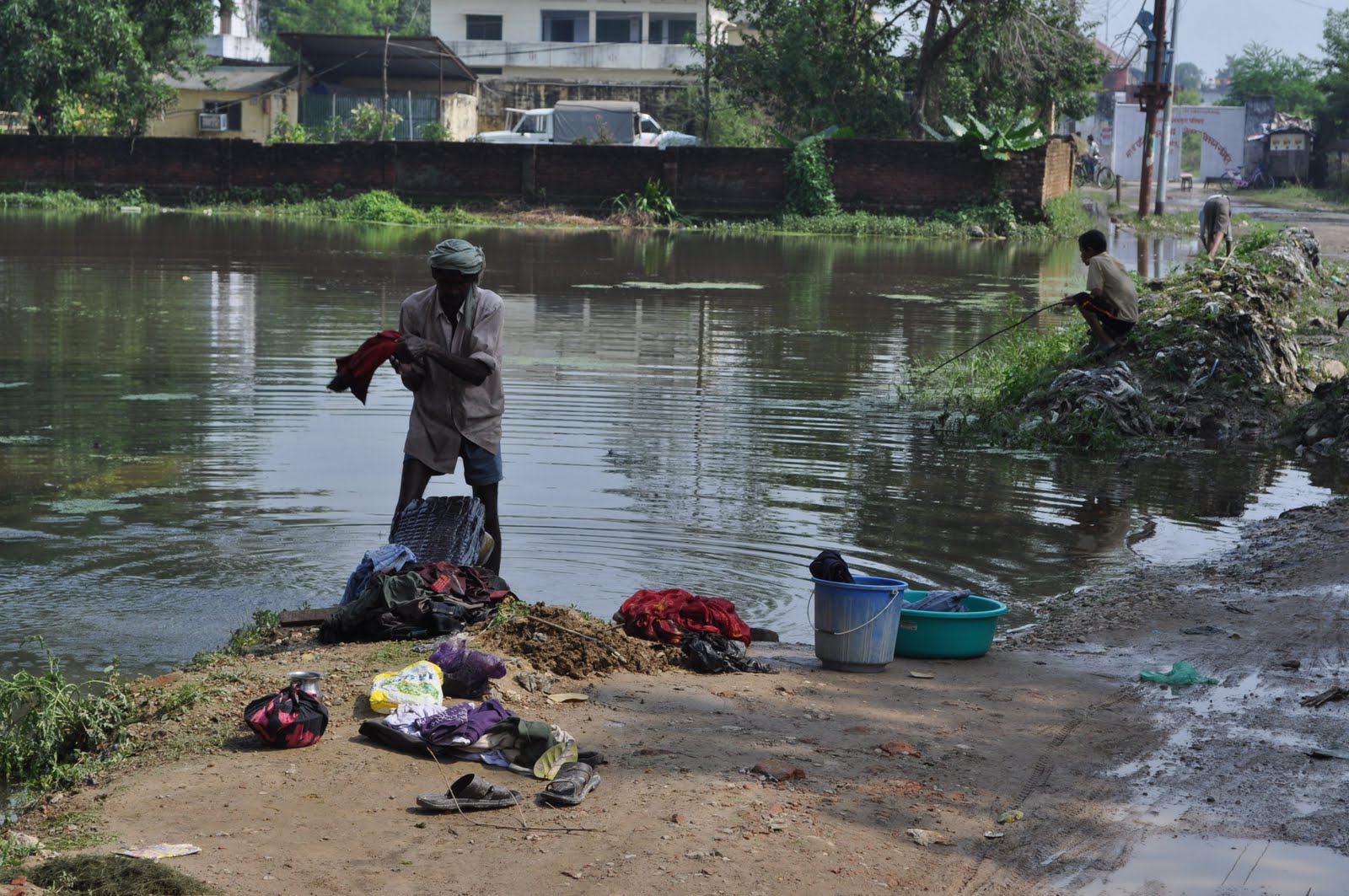
It finally stopped raining yesterday afternoon, and today dawned clear though a little foggy. And the satellite photo shows all the rain moving to the east and clear skies all the way behind. So it looks like the monsoon is finally over, two weeks later than usual. The washer man in this picture looks like he’s happy to dry out, too.

There were no flights to Juphal today, though, because the mountain airstrip is still muddy. But with a full day of good weather, the airplane people say it’s 100% chance we will fly tomorrow morning.

This morning we moved back to the Hotel Batika, the “four-star” hotel that appears to be the only place with a room that has both air conditioning and hot water. They also have the best food in town. The manager showed up with a bicycle rickshaw, the main transportation in town, and used it to transport our bags. We elected to walk, since it’s not far and we need the exercise.

But now we need to move again because the situation has changed on where we will fly from. As of this morning, we had a 7-seat chartered plane waiting for us at Nepalgunj airport where we are now, but I just got a call from Kathmandu to say that we need to move to Surkeet, an airport 3 hours away by bus. So I need to finish this quickly and pack to move hotels once again.

Another day in paradise


We got up at 4:30 this morning to go to Nepalgunj airport, since our chartered aircraft was supposedly there and ready to fly at the crack of dawn. We knew it looked unlikely as it was still raining, but once we got to the airport, the rain actually stopped for a bit and showed us a patch of blue sky. We started to have some hopes of flying until we learned that the airstrip at the destination Juphal was too muddy to be used today. And then the blue sky “sucker hole” closed up and it began pouring harder than ever.

There are now at least five groups in town trying to get to the same mountain airport. One French climbing team wanted to know if we’d share a helicopter, but that would have been ridiculously expensive and probably impossible anyway, since Nepali helicopters are devoted to rescues and food deliveries. And with deadly landslides happening elsewhere in the country, they are sure to be occupied. So we went back into town, driving through several inches of water in some places. Because of crowding, we’ve moved to a yet another hotel called Dreamland. It is somewhat better than the one last night.

Some of the groups are giving up, including the Belgians who we’d hoped to share a plane with. That’s bad news because without a charter we are back depending on a scheduled flight, which may or may not exist. Our organizer wondered if we also wanted to fly back to Kathmandu and do something else, but it would be a terrible waste after all this effort and our expensive restricted area trekking permits are non-refundable.

So we continue to wait. The weather forecast predicts good weather in Kathmandu from Friday on, and the satellite photos suggest it may arrive here even earlier. If so, the airstrip should dry out and we might be able to fly as early as tomorrow morning. There is still some concern that the high passes might have been closed by snow, but we think it will not be a big problem since it will be at least a week before we get to them and snow melts and packs quickly in this season.

I suspect we will have at least one more day to wait in the internet cafe, but if we succeed in flying, our blog entries will stop for almost a month with little or no warning. Don’t worry if that happens. Rest assured that we will not do anything stupid or put ourselves in harm’s way. We have a very good guide and we will keep ourselves safe above all.

Failure to communicate

While we’re waiting for the rain to stop, I thought I’d add a bit about another aspect to travel in Nepal: communication.

In the developed world, we take communication for granted: cell phones, text messages, internet, etc. Living the last two years in Japan, we were highly connected with iPhones that could receive messages, tell the weather, and translate Japanese into English. We could call anywhere in the world for nothing using Skype.

Being a communication junkie, I spent about $8 on a prepaid SIM card for my mobile phone, so that I could have a local Nepal number and call the US for only $1 per minute instead of $4. It works surprisingly well, and I can buy recharge cards as often as I want.

On our first full day of delays in Nepalgunj, all the phone lines went out just as everyone wanted information on delayed flights. All the phones except my local mobile phone! For most of the day, all the travelers were borrowing my cheap little phone as the only way to communicate with Kathmandu.

Some of my communication problems came from the other side of the world. I realized I had forgotten to schedule a loan payment at Bank of America. This would have normally been routine, but BofA’s website insisted on sending a code by text message to my US-based iPhone before it would let me into its website. And my iPhone had no reception in Nepal! Calling the bank’s customer service would have meant spending $50 in the middle of the night, because their offices were always closed at the times when I could use Skype at an internet cafe. Finally, I was able to get AT&T to reprogram my phone to get text messages through a local carrier.

Internet calling services like Skype have taken over all international calls in Nepal, since they are basically free vs. $4 per minute for conventional telephones. The only problem is that internet service is often so bad that Skype is unusable – and unavailable several hours per day when the power goes off.

So despite our fancy tools, we are back in the 1950′s here, when a local call was a challenge and an international call unheard-of. It’s kind of nice, but also a reminder of how dependent we have become on instant communications.