Category Archives: Himalayas

Day 4 – Oct 13 – Unscheduled acclimatization day

Marcia and I both had digestive problems during the night at our campsite, ironically named Rechi. Mine seemed to be routine reactions to a change in food, but Marcia had the more serious problem of nausea, one of the symptoms of minor altitude sickness. We got up and had breakfast, though neither of us had much enthusiasm for it.

The morning’s trail was only 2 hours, though it seemed longer because of the continued climbing and descending to avoid outcroppings. Finally we reached a monastery and boarding school, where the children were lining up for outdoor activities. 15 minutes later we reached our lunch spot, a traditional Tibetan medicine clinic built by the government to keep the art alive. Marcia and I took naps waiting for our lunch.

I spoke with our guide Kinna and we agreed to spend the night here at the elevation of 3100. If we had followed our plan of climbing to Phoksumdo Lake at 3600 meters, we ran the risk of turning Marcia’s minor symptoms into more serious forms of altitude sickness including cerebral and pulmonary edema, which are life-threatening. The only cure for those is immediate descent, which would mean an end to our trip. We had plenty of time, so we could just wait.

We are taking all the standard preventative measures. We are taking Diamox, which prevents and relieves both minor and severe altitude sickness. The locals swear by garlic soup, so we’re sipping that as well. And we are making sure to drink at least 3 liters of water per day. All of this means a lot of trips to the bathroom, but we hope it will make it possible to ascend tomorrow.

I was feeling pretty good after lunch and a short nap, so I took a few walks up and down the valley. It is much drier than even last night’s campsite, because it is in the rain shadow of two chains of 5000-meter peaks. The brush was almost desert-like and the weather spectacularly clear. Gone were the afternoon clouds that had been a daily occurrence further south.

We are spending the night in a room in a small lodge so that we can get a good night’s sleep and recover. It’s primitive but more comfortable than a tent.

Day 5 – Oct 14 – Up to Lake Phoksumdo

We both felt okay this morning, so we began the big climb to Lake Phoksumdo. It was a long climb, but it felt better to know that we would just keep going up rather than dropping back down around the next bend.

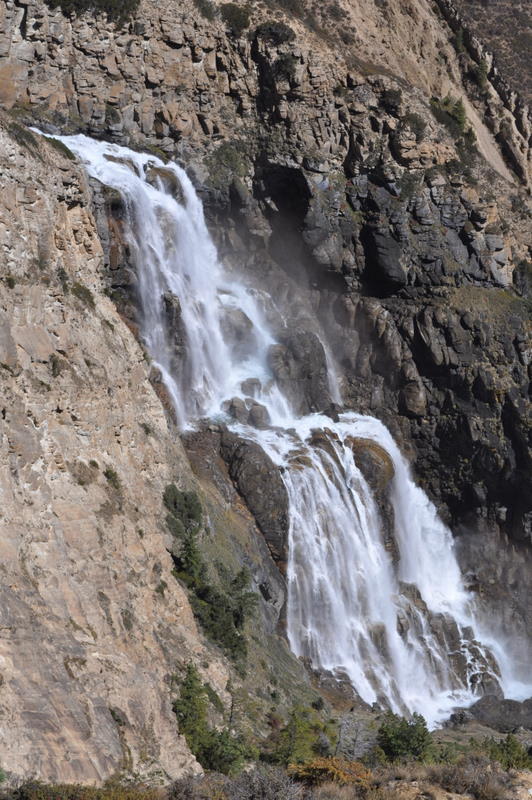
At the top of the final climb we were rewarded with a view of 200-meter-high Phoksumdo Falls, the largest and highest in Nepal. We could also see a small piece of the lake where we would be spending the night. Between us and the lake was a forested slope just starting to turn colors. We walked down through it and reached our lunch and camping spot at 12:30.

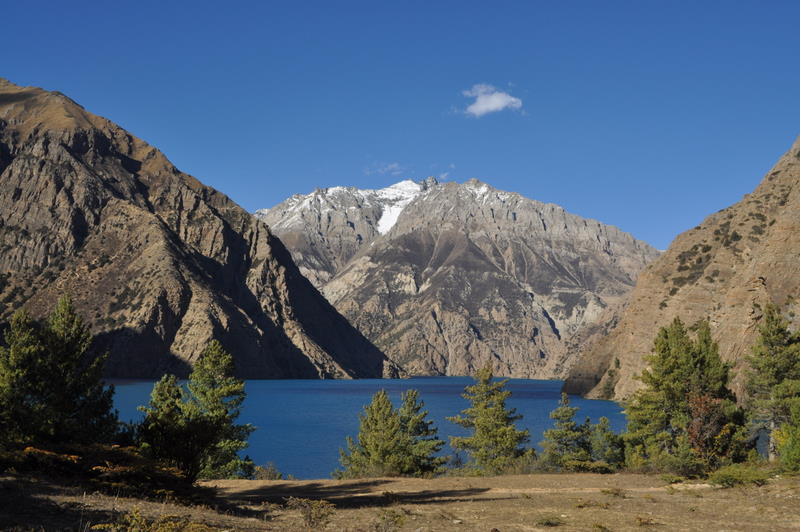
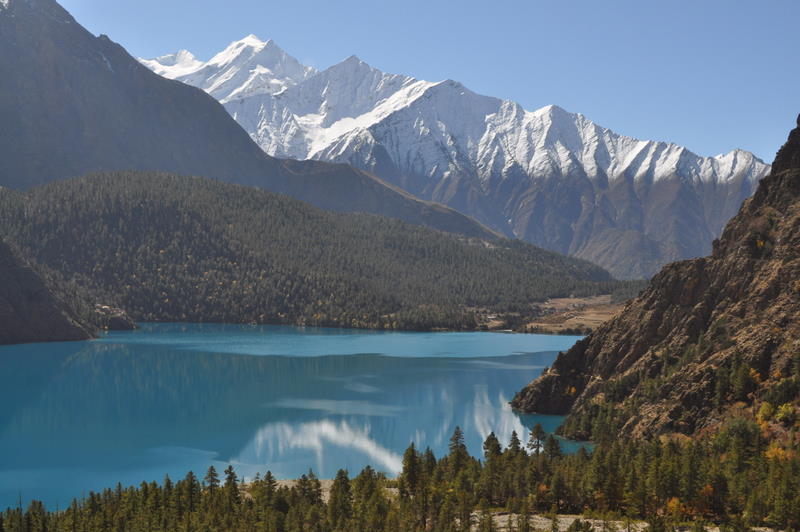
Lake Phoksumdo is a deep blue that varies from azure to turquoise depending on the light. It is very deep and exceptionally clear because nothing lives or grows in it. On each side are high peaks, including a 6600-meter summit of Kanjiroba, Dolpo’s highest mountain.

We had the afternoon off to explore the nearby monastery and the town of Ringmo. The monastery appeared empty – perhaps the monks had already descended to a lower altitude. The town was more lively, with numerous teams of goats and yaks passing through. One large team of about 30 yaks arrived on the trail from the north just before dark. It could be that the fall migration to lower altitudes is already underway. Dolpo herders used to take their flocks into Tibet for the winter, but after the border was closed in 1959, they had to adapt and use warmer areas at lower altitudes within Nepal.

Back in our camp, our cooks had bought and slaughtered a goat. Although both Tibetans and Nepalis are mostly vegetarian, a little meat is helpful at higher elevations. We had goatburger for dinner.

Day 6 – Oct 15 – Around Phoksumdo

There was some cloud cover in the night, but the day dawned bright and clear, with only some fog in the valley at the end of the lake. It was so beautiful that I ran back to the monastery to take some photos of Kanjiroba, which had been shrouded in mountain clouds the night before.

The morning’s trail began with a two-kilometer stretch cut into the rock above the lake. Marcia had been dreading this because early books all talk about it being very exposed and scary, but it really was not bad. Even so, a dead horse at the bottom of one slope was a grim reminder of what can happen if you’re not careful. Our mule men had enough respect for this stretch to carry the loads across themselves and then lead the mules across unladen.

The real work was the next stretch, which climbed 500 meters over a ridge to avoid a much longer and steeper cliff. The views from the top were spectacular, but the wind was also very strong – so strong that it blew my magnetic clip-on sunglasses off my face, never to be seen again. By the time we got down the other side to our lunch spot it was 2pm.

The afternoon was mercifully short, only a couple hours up a glacial valley behind Kanjiroba. Just before camp, however, we had to cross a rushing glacial river where a bridge had washed out. Our guide Kinna and our cook Sonam insisted on helping us across the foot-deep cold rushing water. They were so strong it was like holding on to trees. Kinna told me later about a trip in Tibet where he had needed to carry a group of German tourists one by one on his back because they refused to walk through a waist-high stream that they needed to cross repeatedly. The only mishap involved a woman who weighed 130 kg (280 pounds). On the last trip, her pants split, and her fellow travelers had a grand time taking pictures. It’s astonishing to think of this mild-mannered short man carrying 130 kg across a river.

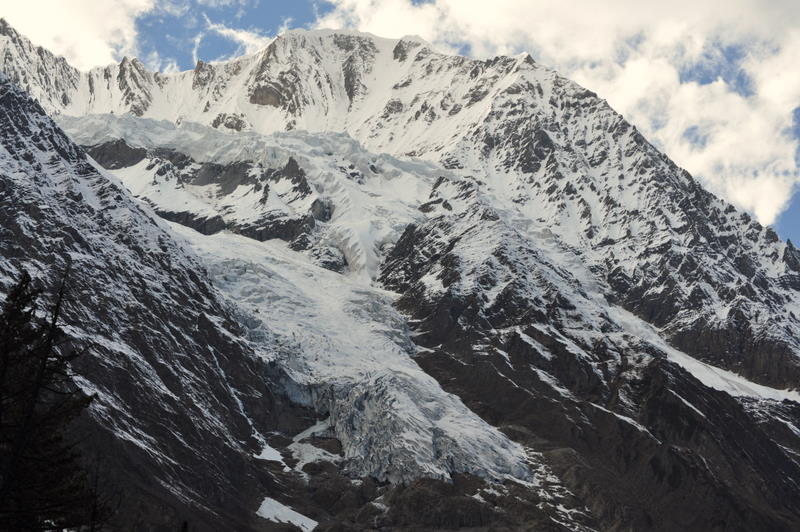
Just across the river from our camp are three hanging glaciers, which creak and break from time to time. In the night, however, the main sound is the faint, rhythmic sound of bells attached to yaks chewing their cud while they sleep.

This camp is at 3700 meters (13,000 feet), the same elevation as Lhasa and the top of Mount Fuji. This will be the lowest point of our next two and a half weeks until our final descent to Jomsom.

Day 7 – Oct 16 – Up to the high camp

I am writing this from our “high camp” at about 4700 meters (15,400 feet) after climbing about 1000 meters today. I say about because all of the maps are wrong in important details and none place this campsite accurately. I came to that figure by tracing contour lines on the better maps and the got almost exactly the same figure from my iPhone’s GPS.

This camp is what Peter Matthiessen called Snowfields Camp, and he tells horrifying stories of carting porter loads uphill through waist-deep snow. No such problems this year. There are patches of snow on north-facing slopes above 4000 meters, but nothing we’ve needed to walk through. And the way to the pass looks clear.

The point of the climb was to place ourselves in striking distance of Kang La, the pass over the Himalayan crest that leads to Shey Gompa. (Maps also disagree on the name of the pass, but that is what I’ll use.) We have to camp high enough to make the rest of the climb in the morning before the winds get too strong, and also to get down to town before it is too late in the day.

The day consisted mostly of putting one foot in front of the other and stopping to catch our breath. The air is thin up here, but neither of us is showing signs of altitude sickness. I find I get into a kind of meditative state by breathing out hard with each left foot and in with the right, letting a rhythmic sound play repeatedly in my head with every eight steps. I hardly notice the relentless climb.

It is cold up here. Marcia and I wore everything we have to bed, and we have down jackets piled on top of our sleeping bags. Unfortunately, we don’t have our winter bags, which we bought 10 years ago for our Everest area trip. Those were too heavy for Marcia to bring by herself to Tokyo and we weren’t sure we’d need them. So we had only one three-season bag and a rectangular bag that is really only good for summer, although it is Marcia’s favorite. Our organizer in Kathmandu promised to provide a full winter bag, but it turned out to be less warm than our three-season bag. So we brought all three bags, and at higher elevations Marcia uses the Kathmandu bag and we supplement with the rectangular bag wherever we’re feeling cold. Hot-water bottles supplied by the staff are a big help for the first part of the night. So far our system seems to have kept us warm on what should be one of the coldest nights of the trip.

Our tent is also funky compared with the high-tech gear of all the big groups camped around us. Our tent is green with a traditional ridgeline design, probably made in India. The inner tent appears to be made of cloth, and we haven’t tested the rainfly in a heavy storm. But it has plenty of space for us and our gear and it seems to do the job. The other groups have stylish yellow dome tents, but they’re also paying twice as much as we are.

Just before dark, our guide pointed out a couple small groups of bharal, or blue sheep. These wild animals are found only in isolated high Himalayan regions like this, and they were the object of many of the early naturalist expeditions to this area. With characteristics of both goat and sheep, they are actually a separate evolutionary line off the common ancestor. In the evening light they looked brown to me, but we should get a better look at them near Shey Gompa where they are supposedly numerous because they have traditionally been protected by the lama there.

What we surely won’t see is a snow leopard. Neither did Peter Matthiessen, which is actually the point of his book by that name. The snow leopard is a master of camouflage, intensely shy, and very rare with a wide hunting area. Early estimates were that there were only six in the entire Dolpo region, and I doubt that number has increased. Marcia and I did see one up close a few years ago in the Darjeeling zoo, and it’s one of the most remarkable animals on earth. Its long whitish-gray fur covers its whole body, making its tail look 15 cm (6 inches) thick. May protection efforts succeed at keeping this magnificent species alive in its home high in the mountains.

Day 8 – Oct 17 – Over Kang La

Today was the day we passed over Kang La into the heart of Dolpo. Some refer to this as Inner Dolpo or Upper Dolpo, but purists would say that the true Dolpo is the four high valleys with purely Tibetan civilization isolated from the rest of Nepal by high passes. Nepal has confused things further by defining an administrative region Dolpa that includes both Upper and Lower Dolpo, but the government seems to have very little presence this far up.

I got many things wrong in yesterday’s account of our camp’s location. We could not see our way to the pass, only the first long pitch of the climb up to another high valley at about 4900 meters elevation. I think Peter Mattheissen’s “Snowfield Camp” was actually in this higher valley, not the lower place where the park now requires travelers to camp.

And there was definitely snow on the pass. In fact, there was so much snow on the normal crossing that we had to use a much higher alternative route. How much higher we’ll never know because my iPhone’s GPS refused to believe our location and insisted on a much lower altitude. From the maps, I am guessing it was about 5500 meters (18,100 feet) because we were pretty much even with the surrounding summits. The regular pass was maybe only 5200 meters, but its north-facing slope made its snow too deep. I suspect this is the reason for the divergences in names and elevations on my different maps, as there are actually two passes that get used in different seasons.

In any case, it was a long, hard slog up snowy switchbacks to the pass. Marcia and I were both feeling the altitude with minor dizziness and headaches, respectively. Even the yaks seemed to be taking their time.

The views from the pass were glorious in both directions. To the south were the Kanjirobas, with the glaciers we had been admiring now slightly below us. One large peak was also visible further south, and the full stretch of Dhauligiri and maybe Annapurna to the east.

To the north, the mountains looked completely different. Although they were still rugged, they were dry, brown and rounded, as if the wind were the major force shaping them. Off in the distance was a striking pyramidal mountain, probably on or over the border in Tibet.

I narrowly averted a disaster with our mules. They were unhappy on top and were looking for any way down. It wasn’t easy because earlier groups had left the main trail a steep, icy mess. While our crew was preoccupied cutting steps in the ice, the lead mule decided to look for another route down on an inviting snowy place. The problem was that this was a cornice, and he would have fallen through way down the slope. I saw him heading that way and three other mules following, and since I don’t speak Nepali Mule, I shouted at our mule man, who should have been paying attention. He ran screaming and almost fell through himself. But he got the lead mule’s attention just as the first foot was discovering the snow was not solid.

The trip down the other side was not bad after the first twenty icy steps. Marcia and I have lots of experience galumphing down snowy slopes. I was tempted to follow others in a glissade until Marcia reminded me how far it was to the nearest hospital if I tore my butt on a rock. Down, down, down, all afternoon down. Marcia got her second wind and beat the rest of us to Shey around 4pm. I could have walked another hour but was glad I didn’t have to.

We slept very well.

Day 9 – Oct 18 – Shey Gompa

Shey Gompa is the destination of most trips to Upper Dolpo. It has three monasteries and abundant Himalayan wildlife. Many of the original visitors spent a month here studying blue sheep and hoping to spot a snow leopard. We are spending a rest day to relax and look around.

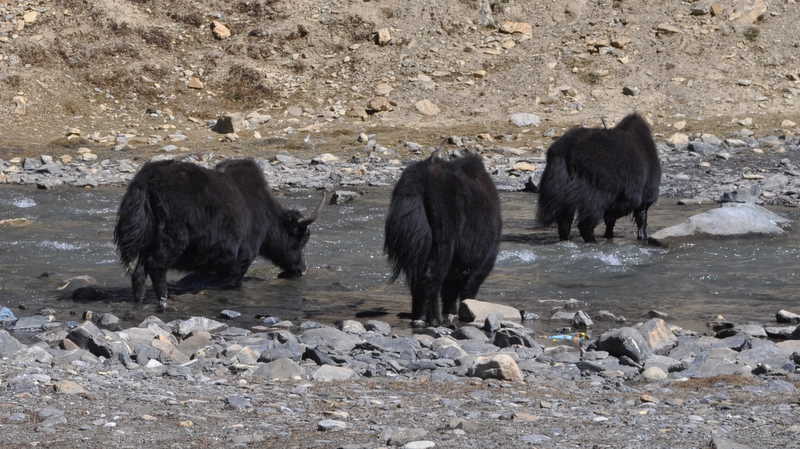
Shey Gompa is situated at the meeting point of three valleys. We are camped by a small stream that is also used by yaks to cool down. They seem to like the ice-cold waters.

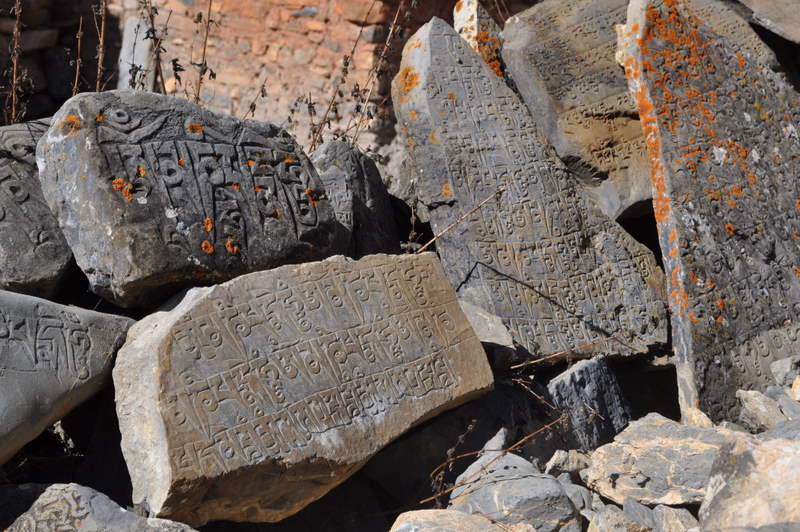
Gompa means monastery in both Tibetan and Nepali. There is a fairly large one right in town, which we walked around in the morning. Between the monastery and its outside mani (prayer) wall was a huge field of stones almost like a crowded cemetery. These were old mani stones whose carvings had been worn down by continual use but were kept for the continuing power of their prayers. Usually a mani stone is carved (often repeatedly) with the Tibetan mantra om mane padme om. Properly, you should walk with a mani wall to your right, though Bön practitioners do the reverse. Locals take these things seriously – a Tibetan woman chewed Marcia out for sitting on a mani stone.

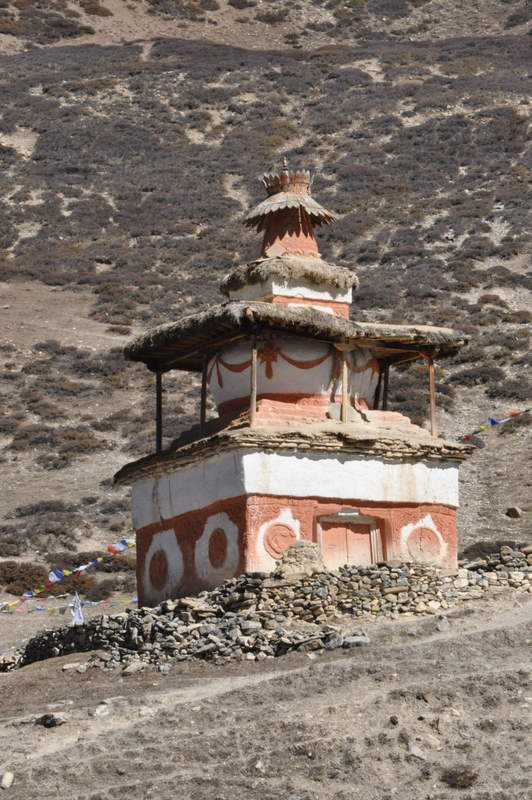
A chörten is a traditional Tibetan building in memory of a lama or other important person. Dolpo has a unique style of chörten that I have not seen anywhere else. In the Dolpo style, they will often use a row of posts around the second story to hold up another roof. Dolpo chörtens also have decorated circles on each level.

The monastery itself was closed as the high lama had gone to another monastery for training. His previous incarnation was crippled and spent winters meditating at the monastery in the mountains. Our guide says the lama is also the brother of the king of the neighboring region of Mustang, now the only king left in Nepal.

We visited the other two monasteries after lunch. Both were up a trail coming down from high above the valley to the northwest. The trail is actually the end of the kora (circuit) around the Crystal Mountain, which gave Shey its name and its significance. The Crystal Mountain is topped by a rock that looks like Mt. Kailas, the holiest mountain in both Hinduism and Buddhism. Every summer, believers from throughout the region come here to walk around this oddly shaped mountain, a strenuous hike that takes them almost back to the pass we crossed yesterday. A kora is always done clockwise with the mountain to one’s right.

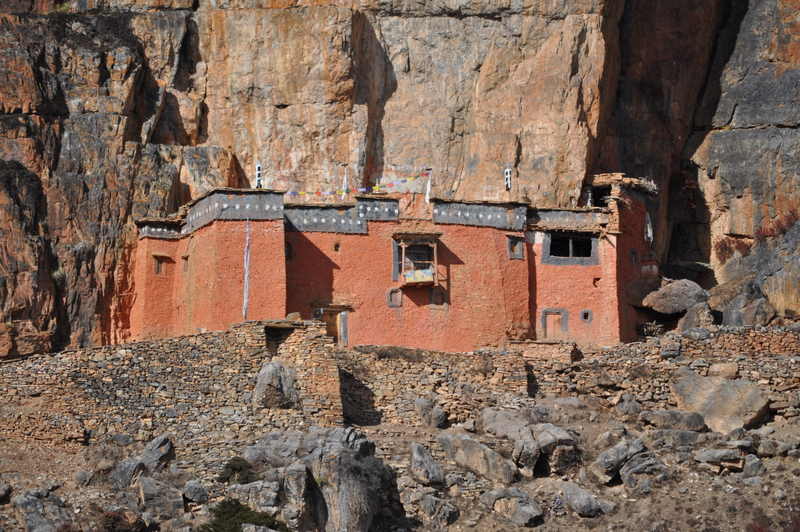
Marcia turned back after the main viewpoint, but I went on with Kinna to visit both monasteries, which were again viewable only from the outside. The first was a relatively large one built directly into the face of the cliff. It enclosed a cave where salty holy water was dripping. The second was a very small hermitage, apparently not associated with the head lama since he doesn’t have a key.

But the real treat was to encounter two small groups of blue sheep at close range, close enough to photograph. There was no direct sunlight, so it was hard to see the blue on their backs. At least one had a good set of horns.

I need to close with another rant against the large organized tours that are the most common way people come on treks. We paralleled a mostly British group all the way from our first campsite. Their trip was scheduled so tight that when they lost a few days to Yeti Air in Nepalgunj (which almost always happens) they had no choice but to rush through their itinerary. They cut out rest and altitude acclimatization days, only to have to retreat when a member got sick trying to cross the pass. And when they reached their destination, they spent one night exhausted and left early the next morning with no chance to look around. On top of that, they are required to engage in small talk with their traveling companions, mostly macho stuff about who almost lost toes to frostbite on previous expeditions. For this failed trip, they may have spent $10,000 each. Not my idea of fun.

Marcia and I feel quite fortunate to be able to do this at our own pace with a great guide and no plane ticket or job to force us back too quickly.

Day 10 – Oct 19 – Shey La to Namgung

Before leaving Shey Gompa, we had a chance to go inside the town monastery. It is fairly typical of a small Tibetan gompa, with statues of different Buddha manifestations in sconces at the front, paintings on the wall, and benches and mats where monks can sit chanting and beating drums and chimes. A wide seat for the high lama was occupied in absentia by his photograph, along with a photo of his previous incarnation. The current lama is 17 years old and still completing his religious training.

The trail out of town was a gradual but continuous climb towards another pass, Shey La. We were able to stop for a hot lunch cooked by our staff, after which the climb became more challenging. Marcia did fine as soon as she sorted out the competition for blood between her lunch and her legs. But I fell behind as I seemed still not fully acclimatized to the elevation at the top of the wide pass, 5150 meters.

But oh the view when we got there! Below us to the north was all of northern Dolpo, where we will be spending the next five days. Valley after valley had changing colors somewhat like Arizona. In the distance were the rugged mountains on the Tibetan border. I was particularly captivated by a mountain that looked like a split Matterhorn, only steeper. I remembered seeing the same striking mountain from the north in 1996 when Marcia and I traveled across Tibet. So the other side of that range must be the high rolling desert of the Yarlung Tsampo valley.

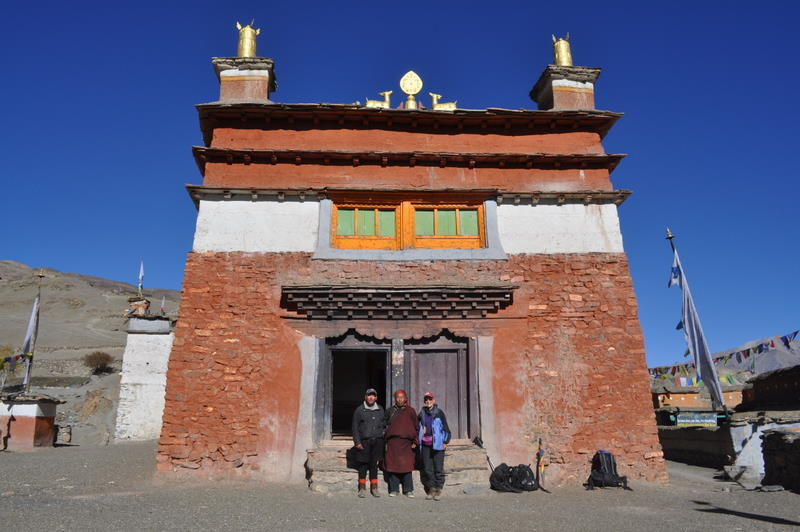
We descended slope after slope to Namgung, where we’re spending the night. Namgung is another monastery town, with the old monastery built into the side of a cliff. In this case the old monastery was abandoned 17 years ago when the brightly painted new one was built on the valley floor. Sheaves of barley lay on the ground nearby waiting to be threshed into the local dried mash tsampa.

Day 11 – Oct 20 – Down the hill to Saldang

Day 11 was a short day with only a half day of hiking downhill to the town of Saldang, where we will have another rest day.

We began with a visit to the new monastery in Namgung. It was more leanly furnished than the better-funded Shey Gompa, but still nice. The images around the walls were tsonkas (tapestries) rather than being painted directly on the walls.

Kinna helped us have a good conversation with the monk who opened the place for us. His father had been the lama at that monastery for many years. When he died, they found a new reincarnation, who is now 18 and studying in India. The man is therefore taking care of the monastery and local rituals until the reincarnation of his father can return. His son is a lama currently living in Taiwan, and he is taking care of his three-year-old grandson, who was there shyly playing with us.

Following the monk’s directions, we took a shortcut straight up a side canyon. The steep, exposed climb was almost too much for Marcia, but evidently not for the monk’s three-year-old grandson, whose footprints we could see. A woman came by carrying a basket, also unfazed by the steep trail.

The half-day hike took longer than it should have because I kept stopping to take pictures of the canyon that continued to open beneath us. Locals went about their work more or less as they have done for hundreds of years. We could hear a woman singing a complex song while she worked way below us. A goatherd chatted with us at a stopping place and got some eye medicine from our guide. The goatherd told us proudly that he had been in Eric Valli’s movie Himalaya (a.k.a. Caravan). Although Valli received some criticism for romanticizing the story and not pumping more of his profits back into aid for the region, the locals seem uniformly proud of the part they and their country played in the making of the movie.

When we arrived at our destination Saldang, we were happy that our guide arranged for us to sleep in the house of the village amchi (traditional Tibetan doctor) Labrang Tundup. To be honest, we were both starting to get a bit tired of living in a tent, and with two more weeks of it to go, we were happy to have a couple nights indoors.

This is the nicest house in town, given to Tundup’s father a generation ago because the town needed an amchi. It is two stories high, three if you include the roof. Each of the stories is connected by a ladder made out of half of a tree trunk with steps carved out. It seems odd to use a whole tree in a place where it probably needed to be hauled over the mountain, but this ladder also looks like it will last a century. The house includes a small gompa, which Tundup uses for his incantations. We chose to sleep on a couple of hard beds that were offered to us, probably displacing the ten-year-old granddaughter Pema. Buddhist figures and Bollywood movie star posters hung above our heads.

It is interesting to stay with a village elder like Tundup. He shared his well-worn autographed copy of Eric Valli’s 1994 book Caravans of the Himalaya, made a few years before the movie. Valli spent a few months as a National Geographic photographer living in this same house with Tundup, and he chronicled the daily life of the doctor. Tibetan medicine includes exorcisms and other rites to free troubled bodies of the evil spirits making them ill – sometimes an amchi can trick the spirits into invading an effigy or piece of clothing instead of the person, and then he cures the ill by disposing of the effigy. Tundup also showed us the instrument he uses for precisely touching hot rods to fire points on the body to treat high-altitude heart problems and other ailments.

Another advantage of staying in a home is that we were able to clean up. Since we could use the house’s pit toilet, our staff set up our toilet tent as a private washing place. It felt great to get ten days of grease out of our hair.

I walked around the village, which is built in terraces. Saldang is the largest settlement we have seen since Dunai, with at least a couple hundred people living in twenty or thirty houses. People seemed heavily involved in threshing barley and other fall harvest activities. The population will drop in the next few weeks as people take their yak caravans to lower elevations, but Saldang is clearly a year-round settlement.

One unfortunate note is that here, as elsewhere, the Italian group had preceded us handing out red balloons to children. Although this initially creates joy, the balloons quickly break and end up cluttering the ditches. And the children immediately expect that every foreigner has pockets filled with red balloons, and they come begging for more. If you ever come to Nepal or another backward country, please do not train children to beg in this way.

Day 12 – Oct 21 – Exploring Saldang

Day 12 was a rest day in Saldang. Marcia and I take different approaches to rest days. For Marcia, a rest day is to rest and rebuild strength for the next phase of the long march. For me, it’s a day to explore, even if it means walking as far as on a normal day.

Understanding this, Kinna originally proposed to take only me to Yangster Gompa, one of the oldest monasteries in Dolpo. It would have been a demanding day of at least 4 hours each way, with considerable uphill, but also an interesting route past the confluence of the two major rivers of this area. But on arriving in Saldang, Kinna learned that the monastery had recently been locked due to theft of some religious object, and he advised we instead explore a village much closer to town. I reluctantly agreed.

The new destination was the home of Tilen Lhundrup, another village elder who had become locally famous as the star of Eric Valli’s movie Himalaya (a.k.a. Caravan). Although Valli imported Tibetan actors for most of the lead roles, he was friends with Tilen from previous trips and cast him in his real-life role as the older caravan leader. Originally from Saldang’s upper village, Tilen used his film earnings to build a new house in the next town over.

It was a gradual climb with expanding views of the deep Nankhong Valley where Saldang is located. I could almost see down to the river confluence where I would have walked on the other route. Because it was going to be a shorter walk, Marcia came along. But the walk proved longer than Kinna expected, and Marcia began making noises of wanting to turn back.

Just then, a local woman came riding a small horse. She was very friendly and explained to Kinna that Tilen and everyone else from the village had gone into Saldang to have a meeting about how to improve the village. She invited us to turn around and follow her and she would find Tilen. She even offered to let Marcia ride her horse, though Marcia declined.

Back in Saldang’s upper village, the woman tied her horse and ran yelling to Tilen that some foreigners had come to visit. Marcia and I didn’t really care about meeting a movie star, but we couldn’t stop her.

Unable to pull Tilen away from his business, the woman ran back and asked if we would come into her house for some yak butter tea. Marcia squirmed at that, having not enjoyed previous encounters with that rancid brew, so the woman cheerfully offered to make black tea instead.

Her house, it turned out, was Tilen’s old house. Kinna later concluded that the woman might have been Tilen’s servant and he might have asked her to entertain us. The ground floor entry was so dark that we could hardly see a thing: we didn’t even notice the hanging goat head until we were leaving. We felt our way through another door into a room with some light coming down from the second floor and with a traditional dugout ladder going up. We followed the woman up the ladder and into her medieval kitchen. The only modern intrusions were a small fluorescent light and a cassette player, both powered by solar collectors on the roof.

She quickly fired up her small wood stove with some kindling and then put on some dried yak dung, which is the main fuel in this treeless country. Yak dung burns smokily, but fortunately her stove had a good chimney. Any remaining smoke escaped through a small hole in the roof.

We were joined by a two-year-old boy whose relation to the woman was unclear. He was not her son, but he certainly acted quite at home. Dolpo people live in extended families to compensate for the long absences and shared work necessary in this harsh environment. We were more amazed to realize that before we came, this two-year-old had been playing unsupervised in the field for several hours. Survival of the fittest breeds strong people.

After several cups of delicious milk tea, we took our leave and returned to our house for a late lunch. Marcia relaxed and read books for the rest of the afternoon while I walked down to the town monastery to take pictures in the good daylight.
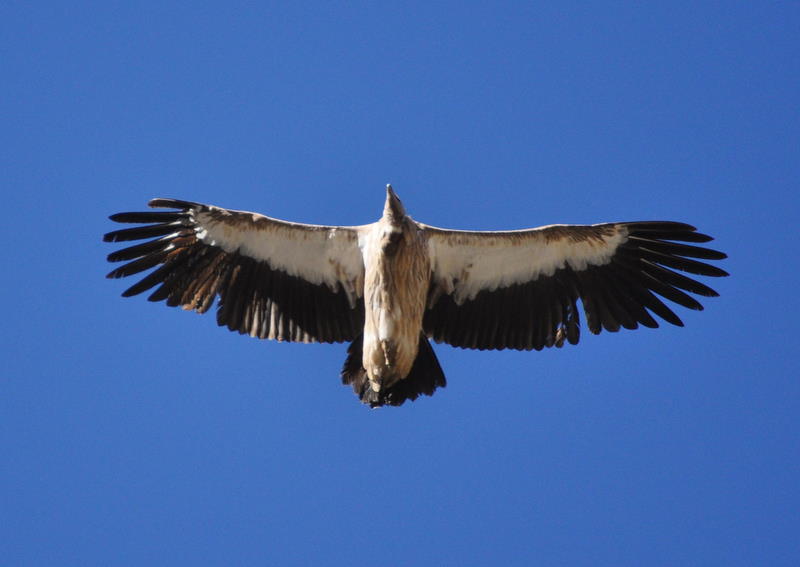
While I was at the monastery, I saw a huge light-colored vulture circling overhead. As I watched, I realized that there were as many as seven. It turns out that a horse had died up the hill, and the call had clearly gone out.

Vultures are an important part of Tibetan life and death, as they are ritually invited to dispose of the dead body in sky burial, which recycles the body in a way that encourages reincarnation. The local belief is that when an animal dies, the vultures see the place in their dreams and they fly right there.

Fortunately it was not our time.

Day 13 – Oct 22 – Up the Namkhong Valley

Before leaving Saldang, Kinna arranged for Tundup to open the monastery. As the local amchi, Tundup has the rights of a lama, and he may actually be the one taking care of the gompa in the winter.

The gompa was new and some of the artwork remained to be finished. The painting seemed very high quality, as Saldang probably has access to the best artists of the area.

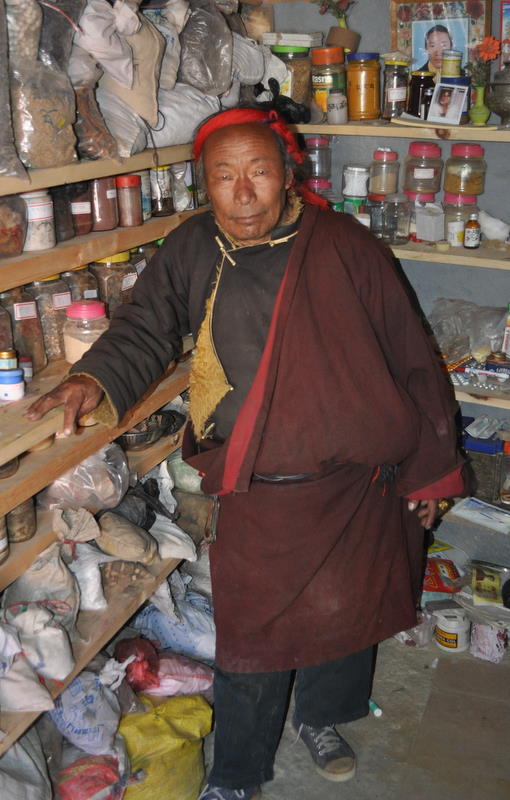
Attached to the gompa was the district medical center, which Tundup also runs. The medicines were almost all Tibetan except for a few boxes of probably outdated drugs. Tundup also has his own personal stockroom of herbal drugs at his house.

Tundup demonstrated his diagnostic art on about four members of the Italian group, who were also visiting at the same time. He held both wrists of the person for about 20 seconds, feeling the pulse and the energy of the person’s body. Based on only that, he said something like “when you get angry, you get a pain between the shoulders.” In three of the four cases, the person felt his or her diagnosis was accurate or even insightful.

On the way out of town, we stopped at the government-run communication post. Powered by a large solar panel, this satellite transmission facility allowed phone calls at pretty reasonable rates, probably subsidized by the government. Kinna and I talked with Ngima for a few minutes and verified that the passes to Jomsom are open. I briefly considered calling someone in the US, but what was the point of hearing news when it will be another two weeks before we can do anything about it?

The day’s hike was long and mostly uneventful. We needed to cover some ground because Do Tarap is about 40 kilometers away and we are scheduled to do that in three days. Most of the hike was easy valley-floor walking, though there were two places where we again needed to climb far above the valley to avoid an obstacle. We passed several monasteries built high up against canyon walls. Several people had set up water-driven grain mills along the river. Just before our camp, we saw a group of at least 20 blue sheep grazing high above us.

Our campsite is right below a local family’s house. We were a little cautious because the children were watching us intently as we set up camp, but it seems to have been inquisitiveness and not an intention to steal. There are still relatively few groups that pass through this restricted area, so we have to accept being stared at.