Author Archives: Tom

Day 2 – June 13 – Snow on Ganda La

We awoke to the sound of our staff brushing snow off our tent. Our camp at 4400 meters was above the snow line and 5 centimeters (2 inches) had fallen overnight. We had breakfast and got a late start.


It continued to snow on and off as we climbed to the 5000 meter Ganda La pass over the Stok Range. Marcia and I considered ourselves acclimatized after ten days in Leh, but we were still out of breath. Even the horses seemed unhappy about climbing in the snow. But finally we all made it and dropped down the muddy trail on the other side.

We kept the day short by camping halfway down the valley. The snow stopped shortly after we arrived in camp.

Day 3 – June 14 – Entering the Markha valley at Skiu

We planned this as a short day to drop the rest of the way to the Markha valley, where we would spend the next four days.

We met the valley at a village called Skiu, a collection of a few houses and farms spread out along the Markha river. A small monastery overlooked the village. Its modern part was like most others, but a small door led to an ancient room with a statue of Maitreiya (Buddha of the Future). This statue stood 6 meters (20 feet) tall and was of great antiquity.

The weather was better than the previous day but we still had a few drops of rain as we neared our campsite. Ladakh is normally a desert and June is one of its driest months, but this year the pattern seems to be different, with small showers passing across the mountains even on days that start sunny. Everyone blames global warming.


Day 4 – June 15 – Markha

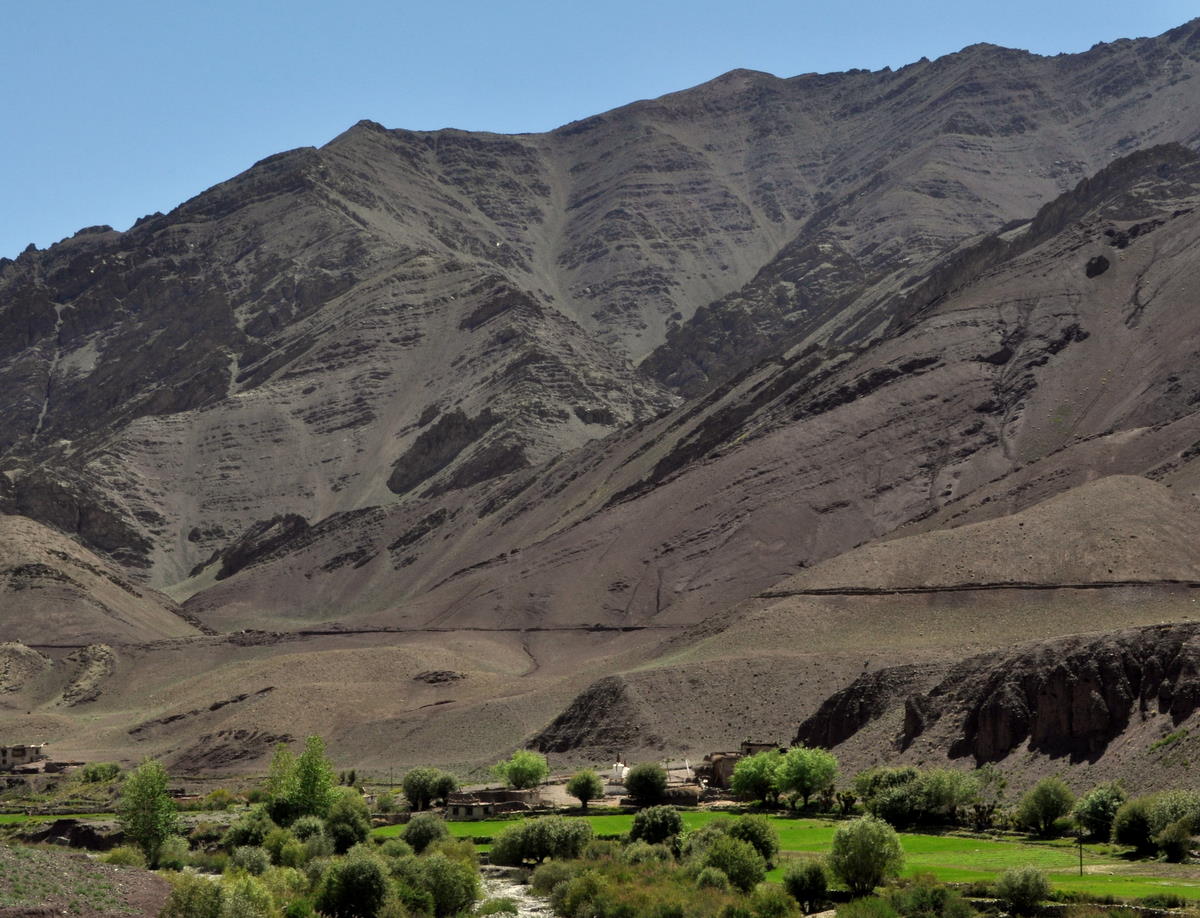
The Markha Valley was narrower than the Indus and much more varied. The hills on each side were a constantly changing scene of rugged spires and eroded slopes. The valley floor had sparse stands of buckthorn and other desert plants, with irrigated fields near human habitations.


The hiking was long but mostly flat. At one place we needed to ford the cold stream, but the water was relatively low and no problem.


We camped at Markha, the most sizeable village in the valley. There was a small monastery and the ruins of a hilltop fort that had been built during the 1830 Kashmiri invasion. The fifteen houses seemed mostly empty, with people off working fields elsewhere in the valley.

Day 5 – June 16 – The upper Markha valley

The valley above Markha became increasingly spectacular. A knife-edge spire was visible from the town, and more overlooked each side valley. In the afternoon, the valley widened enough to give views of Kang Yatze, the 6400-meter peak overlooking the pass we will need to cross.


About two hours above Markha, we took a side trip up a hill to another small monastery. Like others in the valley, this belonged to the Drukpa sect based in Bhutan. It was staffed by a single aging monk sent over the pass from Hemis monastery. The locals were building a house fort the monk at the base of the hill so he would not have to make the 50-meter climb so frequently.


Near our campsite was a water-driven barley mill. The age-old device was fully automatic, with a small arm letting through a few grains at a time from a hopper onto the millstone. The ground flour fell in a mound around the turning stone. This seemed far more advanced than similar mills we had seen in Nepal, which had to be attended.

Day 6 – June 17 – The climb to Nimaling

It rained and snowed during the night, but cleared a bit in the morning. We seemed to be stuck in an early-spring weather pattern with passing showers and patches of sun. It has rained or snowed a bit every day we have been in the valley, but usually just for short periods.


Hangkar, the village where we had camped, had the ruins of another hilltop fort. Above town, the river split into two streams and we followed the left branch uphill. Before long, we began climbing more steeply up a dry slope, eventually reaching a high plateau with a shepherd's grazing ground called Nimaling. Marcia was still short of breath from the 4800-meter (16,000 foot) altitude, but we had no real problems with the climb.

Day 7 – June 18 – Rest day at Nimaling

We had planned a rest day into the trip at the high-altitude valley of Nimaling. It wasn't really necessary as the hiking had been easy, but we had time and the books recommended side trips in good weather.

The weather didn't look so good as the day began. We had a little snow overnight and the flurries continued over breakfast. In light of this, Marcia decided to hang out in the tent while I made the possibly futile climb to a viewpoint. I was glad I did.

The side trip climbed the shoulder of Kang Yatze, the largest mountain in the area. The main 6400-meter (21,000 foot) summit is a difficult technical climb, but given enough time and a little equipment, even non-mountaineers can climb the 6200-meter (20,500 foot) lower summit, Kang Yatze II. Lacking both, I decided merely to climb 500 meters up a moraine in front of the mountain.


Even from there the views were magnificent, because the weather had cleared as I was climbing. I could look all the way up the Markha valley where we had walked, and I could see beyond to a pass over the Zanskar mountains. The second part of our trek will pass along the back side of these mountains.


I was back in camp for a late lunch, and we spent the afternoon reading books. Even on hiking days, we usually arrive early in camp to do a lot of reading.

We also took a short walk up the valley in the sunshine, which had now become widespread. The weather had finally changed for the better.

Day 8 – June 19 – Over the pass

The weather was still nice for the crossing of the highest pass on our trip. From the south, the 5260-meter (17,500 foot) Konmaru La was an easy climb over a saddle that had been clearly visible from my viewpoint of the previous day.


The view from the top was similar to the one I had seen the previous day, but it now included the 7100-meter Kun and Nun peaks to the south and the 7600-meter peaks of the Eastern Karakoram to the far north. I actually got to climb the pass twice because I discovered shortly after beginning the descent that I had misconfigured my camera. So I had to go back up and reshoot all of my photos.

The descent down the north side was much more difficult. There was a fair amount of snow in places near the top, so we had to take an even steeper route than normal. Then halfway down, the trail entered a beautiful but rugged gorge where the well-built trail had been washed out in many places two years before. The temporary alternate route went up and down and frequently used the stream bed as its only way through.


Day 9 – June 20 – Down to Hemis

The last day of the first section of our trek took us down an easy trail to the Indus valley. Most of it was actually a lightly traveled road that the Border Roads Organization (BRO) had built to a town in the valley. We could only speculate why BRO felt it important to make a paved road to 20 houses in a blind valley.


After lunch, we took a bridle path parallel to the Indus over to another side valley that held our final destination, Hemis Monastery. Hemis was holding a famous monastic festival the next day, and its campgrounds were already packed. We set up in an overflow campsite by some stupas at the entrance of the valley.

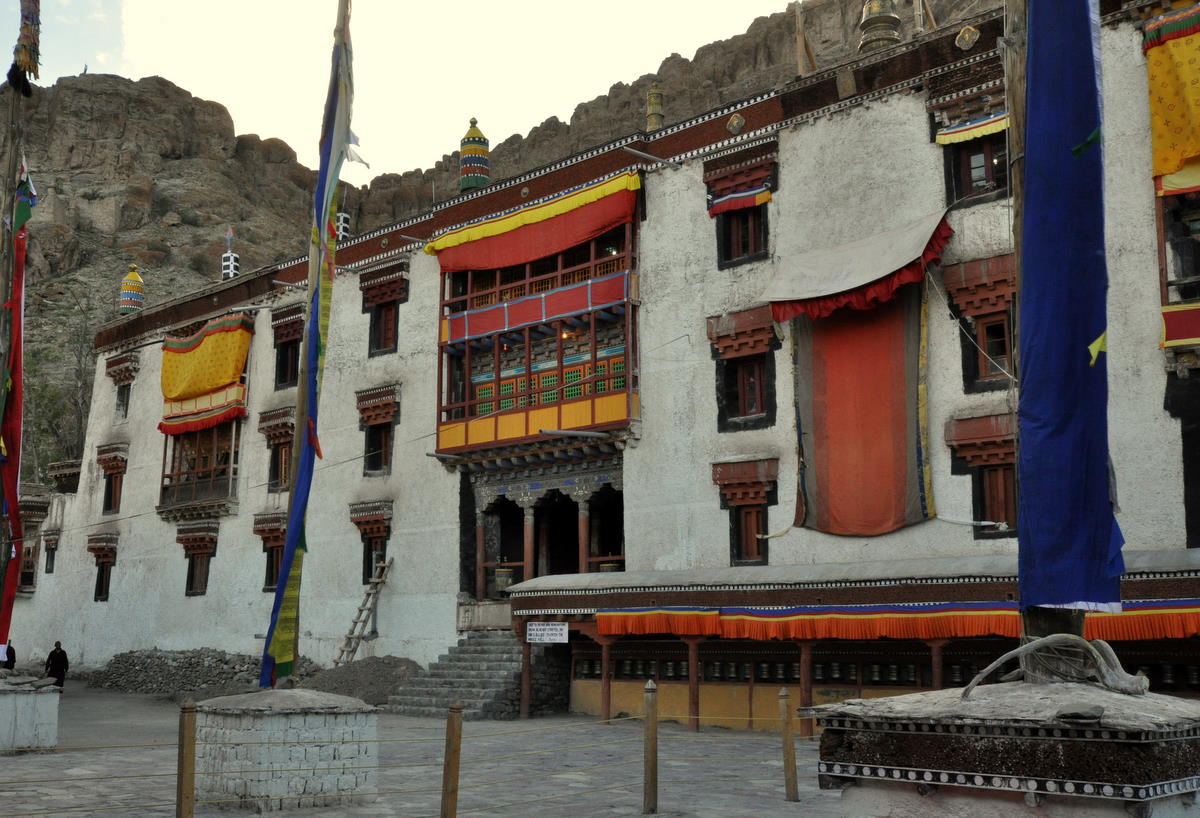
After a little rest and some baths, we walked up to the monastery. Hemis is the largest monastery in Ladakh, having been patronized by the king. It is associated with the Drukpa sect based in Bhutan, whose leader was already in town. The main structures are four stories tall and include a large standing statue of Guru Padmasambhava, who often figures large in Tibetan Buddhist iconography. The monks were busy preparing for the next day's festival.


Day 10 – June 21 – Hemis festival first day

We got up early to stake out a place because we knew it was going to be crowded. The Hemis festival has become famous among European tour groups, whose white-haired flocks swoop in to watch a few hours of monk dancing every year. The better seats are reserved in blocks at about $7 each and with thousands of visitors, this probably funds the monastery.

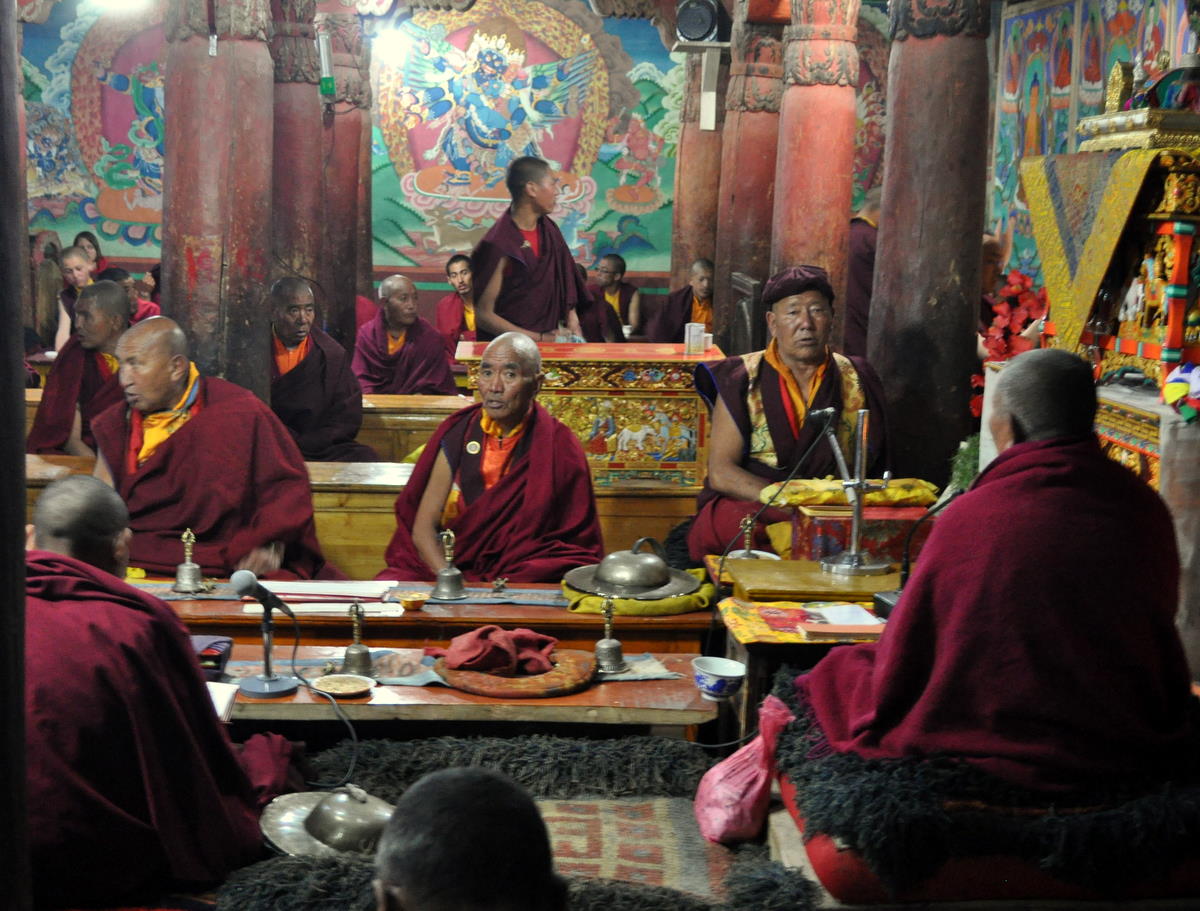
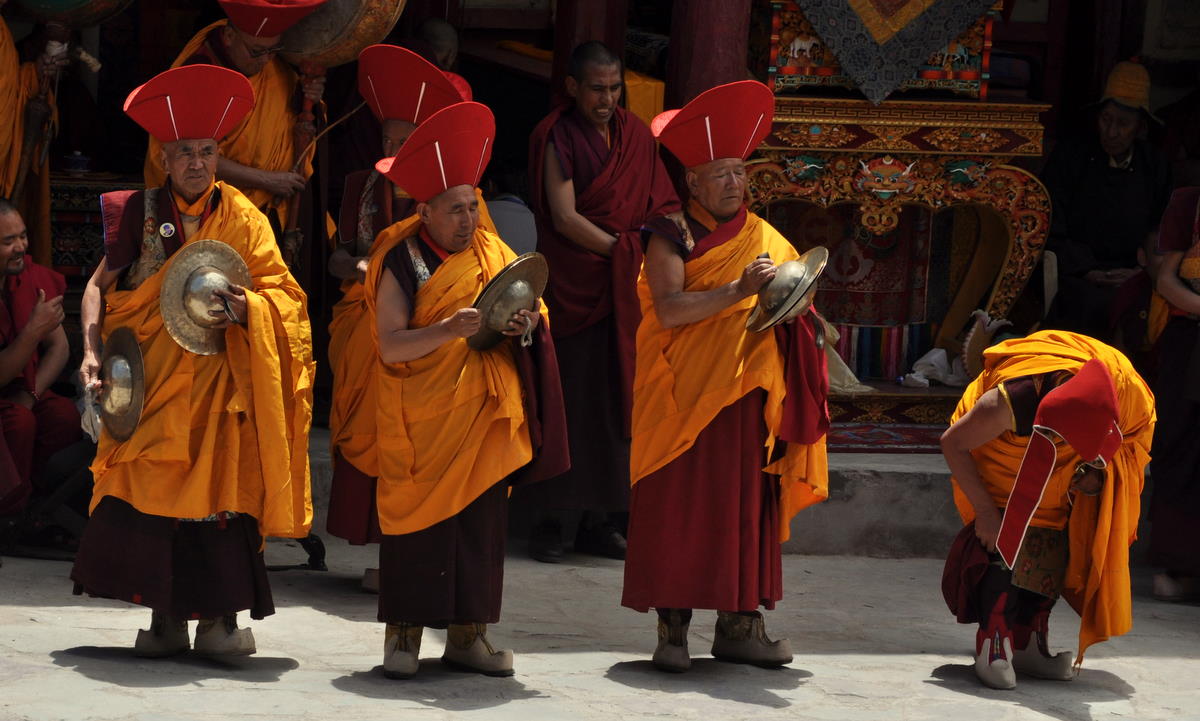
We had several hours to wait while the monks did pujas inside. The presence of the sect's leader and a young rimpoche (reincarnated lama) meant everyone needed extra time to be blessed.

By the time the dancing started around 11, the courtyard was jammed with people, both tourists and locals. With only one entrance, the crowd turned into a crush of people just below us pushing and shoving to get in or out. Fortunately, there aren't any fire marshals in this part of India, and even more fortunately no one got hurt while the show went on.


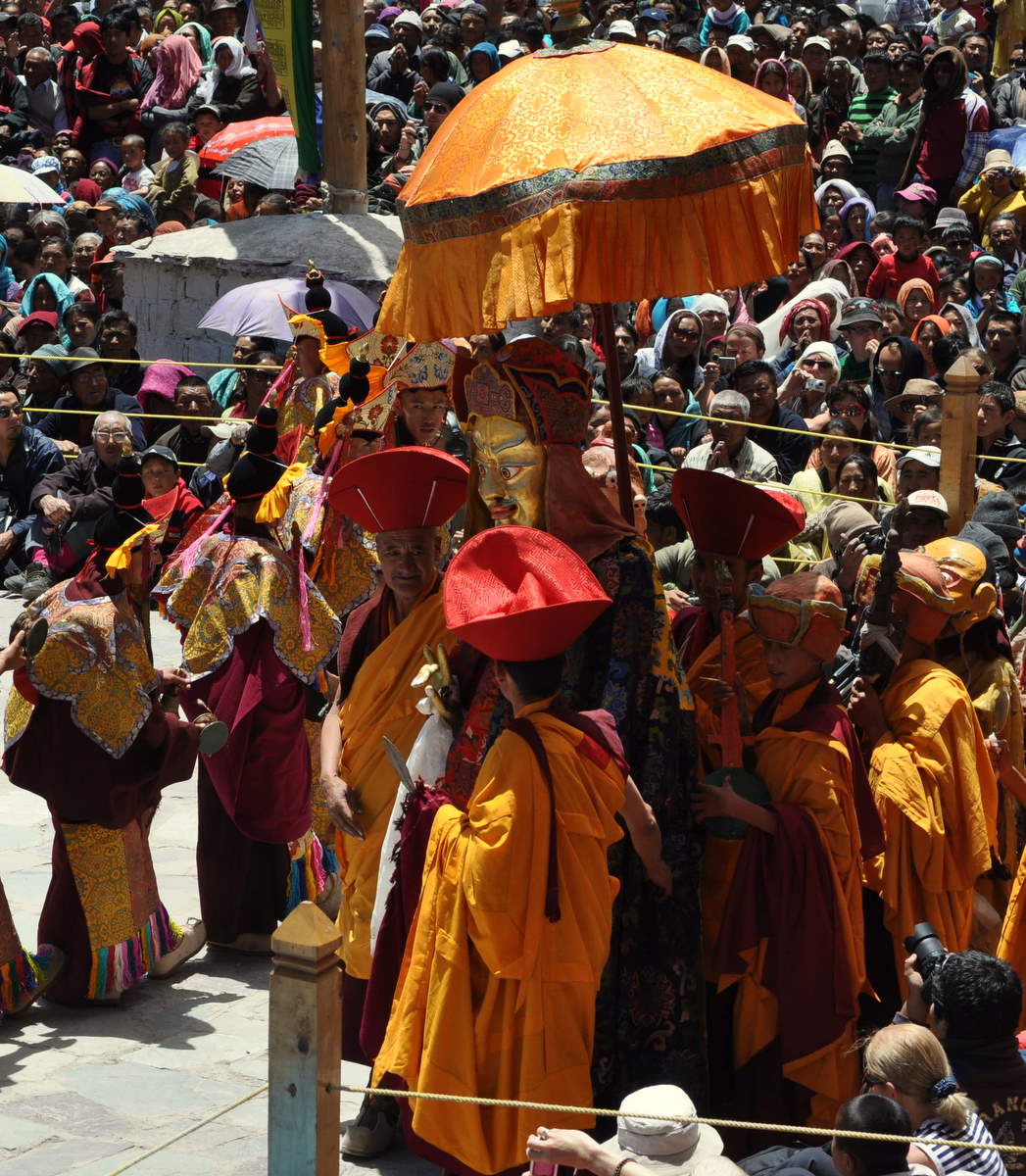
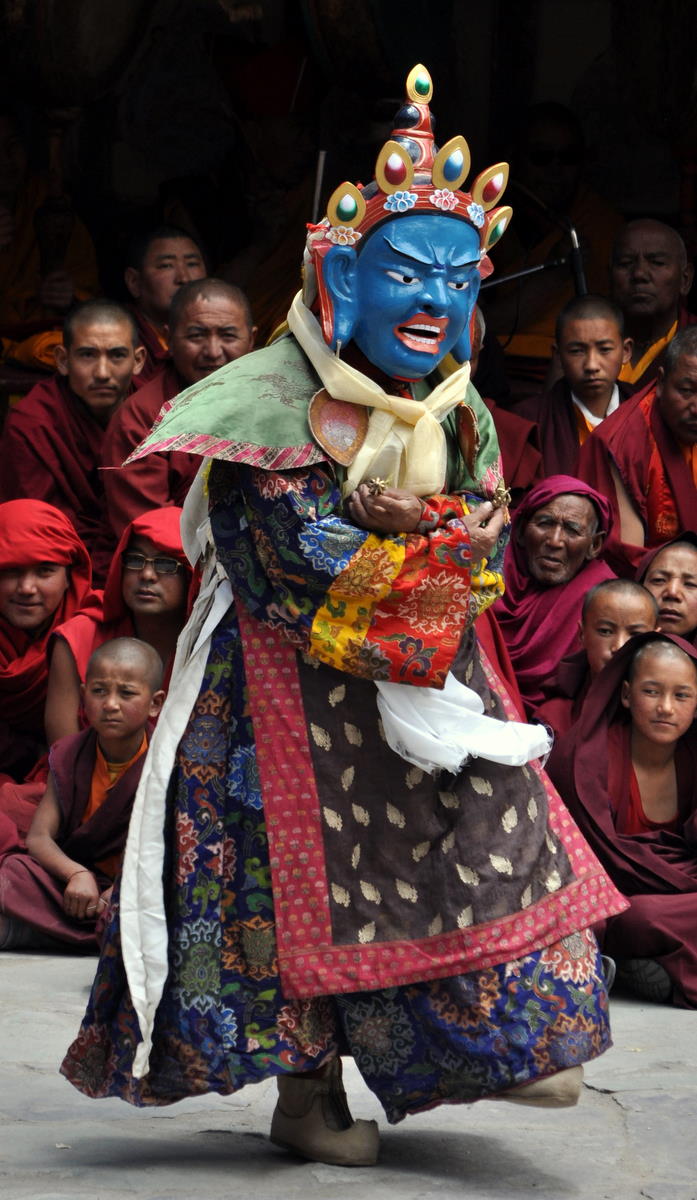
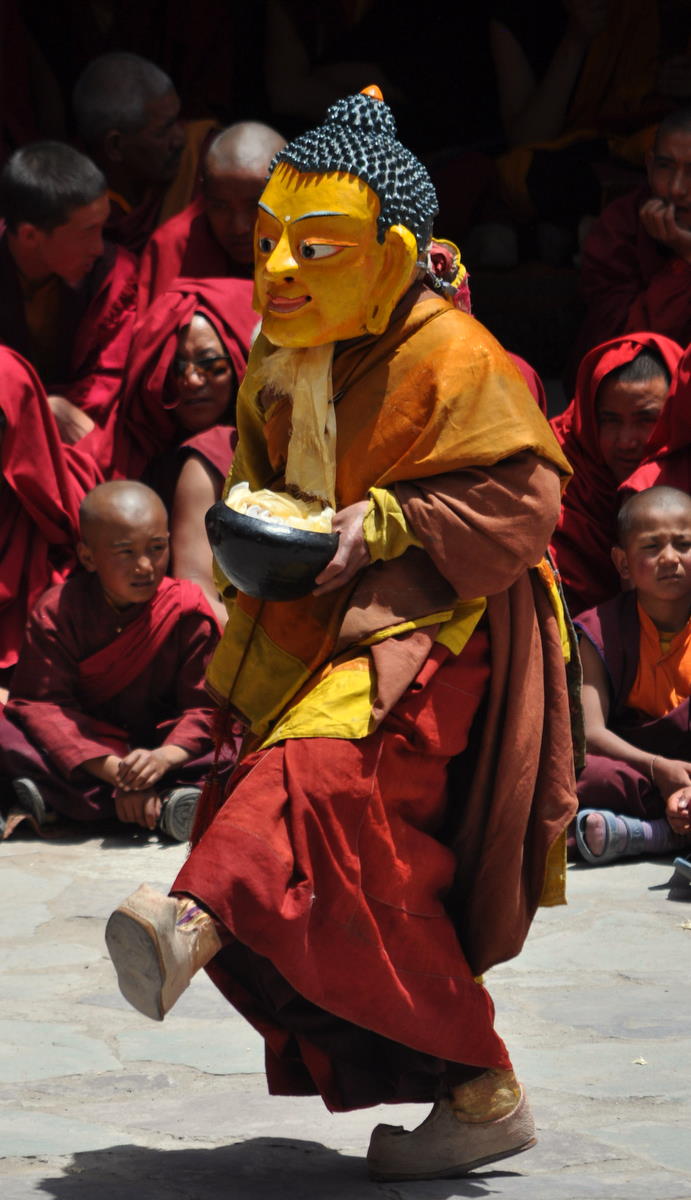
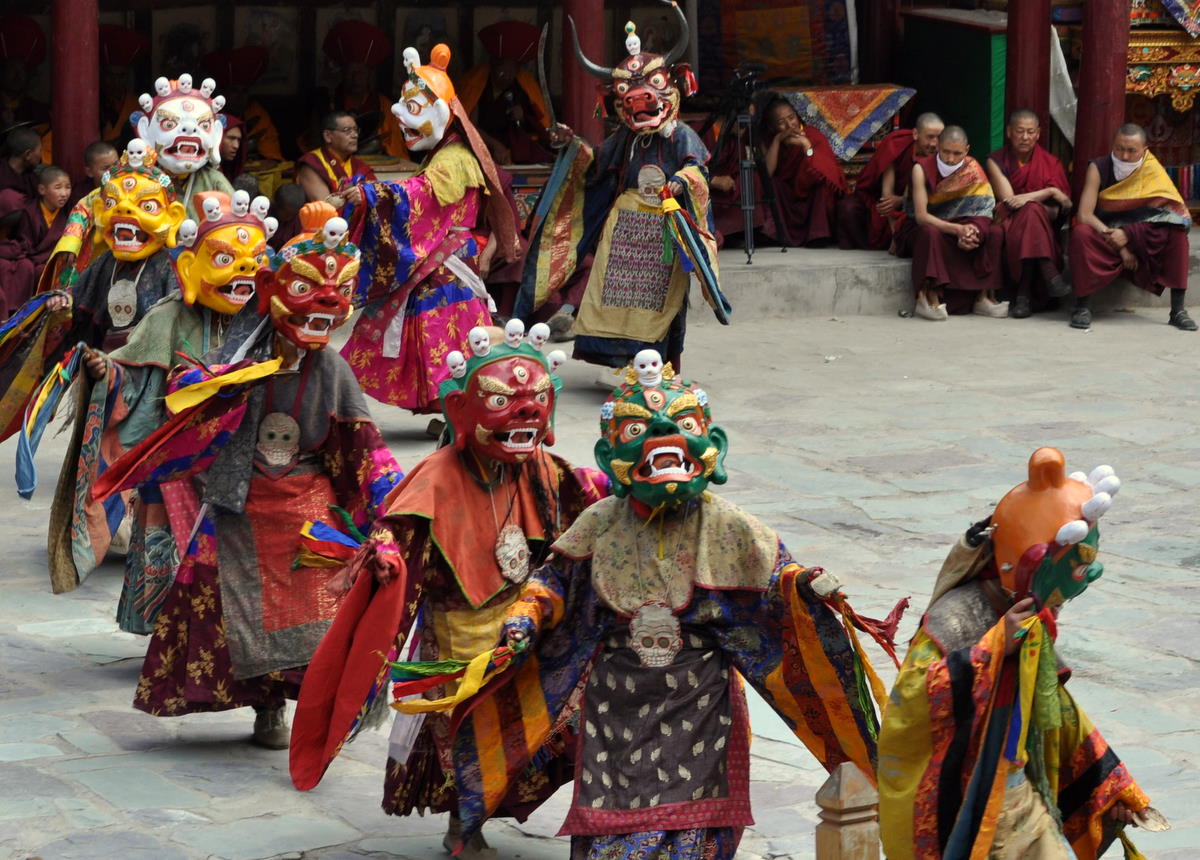
The dancing was impressive for a time. At its climax, there were close to 50 masked dancers in the courtyard, including a large masked figure of Guru Padmasambhava and a smaller Sakyamuni Buddha, who obviously takes second billing in these parts. At the end of the morning the tourists clapped as if they had been to the theater and then most of them left.


The afternoon's dances were short and surprisingly simple. They did have a torma effigy as we had seen elsewhere, but they dispatched it with a few quick whacks instead of the intense ceremony that usually takes much of one or two days. The afternoon finished anticlimactically with a dance of monks in animal masks, then everyone packed up and left to visit the museum.


So far, we were a little disappointed with this the most famous festival. Although it put on a grand show neatly packaged in a few hours for the tourists, it seemed shallow compared with the traditional local festivals that drew few tourists and stretched from morning until night. Perhaps with the tour buses gone, the second day will be more like that.

Day 11 – June 22 – Hemis festival final day

The second day of the Hemis festival was more low-key and actually more to our liking. Although the dancing started late and ended early and lacked the flashy big masks of Guru Padmasambhava and his followers, it seemed more unified and real. Most of the audience was local and it had less of the feeling of a performance for tourists.


Most of this day's dance was devoted to neutralizing and then slaying an effigy of evil spirits, much as we had seen at other festivals. In the long morning wait while pujas were conducted inside the monastery's assembly hall, a monk made a small triangular platform out of tsampa (barley meal). The effigy, also made of tsampa, was later placed on this platform at an appropriate moment in the dance.

After some preliminaries, a group of masked monks made a circle around the platform. Groups of four among them were dressed as different types of people – monks, turbaned merchants, protector gods, and so forth. Each group paid their respects to the platform by dancing around it.

With the effigy now in place, a group of masked gods came out for the serious business of destroying the effigy and its evil spirits. Led by a god with the head of a yak, they danced deliberately in a large circle. Finally the yak-headed god made a clean slice with his sword and severed the effigy's head. Evil had been defeated for another year.

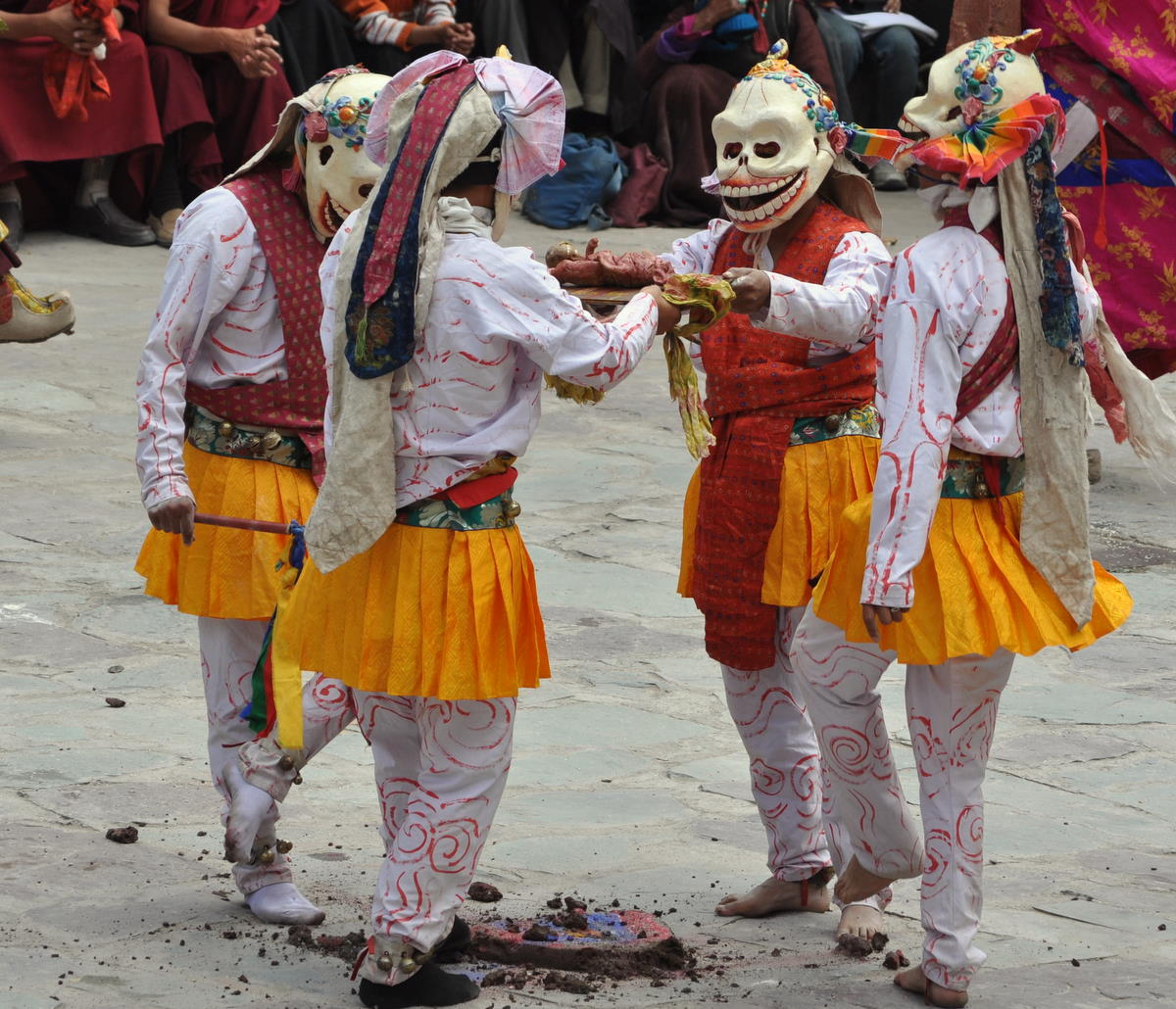
Next came the four skeletons to finish the work. These younger monks danced energetically and sometimes hassled photographers who had encroached too far into the ring. Then they settled down for the serious work of destroying the tsampa platform, which might have inherited some evil spirits when the effigy was slain. While two of them lifted the effigy, the others used their feet to scatter the tsampa.


The dancing ended with a comic routine where a few masked monks brought out their own instruments and played them. These slapstick routines are a common feature of these monk dances, breaking up the seriousness and keeping the crowd under control. In this case, the routine distracted the crowd while the regular musicians packed their instruments and left.


We got back to Leh around 4:30 and checked into our hotel for a final night before leaving on the second part of our trek. Leh's internet connection was fortunately working, so I was able to complete all of the business that I had left hanging at our previous departure.